Dreaming While Awake
 80
80

Dreaming While Awake
Arnold Mindell’s "Dreaming While Awake" attempts to dissolve the artificial barrier between the sleeping dream and the waking experience, a premise that is both ambitious and, at times, challenging. Mindell’s background in physics and Jungian analysis provides a unique lens, allowing him to frame dream processes in terms of energetic fields and systemic interactions rather than solely psychological narratives. His core argument—that dreamlike states are constantly active and accessible—is compelling, particularly when he discusses how to identify and engage with these "low dreams" in everyday moments. However, the text occasionally becomes dense, particularly when he delves into the more technical aspects of his process-oriented psychology, which might alienate readers unfamiliar with his prior work. A strength lies in his practical suggestions for accessing this dream-wake continuum, offering concrete methods for richer self-understanding. The limitation is a certain academic opacity that could obscure the intuitive power of his central thesis for a broader audience. Ultimately, the book offers a valuable, if demanding, reorientation of how we perceive consciousness and its fluid boundaries.
📝 Description
80
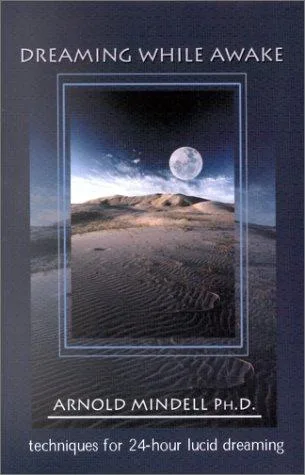
Arnold Mindell's 2000 book, Dreaming While Awake, argues that dreams are not limited to sleep.
Arnold Mindell's 2000 book, Dreaming While Awake, suggests that the dream state is a constant part of waking life, not just something that happens during sleep. Mindell, a physicist and Jungian analyst, uses his background to propose that people can access altered states of consciousness, including dreams, while fully awake. The book questions the separation between internal dream experiences and external reality, asserting that these two realms influence each other. This perspective challenges typical views of consciousness by integrating dream content into everyday awareness and decision-making. It invites readers to consider the continuous presence of dream phenomena throughout their daily activities.
The work is intended for those interested in depth psychology, consciousness studies, and spiritual philosophy. It appeals to readers wanting to understand their dream lives better and how these connect to their waking actions. Those familiar with Jungian psychology, process oriented psychology, or shamanic practices will find connections, though Mindell's synthesis is unique. The book is for anyone curious about expanding awareness and incorporating unconscious material into their daily existence.
Published in 2000, 'Dreaming While Awake' emerged during a time of growing interest in consciousness research and psychological paradigms outside the mainstream. Mindell's work draws from Carl Jung's ideas on the collective unconscious and dream analysis. It also incorporates concepts from quantum physics, mirroring a trend to find connections between the physical world and the mind. This period also saw discussions on lucid dreaming and integrating indigenous knowledge into Western thought, settings where Mindell's concepts gained traction.
💡 Why Read This Book?
• Gain practical methods for identifying and working with "low dreams" – subtle, dreamlike states that influence waking life, a concept specific to Mindell’s process-oriented psychology. • Understand the integration of dream content into daily activities, learning how to access unconscious material without needing to wait for sleep, a key takeaway from Mindell’s 2000 publication. • Explore consciousness through a unique lens that bridges quantum physics and Jungian psychology, offering a novel perspective on the relationship between the inner and outer worlds, distinct from purely psychological or spiritual approaches.
⭐ Reader Reviews
Honest opinions from readers who have explored this book.
❓ Frequently Asked Questions
What is the core concept of "Dreaming While Awake"?
The book's central idea is that the dream process is continuous, not limited to sleep. Arnold Mindell suggests that dreamlike states, termed "low dreams," are constantly active and accessible during waking hours, offering a rich source of information.
How does Arnold Mindell's background influence the book?
Mindell, a physicist and Jungian analyst, brings a unique interdisciplinary approach. His work integrates concepts from quantum physics with depth psychology, offering a systemic and energetic understanding of consciousness and dreams, as explored in his 2000 text.
What are "low dreams" in Mindell's framework?
"Low dreams" refer to the subtle, dreamlike experiences and symbolic patterns that manifest in waking life. Mindell proposes that these are continuous with the dreams experienced during sleep and can be consciously accessed and worked with.
Who is Arnold Mindell?
Arnold Mindell is an American psychologist, author, and founder of process-oriented psychology. He is known for his work on dreams, altered states of consciousness, and the application of psychological principles to social and environmental issues.
Can this book help with lucid dreaming?
While not solely focused on lucid dreaming, "Dreaming While Awake" enhances the ability to perceive and interact with altered states of consciousness. The techniques for accessing "low dreams" can foster greater awareness of internal states, which is foundational for lucid dreaming.
What is the relationship between "Dreaming While Awake" and Jungian psychology?
The book is deeply influenced by Carl Jung's theories on dreams and the unconscious. Mindell expands on Jung's work by proposing that dream processes are not only active during sleep but also permeate waking consciousness, offering a more continuous model.
🔮 Key Themes & Symbolism
The Continuum of Consciousness
Mindell posits that consciousness operates on a continuous spectrum, blurring the lines between sleep and wakefulness. The book introduces the concept of "low dreams" and "high dreams" to describe these states as they manifest in everyday life. This challenges the traditional view of dreams as solely nocturnal phenomena, suggesting that the symbolic language and altered perceptions of dreams are ever-present. By learning to recognize these subtle dreamlike experiences while awake, individuals can access a deeper understanding of their inner world and its influence on their actions and perceptions. This continuous engagement with the unconscious is presented as a path to greater integration and awareness.
Process-Oriented Psychology
The work is a foundational text for understanding Mindell's process-oriented psychology (POP). POP emphasizes the importance of attending to the "process" of experience, whether conscious or unconscious, physical or psychological. "Dreaming While Awake" illustrates how to apply POP principles to the dream realm and its waking manifestations. It provides methods for working with subtle signals, synchronicities, and altered states of awareness that arise in daily life. This approach encourages a non-interfering, observational stance towards one's internal and external experiences, fostering a more organic unfolding of consciousness and personal development.
Integration of Inner and Outer Worlds
A central theme is the profound interconnectedness between the individual's inner psychological landscape and the external reality they inhabit. Mindell argues that the dream process acts as a bridge, translating unconscious material into symbolic forms that can inform waking decisions and perceptions. By actively engaging with these "waking dreams," individuals can achieve a more holistic understanding of themselves and their environment. This integration is not about escaping reality but about enriching it with the insights derived from the unconscious, leading to more authentic and meaningful engagement with life's challenges and opportunities.
Symbolic Language of the Unconscious
The book offers a framework for deciphering the symbolic language that the unconscious employs through dreams and dreamlike states. Mindell suggests that these symbols are not random but are meaningful communications from the deeper psyche. He provides tools and perspectives for interpreting these messages, whether they appear in sleep, spontaneous visions, or subtle shifts in waking perception. Understanding this symbolic dialogue is presented as crucial for navigating personal growth, resolving conflicts, and aligning one's life with a greater sense of purpose. The work encourages a respectful and curious engagement with this inner symbolic communication.
💬 Memorable Quotes
Direct passages from the work, attributed to the author.
“The dream process is not something that happens only when we sleep.”
— This statement captures Mindell's core thesis: that the mechanisms and symbolic language of dreams are active and influential throughout our waking lives, challenging the conventional separation of dream states from daily experience.
“We dream while awake, but we are often unaware of it.”
— This highlights the pervasive nature of "low dreams" – subtle, altered states of consciousness that manifest during waking hours. Mindell suggests these are accessible if we learn to pay attention to their subtle signs and symbolic content.
“The outer world is a reflection of the inner world.”
— This emphasizes the interconnectedness of our internal psychological states and external reality. Mindell uses the concept of "waking dreams" to illustrate how unconscious processes shape our perception of and interaction with the world around us.
“Paying attention to the process is key.”
— This refers to a central tenet of process-oriented psychology. Mindell encourages a mindful, non-judgmental observation of unfolding experiences, whether they originate from sleep or wakefulness, as a pathway to understanding and growth.
“Every experience, even a mundane one, can contain dreamlike qualities.”
— This suggests that the extraordinary can be found in the ordinary. Mindell invites readers to perceive the subtle symbolic and altered states that may be present in everyday moments, revealing a deeper layer of reality.
🌙 Esoteric Significance
Tradition
Mindell's work, while rooted in Jungian psychology and process-oriented psychology, significantly engages with esoteric traditions by positing a continuous dream process that mirrors Gnostic ideas of veiled reality and the potential for conscious awakening within the material world. It aligns with Hermetic principles of "As Above, So Below," suggesting an intrinsic link between the inner dreamscape and outer manifest reality. The emphasis on accessing and integrating unconscious material echoes alchemical processes of transformation and the Theosophical pursuit of higher consciousness.
Symbolism
The book utilizes the concept of "low dreams" as a primary symbolic motif, representing the subtle, often overlooked, dreamlike qualities of waking consciousness. These "waking dreams" function symbolically as messages from the unconscious, akin to the symbolic language found in more traditional dream analysis or even alchemical symbolism, where everyday occurrences can hold profound, hidden meanings. Another significant symbol is the "dream body," which Mindell explores as a non-physical energetic form that bridges the conscious and unconscious realms, influencing both our inner experience and outer interactions.
Modern Relevance
Contemporary thinkers in consciousness studies and transpersonal psychology continue to draw from Mindell's work. His process-oriented approach is influential in fields seeking to understand embodied cognition and subtle energy phenomena. Practices related to mindfulness, lucid dreaming, and somatic psychology often incorporate or are informed by his insights into the continuous nature of consciousness. His work remains relevant for therapists, researchers, and individuals interested in expanding their awareness beyond conventional psychological frameworks, particularly those exploring the intersection of psychology, spirituality, and systemic thinking.
👥 Who Should Read This Book
• Individuals interested in depth psychology and the nature of consciousness seeking to expand their understanding beyond conventional dream analysis. • Practitioners of process-oriented psychology or those curious about its applications for navigating everyday life and personal development. • Students of esoteric philosophy and comparative religion looking for contemporary frameworks that bridge psychological insights with subtle or spiritual dimensions of experience.
📜 Historical Context
Published in 2000, Arnold Mindell's "Dreaming While Awake" emerged at a time when consciousness studies were gaining traction, fueled by advancements in neuroscience and a renewed interest in transpersonal psychology. Mindell, already established for his work in process-oriented psychology and dream analysis, drew upon the legacy of Carl Jung, whose emphasis on the unconscious and archetypes provided fertile ground. This period also saw increased engagement with quantum physics in philosophical and psychological discourse, with thinkers like Fritjof Capra exploring its implications for understanding reality. Mindell’s work offered a unique synthesis, bridging Jungian depth psychology with a physicist’s systemic perspective. While not subject to significant censorship, his ideas represented a departure from mainstream clinical psychology, which often viewed dreams as solely a product of sleep. His approach was more aligned with alternative paradigms and esoteric traditions that explored altered states of consciousness, positioning him as a contemporary of figures like Stanislav Grof and exploring similar territories to the earlier Theosophical Society's engagement with subtle realms.
📔 Journal Prompts
The "low dream" experience: Identify a recent waking moment that felt distinctly dreamlike and describe its sensory and emotional qualities.
Mindell's concept of the "dream body": Reflect on a physical sensation or bodily intuition that seemed to carry a message beyond the literal.
The inner/outer connection: How might a subtle "waking dream" you experienced have influenced your perception of an external event or interaction?
Symbolic interpretation: Choose a recurring subtle experience from your waking life and consider what symbolic meaning it might hold for you.
Process observation: Describe an ordinary daily activity, focusing on its "process" rather than its outcome, noting any unexpected dreamlike qualities that emerged.
🗂️ Glossary
Low Dream
A subtle, altered state of consciousness that occurs during waking hours, characterized by dreamlike perceptions, symbolic imagery, or unusual emotional states, which Mindell proposes are continuous with sleep dreams.
High Dream
In Mindell's framework, refers to states of heightened awareness, ecstatic experiences, or clear insights that can also occur during waking life, contrasting with the more subtle "low dreams."
Process-Oriented Psychology (POP)
A psychological approach founded by Arnold Mindell that emphasizes attending to the unfolding "process" of experience, including subtle signals, dreams, and altered states, to facilitate personal growth and understanding.
Dream Body
An energetic or subtle body concept explored by Mindell, representing a bridge between the conscious mind and the unconscious, influencing both inner experience and outer interactions.
Inner World
Refers to the subjective field of consciousness, including thoughts, emotions, memories, dreams, and the unconscious psyche.
Outer World
Refers to the objective, external reality and the physical environment with which individuals interact.
Symbolic Language
The non-literal, metaphorical means by which the unconscious communicates, often appearing in dreams, synchronicities, and "waking dreams."
🔮 Readers Also Liked
Browse all →









More by Arnold Mindell
All books →




More Free Occult Philosophy Books
View all →