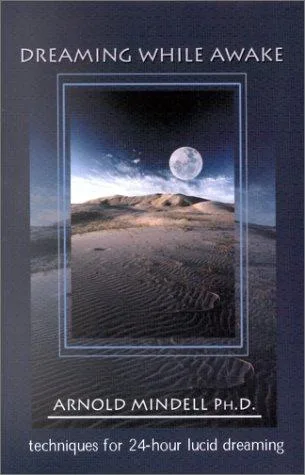
Dreaming While Awake
 78
78

Dreaming While Awake
Arnold Mindell's *Dreaming While Awake* challenges the common perception of dreams as solely nocturnal events. The book's strength lies in its expansive definition of dreaming, framing waking life—from body sensations to relationship conflicts—as a rich source of unconscious communication. Mindell compellingly argues that we are, in essence, "dreaming twenty-four hours a day." A particular strength is his discussion of "world work," connecting individual inner experiences to broader societal patterns, a concept that feels urgent and relevant. However, the sheer breadth of topics, including addiction, time travel, and healing, can at times feel overwhelming, occasionally sacrificing depth for scope. The initial conceptual leap to viewing every life event as a dream cue requires significant imaginative engagement from the reader. Despite this, the work offers a unique lens for understanding the persistent messages of the psyche. It serves as an invitation to attend more closely to the subtle, ongoing dialogue between the conscious and unconscious.
📝 Description
78
Arnold Mindell argued in 2002 that dreams occur not only during sleep but continuously.
Dreaming While Awake, by Arnold Mindell, first published in 2002, redefines dreaming as a 24-hour phenomenon, not limited to sleep. Mindell, founder of Process Psychology, suggests the unconscious communicates through subtle cues and experiences encountered during waking hours. These cues manifest as physical sensations, relationship dynamics, fleeting thoughts, and everyday problems, all seen as potential pathways to deeper psychological and spiritual understanding. This work targets individuals seeking to expand their awareness of consciousness and the unconscious beyond sleep-state dreaming. It is useful for psychotherapists, dream workers, and students of psychology, especially those interested in Process-Oriented Psychology. Practitioners of shamanic traditions, Jungian analysis, and anyone focused on symbolic experience and interpreting subtle phenomena will find relevant material.
Anyone struggling with persistent life issues or physical symptoms they believe hold deeper meaning will also benefit. Mindell's approach offers a practical, experiential method for accessing transpersonal and existential dimensions, building on Jung's ideas about the unconscious's symbolic language and shadow integration. His key innovation was extending dream processes into daily, waking life, diverging from traditional sleep-focused dream analysis.
Published in 2002, Dreaming While Awake emerged from a period of growing interest in consciousness studies and alternative healing methods. Arnold Mindell's work connects to Carl Jung's emphasis on the unconscious's symbolic language and the integration of the shadow. Mindell extended these concepts by viewing the dream process as active throughout waking life. His approach provides a method for accessing deeper psychological and spiritual understanding through everyday experiences, aligning with traditions that see the mundane as a source of symbolic meaning.
💡 Why Read This Book?
• Understand your body symptoms and relationship issues as direct communications from your unconscious, a core concept Mindell elaborates on throughout the book, offering a new interpretive framework. • Learn to apply "lucid healing" principles to your waking life challenges, moving beyond passive observation to actively engage with the symbolic content of your daily experiences as detailed in the book. • Explore "world work" and its implications, recognizing how your personal dream life and inner experiences can be seen as reflections or catalysts for collective consciousness, as Mindell proposes.
⭐ Reader Reviews
Honest opinions from readers who have explored this book.
❓ Frequently Asked Questions
What is Arnold Mindell's core concept of 'dreaming while awake'?
Arnold Mindell's central idea is that dreaming is a continuous 24-hour process, not confined to sleep. He posits that the unconscious communicates through subtle cues in waking life, such as body symptoms, relationships, and random thoughts, all of which can be interpreted as dream signals.
How does 'Dreaming While Awake' relate to Process Psychology?
This book is a significant exploration of Mindell's Process Psychology, extending its principles beyond sleep-state dreams. It applies the core tenets of Process Psychology to waking experiences, viewing them as manifestations of deeper psychological processes and symbolic communication.
What is 'world work' as described by Arnold Mindell?
World work, in Mindell's context, suggests that individual dreams and psychological processes, when understood and worked with, can have a positive impact on collective consciousness and global issues. It connects personal inner experience to the wider world.
Can 'Dreaming While Awake' help with physical symptoms or addictions?
Yes, Mindell explores how physical symptoms and addictions can be viewed as 'dream signals' from the unconscious. By applying dream interpretation principles to these waking experiences, the book suggests pathways for healing and understanding underlying issues.
What is the significance of the 2002 publication date for this book?
Published in 2002, the book emerged during a period of growing interest in consciousness studies and alternative therapeutic approaches. It offered a novel integration of dream theory with practical, everyday psychological and spiritual exploration, building on earlier psychological thought.
Who founded Process Psychology?
Arnold Mindell, the author of 'Dreaming While Awake,' is the founder of Process Psychology. This approach emphasizes the importance of subtle signals and altered states of consciousness in understanding psychological and spiritual development.
🔮 Key Themes & Symbolism
Waking Dream Phenomena
The book's core argument is that the dreaming process is not exclusive to sleep. Mindell posits that the unconscious mind constantly communicates through subtle signals during waking hours. These 'little cues' can appear as physical sensations, relationship dynamics, chance encounters, or fleeting thoughts. Understanding these phenomena requires shifting one's perception to see the symbolic layer inherent in everyday experience, treating waking life itself as a form of ongoing dreamwork.
Lucid Healing and Preventive Medicine
Mindell extends the concept of lucidity beyond dream states into the field of health. 'Lucid healing' involves applying an aware, dream-like perception to diagnose and address physical symptoms or illnesses. By recognizing these symptoms as potential dream messages, individuals can engage with them more effectively, fostering a preventative approach to medicine rooted in understanding the deep psyche's signals.
World Work and Collective Consciousness
A significant aspect of Mindell's theory is 'world work,' which proposes a connection between individual psychological experiences and broader societal or global issues. The book suggests that by working with our personal dreams and inner lives, we contribute to a shift in collective consciousness. This perspective highlights the profound, interconnected nature of human experience and the potential for inner transformation to influence outer reality.
Addictions and Relationships
Mindell examines addictions and relationship patterns not merely as behavioral issues but as manifestations of deeper unconscious processes, akin to dream narratives. He suggests that these challenging areas of life can serve as potent gateways to understanding oneself and the dynamics of the collective unconscious. By interpreting the symbolic language present in these difficulties, individuals can find pathways toward healing and integration.
💬 Memorable Quotes
Direct passages from the work, attributed to the author.
“We are getting countless little cues from...”
— This fragment, likely from the original blurb or introduction, captures Mindell's central idea: the unconscious is always communicating, even when we are fully awake. It prompts the reader to consider the subtle messages embedded in their daily experiences.
“What if you could dream twenty-four hours a day, even while awake?”
— This rhetorical question serves as the foundational premise of the book. It challenges the conventional separation of waking and dreaming states, inviting readers to consider the potential for continuous psychological exploration and insight.
“The seeds of dreaming arise in every moment of the day, in body symptoms, problems, relationships, subtle feelings, interactions, random thoughts, and fantasies.”
— This statement defines the scope of Mindell's 'waking dream' concept. It broadens the definition of dreaming to encompass the full spectrum of human experience, suggesting that all aspects of life hold potential symbolic meaning.
“According to innovative psychotherapist Arnold Mindell, Ph.D., we already do.”
— This phrase directly answers the preceding question about dreaming 24 hours a day. It asserts that the capacity for continuous dreaming is inherent and ongoing, setting the stage for Mindell's exploration of how to access and interpret these waking dream states.
💡 Key Ideas
Editorial paraphrase of the work's core concepts — not direct quotes.
Mindell examines addictions & relationships, time travel, lucid healing & preventive medicine, and Dreaming as world work.
This quote, attributed to The Dream Network Journal, succinctly outlines the diverse range of topics Arnold Mindell addresses. It highlights the book's ambitious scope, connecting individual psychology to broader phenomena like health and global consciousness.
🌙 Esoteric Significance
Tradition
Mindell's work can be situated within the broader Hermetic and Jungian traditions, emphasizing the interconnectedness of psyche and cosmos, and the symbolic language of the unconscious. While not strictly adhering to ancient Hermetic texts, it shares the Hermetic principle of 'As Above, So Below,' applying it to the idea that inner dream processes mirror and influence outer reality. It expands upon Jungian depth psychology by making the unconscious accessible through constant, waking experiences, not just through dream analysis or active imagination.
Symbolism
The book frequently uses the body as a primary symbol, interpreting physical symptoms as direct messages from the unconscious, akin to dream imagery. Relationships are also presented as symbolic arenas, reflecting deeper psychological dynamics and archetypal patterns. Furthermore, the concept of 'time travel,' explored within the context of altered states and dream perception, symbolizes the non-linear, fluid nature of consciousness that transcends ordinary temporal experience.
Modern Relevance
Contemporary thinkers in depth psychology, consciousness studies, and somatic experiencing continue to draw from Mindell's ideas. His emphasis on subtle signals and the integration of psychological and physical experiences aligns with current trends in holistic health and embodied cognition. His concept of 'world work' also finds echoes in contemporary discussions on collective trauma, social dreaming, and the application of psychological insights to global challenges.
👥 Who Should Read This Book
• Individuals interested in Jungian psychology and dream analysis seeking to expand their understanding beyond sleep states. • Therapists and counselors looking for innovative methods to interpret client issues through the lens of unconscious communication in daily life. • Spiritual seekers and practitioners of somatic or transpersonal modalities wanting to deepen their connection between inner experience and outer reality.
📜 Historical Context
Published in 2002, Arnold Mindell's *Dreaming While Awake* arrived at a time when the boundaries of consciousness studies were being actively explored. The late 20th and early 21st centuries saw a surge in interest in transpersonal psychology, Jungian analysis, and shamanic practices, all of which sought to integrate subjective experience with objective reality. Mindell's work emerged from this milieu, building upon Carl Jung's foundational ideas about the collective unconscious and archetypes, while also incorporating elements of quantum physics and systems theory. His unique contribution was to extend the concept of dream processes into the fabric of everyday life, challenging the dualism between the inner world and outer reality. This contrasted with more traditional dream analysis that often focused exclusively on sleep states. The book found resonance with practitioners of Process-Oriented Psychology, a field Mindell himself founded, and offered a practical methodology for accessing deeper psychological dimensions through mundane experiences.
📔 Journal Prompts
Body symptom interpretation as dream signal.
Relationship dynamics as unconscious communication.
Waking fantasy and its symbolic meaning.
The 'little cues' of the unconscious in daily interactions.
World work and personal responsibility.
🗂️ Glossary
Process Psychology
A psychological approach founded by Arnold Mindell, focusing on the subtle signals and altered states of consciousness that reveal deeper psychological and spiritual processes, applicable to both individual experience and collective phenomena.
Dreaming While Awake
Mindell's core concept that the unconscious communicates continuously through waking experiences (body symptoms, relationships, etc.), not just during sleep. It posits that all of life can be viewed as a form of dreaming.
Little Cues
Subtle signals, synchronicities, or seemingly random events in waking life that Mindell identifies as messages from the unconscious, akin to elements within a dream.
Lucid Healing
The application of dream-like awareness and symbolic interpretation to physical symptoms and illnesses, aiming for understanding and therapeutic resolution.
Preventive Medicine
In Mindell's context, this refers to understanding and addressing the unconscious messages conveyed through symptoms or life patterns before they escalate into significant health issues.
World Work
The idea that individual psychological work, particularly dreamwork, contributes to the healing and evolution of collective consciousness and global well-being.
Body Symptoms
Physical sensations or ailments interpreted not just medically, but as symbolic messages from the unconscious, serving as 'dream signals' during waking life.