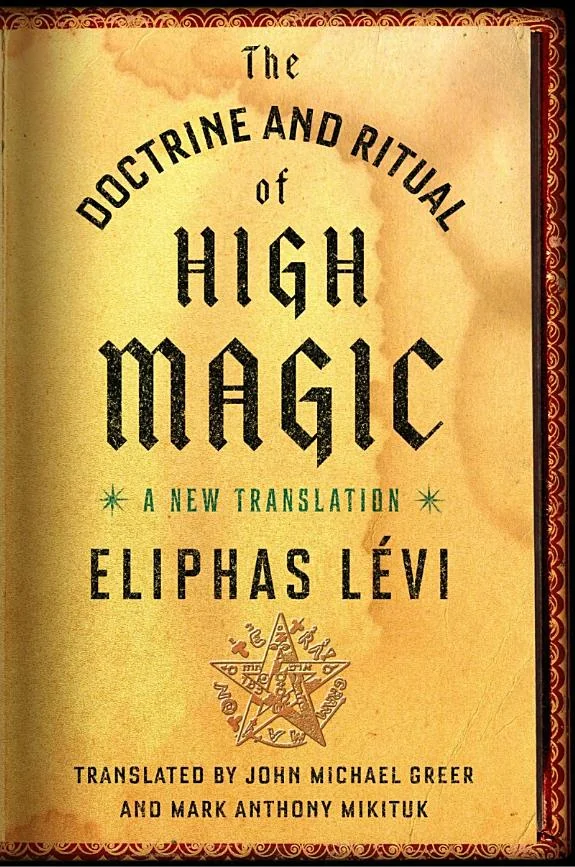
The Doctrine and Ritual of High Magic
 78
78

The Doctrine and Ritual of High Magic
Eliphas Lévi's "The Doctrine and Ritual of High Magic" remains a cornerstone text, its influence undeniable, yet its accessibility is often hampered by dense prose and dated translations. The 2017 edition's purported elegance, while an improvement, doesn't entirely erase the challenges inherent in Lévi's ambitious synthesis. His attempt to map the occult onto a coherent, almost scientific framework is intellectually compelling, particularly his explication of the Astral Light as a universal medium. However, the sheer volume of arcane references and the deeply ingrained theological framework can make the practical application feel distant for the modern practitioner. A notable strength is Lévi's systematic approach, which attempts to provide a unified theory of magic. A limitation is the book's reliance on specific religious interpretations, which may not align with all readers' spiritual paths. The detailed descriptions of pentagram rituals, while historically significant, can feel overly ritualistic and less intuitively applicable than more modern approaches to energy work. This work is a vital historical document and a rich source of esoteric theory, but its practical efficacy requires significant interpretation and adaptation.
Verdict: An essential, albeit challenging, foundational text for understanding Western magical theory.
📝 Description
78
Published in 1854, Eliphas Lévi's "The Doctrine and Ritual of High Magic" sought to unify magic with religion and science.
Eliphas Lévi's 1854 text presents magic not as mere sorcery but as a universal art for spiritual growth and cosmic comprehension. It examines the theoretical basis and practical execution of occult forces, all within a structured philosophical and theological framework. Lévi's goal was to clarify magic, portraying it as an ancient science and the means to access hidden universal laws. The book focuses on the "Astral Light," an unseen, pervasive fluid connecting everything and serving as the medium for magical acts. Lévi asserted that genuine magic stems from influencing this force via will, imagination, and ritual.
This work is recommended for serious students of Western esotericism, occult philosophy, and comparative religion. It is especially pertinent for those studying Kabbalah, Hermeticism, and ceremonial magic. Readers interested in the historical progression of occult ideas and their impact on later movements such as Theosophy and the New Age will find it valuable. Engaging with its complex philosophical arguments and detailed ritual descriptions demands a dedicated reader.
Published in 1854, "The Doctrine and Ritual of High Magic" appeared during a European revival of interest in spiritualism and occultism, a reaction against the strict rationalism of the preceding era. Lévi's book aimed to bridge a perceived spiritual gap by synthesizing various mystical traditions. It emerged before figures like Helena Blavatsky began shaping their own esoteric systems, and Lévi's definition of magic as a rational and religious discipline significantly influenced the subsequent development of occult thought, including Theosophical ideas.
💡 Why Read This Book?
• You will learn about the concept of the Astral Light, Lévi's central idea of a universal energetic medium, and how he believed it could be accessed and influenced through specific practices outlined in the book. • You will gain insight into Lévi's reinterpretation of biblical narratives and ancient traditions through an occult lens, understanding how he sought to legitimize magic as a sacred science and a path to spiritual enlightenment. • You will discover the foundational principles of ceremonial magic as articulated in the mid-19th century, including the importance of divine names, symbols, and the practitioner's moral and intellectual preparation for magical work.
⭐ Reader Reviews
Honest opinions from readers who have explored this book.
❓ Frequently Asked Questions
What is the Astral Light according to Eliphas Lévi?
Lévi describes the Astral Light, also known as the Grand Arcanum, as a universal, invisible fluid and force that permeates all of creation. It is the medium through which all phenomena manifest and is considered the primary agent for magical operations and spiritual illumination.
When was 'The Doctrine and Ritual of High Magic' first published?
The original French edition of 'The Doctrine and Ritual of High Magic' by Eliphas Lévi was first published in 1854, making it a foundational text in the revival of Western occultism.
Who was Eliphas Lévi and what was his significance?
Eliphas Lévi (Alphonse Louis Constant) was a French occultist, magician, and writer in the 19th century. He is considered one of the most influential figures in the revival of ceremonial magic, synthesizing Kabbalah, Hermeticism, and Tarot into a comprehensive system.
What is the relationship between magic and religion in Lévi's work?
Lévi posits that magic is the science of the ancients and the key to understanding true religion. He argues that all religions are based on magical principles and that 'high magic' is a path to divine knowledge, distinct from vulgar sorcery.
Does this book contain practical spells or rituals?
Yes, the book contains theoretical explanations of magical principles and also outlines specific rituals, invocations, and the use of magical symbols like the pentagram, intended for the serious practitioner seeking spiritual development.
How did this book influence later esoteric movements?
Lévi's work provided a comprehensive theoretical framework for Western esotericism that influenced later thinkers and movements, including Theosophy and the Hermetic Order of the Golden Dawn, shaping occult philosophy in the late 19th and 20th centuries.
🔮 Key Themes & Symbolism
The Astral Light
Lévi's central concept, the Astral Light, is presented as the primordial fluid and universal agent of all phenomena. He posits it as the source of both physical and spiritual energy, accessible through focused will and ritual. Understanding and harmonizing with this light is key to performing 'high magic,' which Lévi distinguishes from mere superstition. This force connects the microcosm (human) to the macrocosm (universe), making it the ultimate tool for spiritual transformation and divine knowledge.
Magic as Universal Science
Lévi endeavors to elevate magic from its disreputable image to a legitimate science and a core component of all religions. He argues that ancient wisdom traditions, biblical accounts, and even scientific principles can be understood through the lens of occult philosophy. The book systematically lays out the theoretical framework and practical applications, presenting magic as the 'key of science' and the 'sum of all religions,' accessible through rigorous study and moral discipline.
The Practitioner's Path
High magic, as defined by Lévi, is not a pursuit for the unprepared. It demands immense intellectual rigor, moral purity, and unwavering faith. The practitioner must cultivate their will, understand divine names and symbols, and engage in specific rituals to align themselves with cosmic forces. This path is presented as a spiritual discipline aimed at self-perfection, divine union, and the attainment of true occult knowledge, warning against the dangers of misuse.
Symbolism and Correspondence
The book places significant emphasis on the power of symbols and the doctrine of correspondences. Lévi explores how various symbols, particularly the pentagram and the hexagram, represent fundamental universal truths and divine operations. He outlines a complex system of correspondences between planets, elements, divine names, and human faculties, suggesting that by understanding these relationships, one can gain control over the forces of nature and the spiritual realms.
💬 Memorable Quotes
Direct passages from the work, attributed to the author.
“Magic is the science of the kings.”
— This statement frames magic not as a vulgar or common practice, but as a sophisticated discipline reserved for those with the intellect and authority to wield its power responsibly for universal good and spiritual advancement.
“The Absolute is the one and only God, infinite and absolute, the living and intelligent ocean of being.”
— Lévi's concept of the Absolute reflects a pantheistic or panentheistic view, describing God not as a distant creator but as the all-encompassing substance and consciousness of the universe, from which all existence emanates.
“The dogma of the fall and the dogma of the redemption are two faces of the same esoteric truth.”
— This interpretation suggests that the biblical narratives of humanity's fall from grace and subsequent salvation are symbolic representations of an occult process of spiritual descent and eventual reintegration with the divine.
“The equilibrium of the four elements is the secret of health, the secret of life, and the secret of the Great Work.”
— This emphasizes the importance of balance in all things—physical, mental, and spiritual—as the foundation for well-being and the successful execution of magical or alchemical transformations, according to Lévi's system.
“To know, to dare, to will, and to keep silent are the four pillars of occult science.”
— This famous quatrain expresses the essential virtues required for a practitioner of high magic: knowledge of universal laws, the courage to act, the focused will to manifest intentions, and the discretion to protect the mysteries.
🌙 Esoteric Significance
Tradition
Lévi's work is deeply rooted in the Western Esoteric Tradition, particularly drawing from Kabbalah, Hermeticism, Neoplatonism, and Gnosticism. He synthesized these disparate threads into a coherent system, presenting 'high magic' as the universal science underlying all religions. He sought to revive and reinterpret ancient magical practices within a Christian framework, though his cosmology is panentheistic. His system became foundational for many 19th and 20th-century occult orders, bridging traditional esoteric knowledge with a more modern, philosophical approach.
Symbolism
Key symbols in the book include the Pentagram, representing the microcosm and the five elements (spirit presiding over matter), and the Hexagram (Seal of Solomon), symbolizing the macrocosm and the union of opposing forces (fire/water, spirit/matter). Lévi also elaborates on the significance of divine names, angelic hierarchies, and the Tarot, viewing them as keys to understanding the divine order and the mechanics of the universe, encoded through symbolic language.
Modern Relevance
Lévi's concepts, especially the Astral Light and his structured approach to ceremonial magic, continue to influence contemporary occultists, ceremonial magicians, and esoteric philosophers. His work is studied by practitioners of modern Kabbalah, Hermeticism, and Tarot divination. Thinkers in the New Age movement and eclectic spiritual paths often draw upon his foundational ideas regarding universal energy, spiritual laws, and the interconnectedness of all things.
👥 Who Should Read This Book
• Students of Western Esotericism: Those seeking to understand the historical development and theoretical underpinnings of modern occultism will find this text foundational, particularly regarding Kabbalah and Hermeticism. • Practitioners of Ceremonial Magic: Individuals interested in the roots of modern ritual practices will benefit from Lévi's systematic explanations of magical theory, symbolism, and the ethical framework for practitioners. • Comparative Religion Scholars: Readers interested in how mystical and occult traditions interpret religious texts and universal spiritual concepts will find Lévi's unique synthesis and reinterpretation of biblical narratives clear.
📜 Historical Context
Published in 1854, Eliphas Lévi's "The Doctrine and Ritual of High Magic" emerged during the Second French Empire, a period marked by spiritualistic revivals and a fascination with the occult following the rationalism of the Enlightenment. Lévi, writing under his famous pseudonym, sought to systematize and legitimize magic, presenting it as a science and a divine art, a stark contrast to the more empirical and materialistic philosophies gaining traction. His work was a significant departure from earlier, more fragmented grimoires and was influenced by Kabbalistic traditions and Hermetic philosophy. It directly engaged with and responded to a widespread spiritual hunger, aiming to reconcile occultism with religious orthodoxy. Lévi's articulation of magic as the 'science of the ancients' profoundly influenced subsequent generations of occultists, including figures associated with the Theosophical Society, which was founded just two decades later in 1875, demonstrating the fertile ground his ideas cultivated.
📔 Journal Prompts
The concept of the Astral Light as a universal medium for manifestation.
Lévi's interpretation of the Pentagram and its elemental correspondences.
The role of 'knowing, daring, willing, and keeping silent' in the magical path.
Reconciling ancient magical science with modern religious or scientific understanding.
The ethical responsibilities inherent in wielding 'high magic'.
🗂️ Glossary
Astral Light
Lévi's term for the universal, invisible fluid and force that permeates all existence, serving as the medium for manifestation, energy, and spiritual phenomena. Also called the Grand Arcanum.
High Magic
Lévi's term for the true, scientific, and religious art of magic, focused on spiritual attainment and understanding universal laws, distinct from vulgar sorcery or superstition.
Kabbalah
A system of Jewish mysticism that Lévi extensively incorporated into his magical philosophy, particularly its concepts of divine emanation, the Tree of Life, and Hebrew correspondences.
Pentagram
A five-pointed star symbol, which Lévi extensively analyzes as representing the microcosm, the human being, and the dominion of spirit over the four elements.
Grand Arcanum
An alternative name used by Lévi for the Astral Light, emphasizing its fundamental importance and mysterious nature within his magical system.
The Great Work
A term often associated with alchemy and magic, referring to the process of spiritual transformation, purification, and the attainment of higher consciousness or divine union.
Correspondences
The principle that elements, planets, divine names, and other aspects of the universe are interconnected and reflect each other, forming a complex web of relationships that can be understood and utilized magically.
This book appears in 1 collection
🔮 Readers Also Liked
Browse all →








From the “High Magic” Collection
View all →




More Free Magic & Ritual Books
View all →