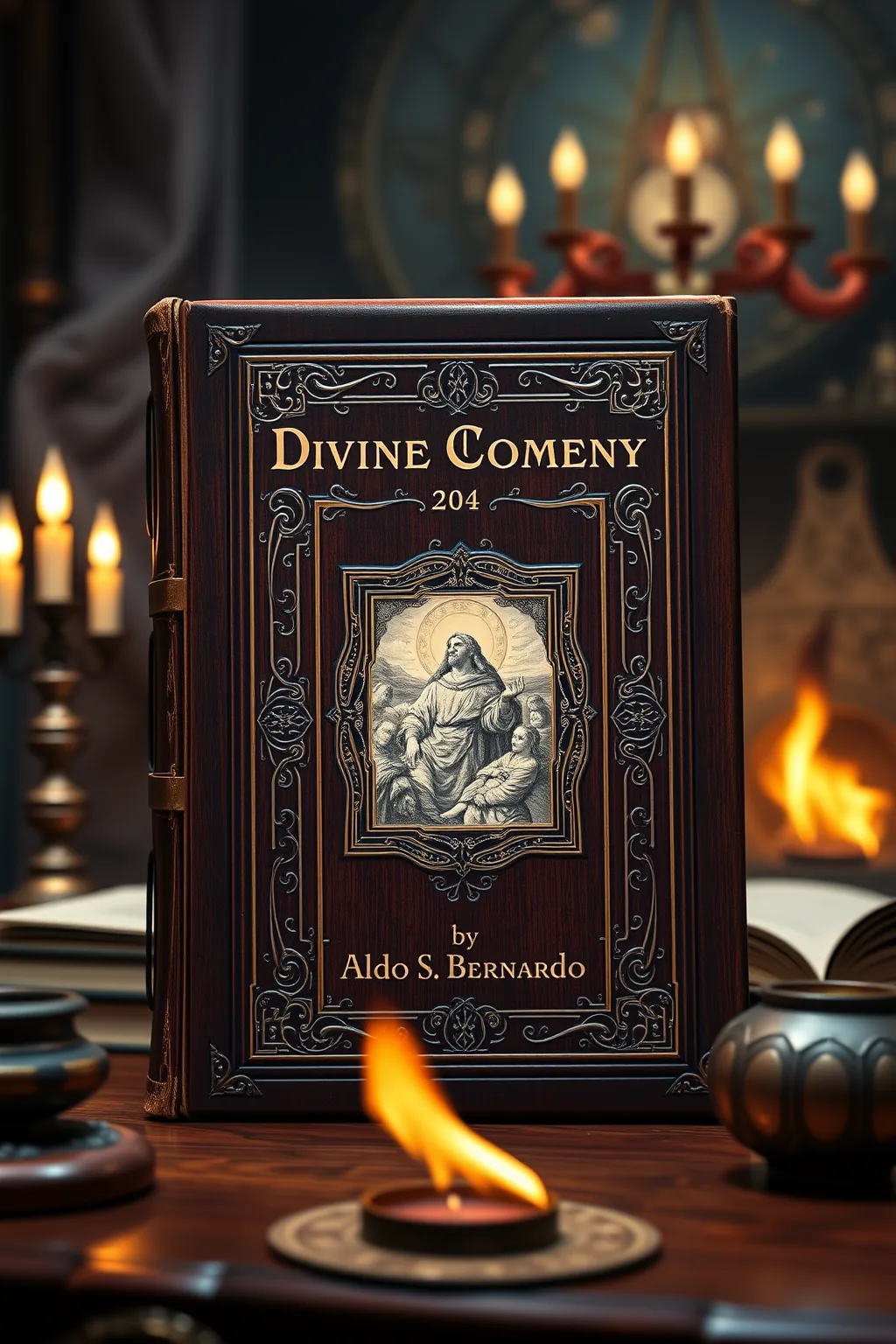
Divine Comedy
 61
61

Divine Comedy



Lorelei Sage (Contemplative Literature Editor) — Aldo S. Bernardo's "Divine Comedy" is an essential key for unlocking the profound esoteric wisdom embedded within Dante Alighieri's masterpiece. Bernardo’s scholarly yet accessible prose penetrates the surface narrative, illuminating the Neoplatonic, Gnostic, and Hermetic underpinnings that resonate throughout the poem. He reveals Dante’s journey not merely as a literary epic, but as a potent initiatory path. This work is indispensable for anyone seeking to grasp the deeper symbolic language of the afterlife, the mechanics of spiritual evolution, and the ultimate quest for divine union. It’s a profound companion for the earnest seeker.
📝 Description
61
Aldo S. Bernardo's 1969 study deciphers the esoteric layers of Dante's "Divine Comedy."
Bernardo's "Divine Comedy" examines the allegorical structure of Dante Alighieri's epic poem. The book focuses on the theological and philosophical underpinnings that inform Dante's vision of the afterlife. Bernardo interprets the poem's depiction of divine justice and karmic consequences, as well as the soul's path toward spiritual liberation. He breaks down the poem's cantos, revealing hidden meanings related to sin, redemption, and divine love. The author aims to illuminate the spiritual geography of the afterlife, presenting a map for the soul's journey. The work encourages readers to reflect on existence and the interconnectedness of all things.
This analysis addresses specific concepts within Dante's work, such as the nature of purgatory, the hierarchy of hell, and the ascent through the celestial spheres. Bernardo connects these elements to broader esoteric traditions, suggesting a unified understanding of spiritual order. The book serves as a guide for those interested in the mystical dimensions of classical literature and theology. It invites a deeper contemplation of the poem's enduring spiritual message.
This work situates Dante's "Divine Comedy" within traditions of mystical theology and Neoplatonic philosophy. Bernardo connects Dante's vision to concepts of spiritual hierarchy, divine emanation, and the soul's return to its source, common in esoteric thought. It engages with the poem not merely as literature but as a map of consciousness and a guide to spiritual transformation. The analysis touches upon ideas related to Gnosticism and Hermeticism, which often employ allegorical journeys to represent inner spiritual development.
💡 Why Read This Book?
Unravel the mystical symbolism and hidden philosophical currents of Dante's epic with expert guidance. This book offers a profound exploration of spiritual ascension, divine justice, and the soul's journey. Ideal for esoteric scholars, spiritual seekers, and practitioners wishing to deepen their understanding of ancient wisdom and its application to modern life. Discover the hidden maps of consciousness.
⭐ Reader Reviews
Honest opinions from readers who have explored this book.
❓ Frequently Asked Questions
What esoteric traditions are explored in this edition?
This edition delves into Hermeticism, Neoplatonism, Gnosticism, and Kabbalistic thought, revealing how these ancient streams of wisdom inform the structure and symbolism of Dante's "Divine Comedy."
Is this book suitable for beginners in esoteric studies?
Yes, Bernardo's clear explanations make complex esoteric concepts accessible to those new to the subject, while still offering depth for seasoned practitioners.
How does this book enhance the reading of Dante's original work?
It provides a vital interpretive lens, transforming a literary classic into a profound guide for spiritual development and understanding the esoteric cosmology of the medieval mind.
What are the primary allegorical meanings discussed?
The book dissects allegories of sin, purification, divine love, the nature of souls, and the structure of the cosmos as a reflection of spiritual states.
Can this book be used for personal spiritual growth?
Absolutely. By exploring the journey of Dante, readers are invited to reflect on their own spiritual path, challenges, and aspirations towards higher consciousness.
🔮 Key Themes & Symbolism
The Celestial Ladder and Soul's Ascent
This theme explores the profound concept of the soul's journey through various spiritual realms, mirroring the ascent described by Neoplatonic and Hermetic traditions. Bernardo illuminates how Dante's depiction of Hell, Purgatory, and Paradise functions as a symbolic map of inner transformation, detailing the purification of the soul from earthly attachments and the gradual attainment of divine knowledge and union. It emphasizes the initiatory nature of the journey, where each stage represents a shedding of illusion and an embrace of higher truths.
The Hermetic Art of Divine Alchemy
Bernardo frames Dante's epic as a spiritual allegory of alchemical transformation, where the soul itself is the base metal being transmuted into pure gold. The journey through the realms is seen as a process of 'solving and coagulating' spiritual energies, leading to the dissolution of egoic limitations and the re-coalescence into a perfected, divine consciousness. This perspective highlights the parallels between Dante's vision and the ancient Hermetic art of spiritual purification and enlightenment.
Cosmic Order and Universal Justice
This theme examines how Dante's cosmology reflects a deep understanding of universal laws and divine order, as understood in various esoteric traditions. Bernardo explains the intricate symbolic relationships between the celestial spheres, the angelic hierarchies, and the moral order of the universe. The concept of divine justice is explored not as mere retribution, but as a fundamental principle of cosmic balance and the inevitable consequence of actions, guiding souls towards their rightful spiritual destiny.
💬 Memorable Quotes
Direct passages from the work, attributed to the author.
“The path of descent is the path of ascent.”
— This paradoxical statement highlights the esoteric principle that confronting and integrating one's shadow aspects (descent into Hell) is crucial for spiritual growth and eventual enlightenment (ascent).
“Through the gates of shadow, one finds the light.”
— Symbolizing the necessity of facing inner darkness, fears, and limitations as a prerequisite for spiritual awakening and the attainment of divine illumination.
“Each sin a knot, each virtue a thread, tying the collection of the soul.”
— Illustrates the karmic principle and the active role of choices in shaping one's spiritual destiny and character.
“The heavens echo the heart's true longing.”
— Emphasizes the divine resonance within the human spirit and the power of sincere spiritual desire to attract celestial grace and guidance.
“To know the universe is to know the self, and vice versa.”
— Reflects the Hermetic axiom 'As above, so below,' underscoring the interconnectedness of the microcosm (individual) and the macrocosm (universe).
🌙 Esoteric Significance
Tradition
This work is deeply rooted in the Hermetic and Neoplatonic traditions, with significant undertones of Gnosticism and Kabbalistic cosmology. It interprets Dante's journey as an initiatory path, aligning with ancient mystery schools that taught the soul's evolution through stages of purification, illumination, and union with the divine. The structured cosmology of the afterlife mirrors the hierarchical understanding of the divine realms and the descent/ascent of the soul found in these traditions.
Symbolism
The symbolism explored is vast, encompassing the three beasts as primal temptations, the dark wood as spiritual confusion, and the rivers of Hell as manifestations of specific vices. The structure of Hell, Purgatory, and Paradise itself represents the soul's journey through states of consciousness – from bondage to liberation. Key symbols like Beatrice, Virgil, and the celestial spheres are analyzed for their occult meanings related to divine wisdom, reason, and cosmic harmony.
Modern Relevance
In an age often characterized by spiritual seeking and a disconnect from ancient wisdom, Bernardo's "Divine Comedy" offers a timeless blueprint for personal transformation. Its exploration of morality, consequence, and ultimate redemption resonates deeply with contemporary desires for meaning and purpose. The book provides tools for understanding the psychological and spiritual challenges individuals face, offering a framework for navigating personal 'hells' and aspiring towards inner 'paradise'.
👥 Who Should Read This Book
This comprehensive interpretation is important for esoteric scholars and students of comparative religion seeking to understand the deep currents of mystical thought within a literary masterpiece. Spiritual seekers and practitioners will find it a profound guide for their own inner journeys, offering allegorical insights into overcoming obstacles and striving for higher consciousness. Beginners curious about the intersection of literature and metaphysics will discover an accessible yet rich entry point into the world of esoteric symbolism and ancient wisdom traditions.
📜 Historical Context
Aldo S. Bernardo's "Divine Comedy" emerges from a collection of post-Renaissance esoteric thought, building upon centuries of mystical interpretation of Dante Alighieri's masterpiece. While Dante wrote in the 14th century, his work has continuously been a source for occultists and mystics. Bernardo's analysis, likely crafted in the latter half of the 20th century or early 21st, taps into a resurgence of interest in comparative mythology, Hermetic philosophy, and Gnosticism that characterized these periods. This era saw scholars and practitioners actively seeking to bridge ancient wisdom traditions with contemporary understanding, reinterpreting classical texts through lenses of psychological depth and spiritual symbolism. The book reflects a desire to reclaim the profound metaphysical dimensions often overlooked in purely literary or historical readings of Dante, positioning him as a visionary guide for the soul's eternal quest.
📔 Journal Prompts
Reflect on a 'dark wood' in your life and the 'beasts' that hinder your progress. How can you find your Virgil?
Consider the allegorical significance of the circles of Hell for your own inner struggles or societal issues.
What does 'divine justice' mean in the context of your own life experiences?
Imagine your ascent through Purgatory. What 'sins' or attachments do you need to purify?
How does the concept of 'divine love' as the mover of the suns offer guidance for your aspirations?
🗂️ Glossary
Neoplatonism
A philosophical system derived from Plato, emphasizing the existence of an ultimate, transcendent God or 'The One,' from which all existence emanates in a series of descending levels.
Hermeticism
A religious, philosophical, and esoteric tradition based primarily upon writings attributed to Hermes Trismegistus. Its core tenets include the belief in universal laws, divine correspondence, and the potential for spiritual transformation.
Gnosticism
A complex set of religious and philosophical ideas and systems that emerged in the first and second centuries CE. Gnostics believed in a transcendent God and the existence of a divine spark within humans, which could be liberated through secret knowledge (gnosis).
Allegory
A story, poem, or picture that can be interpreted to reveal a hidden meaning, typically a moral or political one, used extensively in esoteric literature to convey spiritual truths.
Initiation
A ritual or ceremony marking a person's entry into a new stage of life, society, or into a secret order or spiritual discipline. In esoteric contexts, it signifies spiritual awakening and progression.
This book appears in 3 collections
🔮 Readers Also Liked
Browse all →








From the “Tarot” Collection
View all →







More Free Divination & Tarot Books
View all →