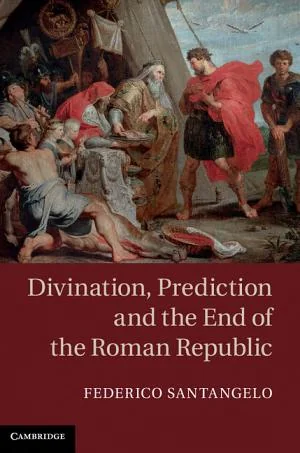
Divination, Prediction and the End of the Roman Republic
 71
71

Divination, Prediction and the End of the Roman Republic
Santangelo's study offers a welcome, rigorously argued counterpoint to simpler narratives of Roman superstition. The work's strength lies in its detailed engagement with a wide array of sources, demonstrating how divination was both a tool of statecraft and a subject of intellectual scrutiny by Romans themselves. The chapter discussing the debates surrounding omens during military campaigns, for instance, vividly illustrates the pragmatic and often skeptical approach to prophecy. A limitation, however, is the dense academic prose, which, while precise, can make the material less accessible to a general audience. The exploration of how specific political crises, such as those surrounding the crossing of the Rubicon by Caesar in 49 BC, were framed through divinatory discourse is particularly compelling. Ultimately, this is a vital contribution for understanding the complex interplay of belief and power in Roman history.
📝 Description
71
Federico Santangelo's 2010 book examines divination's role in the Roman Republic's final century.
Federico Santangelo's study investigates the complex interplay between Roman political life and the widespread practice of divination during the late Republic. The book assesses how these divinatory customs changed amid significant political and social turmoil. It examines evidence for internal Roman discussions and critiques regarding the effectiveness and limitations of prophecy and prediction in the second and first centuries BC. The late Roman Republic, roughly 133 BC to 27 BC, was a time of intense civil conflict, political reform efforts, and the weakening of established institutions. Prominent figures like the Gracchi brothers, Marius, Sulla, Pompey, and Caesar operated within this unstable environment, frequently consulting oracles and omens. Santangelo situates the use of divination within this historical setting, showing it was not simply a passive cultural element but an active part of political debate and decision-making. It was subject to manipulation and doubt, even as its public function remained crucial.
The work covers concepts like the disciplina Etrusca, the Etruscan traditions that shaped Roman divinatory practices, and the role of haruspices, or offal-gazers. It also discusses the importance of augury from birds and other natural events, as well as the manipulation of these signs.
This work situates Roman divination within a broader historical understanding of how belief systems and ritual practices influence political and social structures. It examines the specific Roman application of traditions like the disciplina Etrusca, which formed a codified system of interpreting divine will. The book analyzes how these established methods of prediction, such as augury and haruspicy, were not only adhered to but also debated and sometimes manipulated by individuals within the Roman elite. It reflects on the human tendency to seek meaning and guidance in uncertain times, particularly during periods of significant societal change and conflict.
💡 Why Read This Book?
• Gain insight into the practical application of divination within Roman government, understanding how figures like Sulla used augury during the 80s BC to legitimize their actions, a perspective often overlooked in general histories. • Explore the critical debates surrounding the limits of prediction in the 2nd and 1st centuries BC, revealing an intellectual sophistication in Roman thought regarding fate and free will that challenges simplistic notions of superstition. • Understand the evolution of divinatory practices, such as the role of the *haruspices*, and how their public function was debated and sometimes manipulated during periods of intense political transformation in the Roman Republic.
⭐ Reader Reviews
Honest opinions from readers who have explored this book.
❓ Frequently Asked Questions
How did divination influence Roman political decisions in the late Republic?
Divination, particularly through augury and haruspicy, was deeply integrated into Roman governance. Decisions regarding war, elections, and public works often required favorable omens. Santangelo shows how leaders like Sulla, during the civil wars of the 80s BC, actively used or interpreted signs to bolster their authority and justify their actions.
What evidence exists for Roman skepticism towards divination?
The book discusses how Romans, especially educated elites in the 2nd and 1st centuries BC, engaged in critical reflection. Philosophical influences, particularly from Greek thought, encouraged questioning the absolute reliability of predictions, leading to debates about fate versus human agency.
Who were the main practitioners of divination in Rome?
Key figures included the augurs, who interpreted bird flight and omens, and the haruspices, specialists in interpreting animal entrails, often of Etruscan origin. The Pontifex Maximus also played a role in overseeing religious practices, including divination.
Did divination practices change during the late Republic?
Yes, Santangelo details significant shifts. While traditional forms persisted, their public interpretation became more politicized. The period saw both increased reliance on divination in times of crisis and a concurrent rise in intellectual debate about its predictive power.
What is the significance of the 'disciplina Etrusca' in Roman divination?
The 'disciplina Etrusca' refers to the body of Etruscan religious knowledge and practices, particularly in divination, that the Romans adopted and codified. It formed the theoretical and practical basis for much of Roman haruspicy and omen interpretation.
How does this book connect divination to the end of the Roman Republic?
Santangelo argues that divination was not peripheral but central to the political maneuvering and decision-making of the era. The book explores how its use, manipulation, and critique were intertwined with the breakdown of Republican institutions and the rise of powerful individuals.
🔮 Key Themes & Symbolism
Divination as Political Tool
This work illuminates how Roman leaders, from generals to senators, actively employed divinatory practices not just out of personal belief, but as strategic instruments in the political arena. The interpretation of omens, whether real or manufactured, could legitimize actions, rally support, or sow doubt among opponents. Santangelo examines instances where the outcome of battles or the timing of critical decisions, like Sulla's marches on Rome in the 80s BC, were heavily influenced by the perceived will of the gods as revealed through these rituals, underscoring divination's function in power dynamics.
Intellectual Scrutiny of Prediction
Beyond its political utility, the book uncovers a significant vein of intellectual skepticism and debate regarding the efficacy of divination among educated Romans during the late Republic. Influenced by Greek philosophy, thinkers began to critically assess the limits of prophecy and the role of human agency versus fate. This internal critique suggests a more complex Roman worldview than one solely dominated by superstition, revealing a society grappling with uncertainty and the nature of knowledge itself.
Evolution of Ritual Practice
Santangelo traces the development and adaptation of specific divinatory techniques, such as haruspicy derived from the 'disciplina Etrusca,' and augury. He demonstrates how these ancient practices were continually reinterpreted and sometimes manipulated to fit the changing political and social range of the late Republic. The book highlights how the formal structures of Roman divination coexisted with, and were sometimes challenged by, evolving philosophical ideas and the pragmatic needs of a state in crisis.
Omens and Statecraft
The book argues that omens were not mere background details but active participants in the drama of the late Roman Republic's demise. Whether it was the flight of birds consulted by augurs before a battle or the interpretation of entrails by haruspices, these signs were crucial components of the decision-making process. Santangelo's analysis shows how the public perception and political deployment of these divine communications were integral to the functioning, and eventual dysfunction, of Republican institutions.
💬 Memorable Quotes
Direct passages from the work, attributed to the author.
“The practice of divination was a central feature in the workings of the Roman government.”
— This statement expresses the book's core argument: divination was not a fringe activity but a fundamental element of Roman political machinery, deeply embedded in decision-making processes at the highest levels.
“Evidence for a critical reflection and debate on the limits of divination and prediction in the second and first centuries BC.”
— This highlights the book's focus on intellectual history, revealing that Romans themselves questioned the certainty of prophecies, engaging in sophisticated debates about fate, free will, and the reliability of divinatory methods.
“Divination changed at a time of great political and social change.”
— This points to the dynamic nature of Roman religious practices. As the Republic faced unprecedented upheaval, its divinatory systems adapted, were manipulated, and were subjected to scrutiny, reflecting the broader societal transformations.
“The work explores the ways in which it changed.”
— This emphasizes the book's investigative approach, promising a detailed examination of the transformations in Roman divinatory practices, moving beyond a static view of ancient religion.
“The intersection between Roman politics, culture and divination in the late Republic.”
— This phrase defines the book's scope, indicating a multi-faceted analysis that connects religious beliefs and practices directly to the political machinations and cultural milieu of a central historical period.
🌙 Esoteric Significance
Tradition
While Roman divination is not typically categorized within modern esoteric traditions like Hermeticism or Kabbalah, Santangelo's work touches upon the ancient roots of Western esoteric thought. The emphasis on codified rituals, symbolic interpretation of natural phenomena, and the belief in a hidden order governing the cosmos aligns with broader principles found in earlier mystery religions and folk magic. The 'disciplina Etrusca,' as a system of divinely revealed knowledge, can be seen as a precursor to later occult sciences that sought to decipher divine will through specific symbolic languages and practices.
Symbolism
Key symbols explored include the flight of birds (*auspicium*), the entrails of sacrificed animals (*haruspicina*), lightning, and other celestial or terrestrial omens. In the Roman context, these were not merely superstitious signs but vital communications from the gods, dictating the legitimacy of actions, the timing of ventures, and the favor of the divine. The interpretation of these symbols required specialized knowledge, held by colleges of priests and diviners, making them potent tools for both religious and political control.
Modern Relevance
Contemporary practitioners and scholars interested in the historical roots of Western esotericism, particularly those exploring the intersection of religion, psychology, and political power, find value in Santangelo's research. Thinkers examining the sociology of belief, the manipulation of ideology, and the enduring human need to understand or influence the future through symbolic means can draw parallels. The book provides a historical case study for understanding how systems of belief, even when subject to intellectual critique, continue to shape collective action and societal structures.
👥 Who Should Read This Book
• Historians specializing in the Roman Republic seeking detailed analysis of political decision-making processes and the role of religious belief. • Scholars of ancient religion and ritual interested in the practical application and evolution of divinatory practices in a major historical civilization. • Students of comparative politics and sociology of religion curious about how belief systems influence statecraft and societal stability during periods of crisis.
📜 Historical Context
The late Roman Republic, spanning roughly from the Gracchi reforms in 133 BC to the rise of Augustus in 27 BC, was an era defined by profound political instability, civil wars, and the breakdown of traditional Republican norms. This period witnessed the ascent of powerful military figures like Marius, Sulla, Pompey, and Caesar, whose ambitions frequently clashed, leading to widespread conflict. Intellectual currents were also shifting, with increasing exposure to Hellenistic philosophy, particularly Stoicism and Epicureanism, which offered alternative frameworks for understanding the world and human agency, sometimes in tension with traditional religious beliefs. Santangelo's work engages with scholars like Claude Nicolet, who explored Roman citizenship and intellectual life, and the ongoing debates about the role of religion in Roman public and private spheres. While not subject to specific censorship events related to divination itself, the intellectual climate allowed for critical discourse, contrasting with earlier periods. The book's meticulous sourcing situates Santangelo's analysis within a rich historiographical tradition examining Roman religion and politics.
📔 Journal Prompts
The role of the *haruspices* in legitimizing Sulla's power during the 80s BC.
Roman debates on the limits of prediction and the concept of fate.
The political manipulation of augury during the Punic Wars.
The influence of Greek philosophical critiques on Roman divination.
How the *disciplina Etrusca* shaped Roman religious practice.
🗂️ Glossary
Augury
The practice of interpreting omens, particularly the flight and behavior of birds, as divine signs to guide decisions in Roman public life. It was a formal religious office held by augurs.
Haruspicy
A form of divination involving the inspection of the entrails of sacrificed animals, especially the liver. This practice was largely inherited from the Etruscans ('disciplina Etrusca').
Disciplina Etrusca
The body of religious doctrine and practice derived from the Etruscans, encompassing divination, ritual, and theology, which the Romans adopted and adapted.
Omens
Events or signs perceived as indicators of future occurrences, interpreted by diviners as messages from the gods. These could range from natural phenomena to unusual occurrences.
Late Republic
The historical period in Roman history roughly from 133 BC (the tribunate of Tiberius Gracchus) to 27 BC (the establishment of the Principate by Augustus).
Pontifex Maximus
The chief high priest of the Roman state religion. While not a diviner himself, he oversaw religious matters, including the interpretation and regulation of omens.
Republic
The form of Roman government from its legendary founding in 509 BC until the establishment of the Roman Empire under Augustus in 27 BC, characterized by elected officials and a Senate.