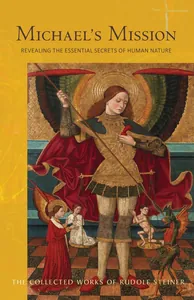
Die Sendung Michaels

 80
80

Die Sendung Michaels
Rudolf Steiner's *Die Sendung Michaels* offers a dense, yet illuminating, perspective on the Archangel Michael, framing him as a pivotal figure in human spiritual evolution. The lectures, originally given in 1919, position Michael as the leader of forces guiding humanity toward intellectual independence, a crucial step in developing free spiritual beings. Steiner's detailed exegesis of spiritual hierarchies and their influence on earthly events is characteristic of his work. A particular strength lies in his nuanced portrayal of Lucifer and Ahriman, not as simple devils, but as necessary, albeit challenging, cosmic counterpoints to Michael's influence. However, the text's primary limitation for the uninitiated reader is its reliance on a pre-existing understanding of Steiner's extensive cosmology; concepts like 'spiritual science' and the specific roles of various spiritual beings are assumed knowledge. The discussion of Michael's connection to the 'fall' of ancient spiritual beings, as referenced in the lectures, demands careful consideration. Ultimately, *Die Sendung Michaels* serves as a profound, albeit demanding, exploration of spiritual warfare and human destiny.
📝 Description
80
Rudolf Steiner delivered lectures on Michael's mission in 1919, a year of global upheaval.
Die Sendung Michaels contains lectures Rudolf Steiner gave in 1919. These talks focus on the cosmic role of the Archangel Michael. Steiner describes Michael as a spiritual leader influencing human consciousness and the development of human intellect. The lectures also address opposing spiritual forces and their impact on humanity's future. This is not a narrative but a detailed discussion of spiritual hierarchies and their connection to human development. Steiner explains Michael's role in guiding humanity toward intellectual freedom and spiritual self-awareness, particularly during the turbulent early 20th century. The work emerged from a period of significant global change, with Steiner seeking spiritual interpretations of historical events.
This text is for students and researchers of Anthroposophy. It will interest readers studying angelology from a non-traditional viewpoint, specifically how spiritual beings are seen to affect history and evolution. Those interested in the esoteric foundations of consciousness, the nature of antagonistic spiritual forces, and the part specific beings play in human destiny will find value here. A willingness to engage with complex spiritual and cosmological ideas is necessary.
These lectures connect to Anthroposophy, a spiritual-scientific movement Steiner founded. Within this tradition, spiritual beings are understood to interact with human history and consciousness. The work reflects broader themes present in movements like Theosophy, which also examined spiritual hierarchies and cosmic evolution. Steiner's specific contribution here is an articulation of Michael's role in fostering intellectual freedom and spiritual awareness.
💡 Why Read This Book?
• Gain a unique understanding of Archangel Michael's role as a force for intellectual freedom and spiritual development, as presented in Steiner's spiritual science. • Grasp the dynamic interplay between Michael, Lucifer, and Ahriman as outlined in the 1919 lectures, offering a specific esoteric perspective on cosmic and human evolution. • Explore the concept of 'spiritual science' as a method for perceiving the spiritual realities discussed, providing a pathway for personal investigation beyond the text itself.
⭐ Reader Reviews
Honest opinions from readers who have explored this book.
❓ Frequently Asked Questions
What is the original publication year of Rudolf Steiner's *Die Sendung Michaels*?
While the lectures were delivered in 1919, *Die Sendung Michaels* was first published in 1994, compiling these significant addresses for a wider audience.
Who was Rudolf Steiner and what is Anthroposophy?
Rudolf Steiner (1861-1925) was an Austrian esoteric scholar and philosopher who founded Anthroposophy, a spiritual philosophy that posits a connection between the physical and spiritual worlds, accessible through specific methods of inner development.
What is the central theme of *Die Sendung Michaels*?
The central theme is the cosmic significance and mission of Archangel Michael, particularly his role in guiding humanity's spiritual evolution towards intellectual freedom and consciousness, especially in the context of the early 20th century.
Does the book discuss forces opposing spiritual progress?
Yes, the work extensively discusses Luciferic and Ahrimanic influences, presenting them as necessary, though challenging, forces within human and cosmic evolution that interact with Michael's mission.
Is *Die Sendung Michaels* suitable for beginners in esoteric studies?
It is best suited for those with some familiarity with Rudolf Steiner's broader work or Anthroposophy, as it builds upon established concepts and terminology.
What is the significance of the year 1919 in relation to these lectures?
The lectures were delivered in 1919, a pivotal post-World War I period, during which Steiner sought to offer spiritual insights into the historical moment and the evolving spiritual tasks facing humanity.
🔮 Key Themes & Symbolism
Michael's Evolutionary Role
This work posits Archangel Michael as a central figure in human spiritual evolution, particularly his function in fostering intellectual clarity and free consciousness. Delivered in 1919, the lectures emphasize Michael's work in combating chaotic or materialistic forces that seek to hinder humanity's ascent. Steiner details how Michael's influence supports the development of independent thinking, a crucial step in the transition from instinctual awareness to conscious spiritual perception. The book frames this as an ongoing cosmic task with direct relevance to the challenges faced by humanity in the 20th century and beyond.
Luciferic and Ahrimanic Counterforces
Central to understanding Michael's mission is the examination of opposing spiritual forces, identified as Luciferic and Ahrimanic. Lucifer is presented as the force of spiritual pride, illusion, and premature spiritual insight, while Ahriman represents materialism, intellectual rigidity, and the deadening of the spirit. Steiner illustrates how these forces, though potentially destructive, are necessary catalysts for human development. Michael's role is to guide humanity through the challenges posed by these influences, enabling the conscious transformation of their effects into forces for spiritual growth and understanding.
Spiritual Science and Perception
The lectures in *Die Sendung Michaels* are presented within the framework of 'spiritual science,' Steiner's term for a method of investigating the spiritual world through disciplined inner development. This approach aims to provide verifiable knowledge of spiritual realities, including the activities of beings like Michael, Lucifer, and Ahriman. The book implies that direct perception of these spiritual forces is possible and necessary for understanding human destiny. It challenges readers to consider methods of consciousness that extend beyond ordinary sense experience.
The Archangel Michael's Mission
The core of the book revolves around the specific 'mission' (Sendung) of Michael, particularly in the modern era. Steiner describes Michael as the 'herald' or 'leader' of forces that prepare humanity for a new epoch of spiritual consciousness. His work is seen as essential for working through the dangers of materialism and for awakening the dormant spiritual capacities within the human being. The lectures, given in the wake of World War I, imbue Michael's mission with a sense of urgency for the spiritual future of civilization.
💬 Memorable Quotes
Direct passages from the work, attributed to the author.
“Michael is the spirit who has brought the spirit of freedom to mankind.”
— This statement highlights Michael's perceived role as a facilitator of human autonomy and independent thought, positioning him as a key agent in the evolution of consciousness towards self-determination.
“We must seek to understand the spiritual beings who work in the cosmos and in human evolution.”
— This emphasizes the Anthroposophical view that unseen spiritual forces actively shape reality and human development, advocating for their study through methods like spiritual science.
“Luciferic forces lead to illusion and premature spiritualization.”
— This concisely defines the danger associated with Luciferic influence, warning against seeking spiritual experiences without the grounding and clarity provided by Michael's work.
“Ahrimanic forces bind humanity to the material world and deaden the spirit.”
— This describes the negative impact of Ahrimanic tendencies, emphasizing the risk of becoming solely focused on the physical realm at the expense of spiritual awareness.
“The time has come for humanity to consciously engage with spiritual realities.”
— This suggests a critical juncture in human history where passive reception of spiritual influence is no longer sufficient; conscious participation and understanding are now required.
🌙 Esoteric Significance
Tradition
This work is firmly rooted in the Anthroposophical tradition, founded by Rudolf Steiner. While drawing on broader Christian angelology and Hermetic concepts of spiritual hierarchies, Steiner reinterprets these within his specific spiritual-scientific framework. He moves beyond traditional religious portrayals to present Michael as an active, evolving spiritual being directly influencing human consciousness and the course of evolution, particularly the development of intellect.
Symbolism
The central figure is Archangel Michael, symbolized as the bearer of light, intellect, and spiritual freedom. His work is often contrasted with the symbolic representations of Lucifer (pride, premature spirituality, illusion) and Ahriman (materialism, rigidity, spiritual death). The concept of the 'mission' itself symbolizes a directed, purposeful activity of spiritual beings within the unfolding of cosmic and human history.
Modern Relevance
Contemporary Anthroposophists and students of Steiner's work continue to draw upon *Die Sendung Michaels* for understanding the spiritual underpinnings of modern societal challenges. The emphasis on developing conscious thinking and spiritual awareness in the face of materialistic pressures remains highly relevant for those seeking spiritual paths that engage with the complexities of the contemporary world.
👥 Who Should Read This Book
• Students of Anthroposophy seeking to deepen their understanding of Rudolf Steiner's cosmology and the role of spiritual beings in human evolution. • Researchers of comparative angelology interested in non-traditional interpretations of Archangel Michael and his cosmic significance. • Individuals exploring the esoteric relationship between spiritual forces (Michael, Lucifer, Ahriman) and the development of human consciousness and intellect.
📜 Historical Context
Rudolf Steiner delivered the lectures that form *Die Sendung Michaels* in Dornach, Switzerland, during 1919. This was a period of profound global transition, immediately following the devastation of World War I and amidst the ideological ferment of the early 20th century. Steiner's work sought to offer a spiritual perspective on the forces shaping human destiny, often in contrast to purely materialistic or mechanistic worldviews gaining traction at the time, such as those emerging from scientific materialism. Contemporary esoteric movements, including Theosophy (from which Steiner had formally separated years earlier), were also actively discussing cosmic hierarchies and spiritual evolution. Steiner's specific articulation of Michael's mission, however, presented a unique Anthroposophical interpretation, emphasizing the development of free, independent human consciousness as central to the Archangel's task in this era.
📔 Journal Prompts
The significance of Michael's mission in fostering human intellectual freedom.
Reflect on the described characteristics of Luciferic and Ahrimanic influences.
Consider the implications of spiritual science for perceiving cosmic beings.
Michael's role as a leader in the spiritual evolution of humanity.
The balance between Michael's influence and the challenges posed by opposing forces.
🗂️ Glossary
Anthroposophy
A spiritual philosophy founded by Rudolf Steiner, positing a connection between the physical and spiritual worlds, accessible through methods of inner development and spiritual perception.
Spiritual Science
Rudolf Steiner's term for a disciplined, empirical approach to investigating the spiritual world, distinct from traditional religion and empirical science.
Archangel Michael
In Steiner's cosmology, a leading spiritual being (Archai) who guides human evolution, particularly the development of intellect and spiritual freedom, often in opposition to Luciferic and Ahrimanic forces.
Luciferic Influence
Spiritual forces associated with pride, illusion, premature spiritualization, and a false sense of egoic independence that can lead consciousness astray.
Ahrimanic Influence
Spiritual forces associated with materialism, intellectual rigidity, the deadening of the spirit, and binding human consciousness solely to the physical world.
Cosmic Battle
The ongoing struggle between spiritual forces (represented by Michael, Lucifer, and Ahriman) that influences the course of cosmic and human evolution.
Sendung
German for 'mission' or 'sending'; in this context, refers to the specific task or purpose assigned to Archangel Michael within the framework of spiritual evolution.
🔮 Readers Also Liked
Browse all →









More by Rudolf Steiner
All books →




More Free Occult Philosophy Books
View all →