Dialogi
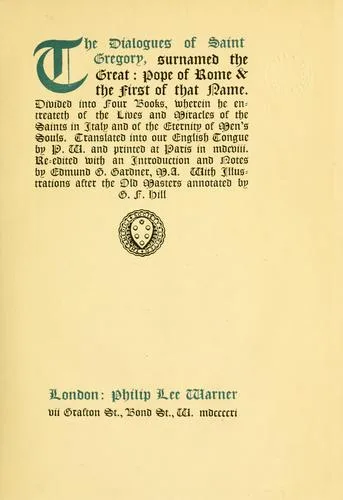
 84
84

Dialogi
Pope Gregory I's Dialogi, particularly in its 1924 edition, presents a fascinating study in early medieval spiritual discourse. The work’s strength lies in its earnest portrayal of faith confronting the uncertainties of its era. Gregory's insistence on divine agency in everyday events, as seen in the numerous accounts of miracles and saintly interventions, offers a stark contrast to modern secular perspectives. However, the text’s inherent didacticism can sometimes feel repetitive; the consistent framing of events as moral lessons or divine tests, while characteristic of the period, may test the patience of contemporary readers seeking narrative complexity. The extended discussion on the nature of souls and purgatory (Book IV) is particularly arresting, revealing a detailed, if speculative, cosmology of the afterlife that profoundly shaped later Catholic doctrine. Ultimately, Dialogi is a significant, albeit challenging, artifact of pre-scholastic Christian thought.
📝 Description
84
Pope Gregory I wrote Dialogi in the late 6th century, structuring it around theological instruction and lives of saints.
Pope Gregory I's Dialogi, written around 590 AD, is a collection of conversations and narratives intended for theological and moral instruction. The work features accounts of miracles and the lives of saints, reflecting the spiritual needs of a Europe in upheaval after the Western Roman Empire's collapse. Gregory, a significant figure in church administration and liturgy, penned this text during his papacy. Dialogi circulated widely, influencing medieval theological and literary traditions by serving as a source of spiritual guidance and moral examples. The book engages with core Christian beliefs, examining divine providence, the nature of the soul, and the spiritual struggles individuals faced. It also touches upon the activity of angelic and demonic forces, and concepts of the afterlife.
While not initially categorized as esoteric, Dialogi has been read in that light due to its discussions on divine intervention and the soul's spiritual journey. Readers interested in early Christian thought, medieval history, hagiography, or the historical understanding of miracles will find substantial material. The text offers insight into the foundational stories and theological ideas that shaped Western culture and spirituality, presented through narratives that were often viewed as direct conduits of divine wisdom.
Though Dialogi was primarily a work of moral and theological instruction for its time, its focus on divine intervention, the spiritual life of saints, and the unseen forces influencing human existence has led to its interpretation within esoteric traditions. The narratives detail encounters with the miraculous and explore the soul's relationship with the divine and the spiritual realm. For readers seeking to understand the historical roots of contemplative and mystical thought, Dialogi offers a window into how these concepts were understood and communicated in the early medieval period, often through stories of spiritual exemplars and divine communication.
💡 Why Read This Book?
• Gain insight into the pre-scholastic understanding of divine intervention and miracles, as detailed in Gregory I's accounts, offering a unique perspective on faith in the 6th century. • Explore the theological underpinnings of purgatory, a concept significantly elaborated upon in Book IV of Dialogi, which has had a lasting impact on Western religious thought. • Understand the foundational role of hagiography and saintly lives in shaping medieval spiritual practice, as exemplified by the numerous narratives Gregory includes.
⭐ Reader Reviews
Honest opinions from readers who have explored this book.
❓ Frequently Asked Questions
When was Pope Gregory I's Dialogi originally written?
Pope Gregory I's Dialogi was originally written in the late 6th century, likely between 593 and 595 AD. The edition referenced was first published in 1924, making it a later accessible version of this historical text.
What is the primary subject matter of Dialogi?
The primary subject matter of Dialogi involves theological discussions, moral instruction, and narratives of miracles and saints' lives, as conveyed through dialogues. It explores divine intervention, the nature of the soul, and spiritual challenges.
Is Dialogi considered a primary source for understanding medieval beliefs?
Yes, Dialogi is considered a primary source for understanding early medieval Christian beliefs, particularly concerning the afterlife, demonology, and the veneration of saints. Its widespread circulation ensured significant influence.
What is the significance of the 1924 publication date?
The 1924 publication date indicates a modern scholarly edition or translation, making Pope Gregory I's work accessible to a contemporary audience, potentially with annotations or introductions that contextualize it for 20th-century readers.
Does Dialogi contain verifiable accounts of miracles?
Dialogi contains numerous accounts that Pope Gregory I presents as verifiable miracles, illustrating divine power and the efficacy of faith, prayer, and relics during the late 6th century.
Who were some contemporaries of Pope Gregory I?
Notable contemporaries of Pope Gregory I included figures like Saint Columba of Iona and the Byzantine Emperor Maurice. His papacy also overlapped with the early years of the Prophet Muhammad's ministry.
🔮 Key Themes & Symbolism
Divine Providence and Miracles
Dialogi heavily emphasizes the active role of God and divine forces in the world. Miracles are not presented as aberrations but as consistent manifestations of God's power and will, often occurring in response to prayer or through the intercession of saints. Pope Gregory I meticulously recounts events, from healing the sick to averting natural disasters, to illustrate this constant divine oversight. This theme reflects a worldview where the supernatural was intricately interwoven with the fabric of daily existence, providing solace and moral instruction in a turbulent era.
The Nature of the Soul and Afterlife
A significant portion of Dialogi, particularly Book IV, is dedicated to exploring the state of the soul after death. Gregory discusses purgatory, the concept of purification after earthly life, and the efficacy of prayers for the departed. The work attempts to provide a framework for understanding spiritual existence beyond the physical realm, drawing on existing traditions and his own theological interpretations. This exploration was crucial in shaping medieval Christian eschatology and the practices surrounding prayer for the dead.
Saints as Spiritual Exemplars
The lives and deeds of various saints are central to Dialogi. These narratives serve not merely as historical accounts but as potent moral exemplars. Gregory presents saints like Benedict of Nursia not just as holy individuals but as conduits of divine grace and power, capable of performing extraordinary feats. Their lives demonstrate the virtues of faith, asceticism, and obedience, offering tangible models for believers seeking spiritual advancement and divine favor in their own lives.
Spiritual Warfare and Discernment
The Dialogi acknowledges the presence and influence of demonic forces in the world, framing human life as a spiritual battleground. However, it also stresses the importance of spiritual discernment. Gregory warns against mistaking demonic illusions for genuine divine manifestations. This theme highlights a nuanced understanding of spiritual phenomena, requiring believers to critically evaluate experiences and rely on established doctrine and the guidance of the Church to distinguish truth from deception.
💬 Memorable Quotes
Direct passages from the work, attributed to the author.
“True miracles proceed from faith, not from mere spectacle.”
— This interpretation highlights Gregory's concern with the authenticity of spiritual experiences. He implicitly contrasts genuine divine works, rooted in piety, with potential deceptions or mere displays of power, advocating for discernment in recognizing God's hand.
“The afterlife is a realm shaped by earthly choices.”
— This interpretation directly relates to Gregory's discussions on purgatory and judgment. It posits a causal link between one's terrestrial existence and their post-mortem spiritual state, emphasizing the enduring consequences of actions.
“Saints serve as living bridges between humanity and the divine.”
— This interpretation captures the role of hagiography in Dialogi. It presents holy figures not just as paragons of virtue but as active intercessors and exemplars, facilitating a connection between mortal believers and the celestial realm.
💡 Key Ideas
Editorial paraphrase of the work's core concepts — not direct quotes.
The soul is judged by its own deeds.
This paraphrased concept underscores Gregory's emphasis on personal responsibility in the afterlife. It suggests that one's spiritual fate is directly tied to their actions and moral conduct during earthly life, a core tenet of early Christian moral theology.
Prayer can alter the course of earthly and eternal events.
This paraphrased concept reflects the profound efficacy attributed to prayer within Dialogi. It conveys Gregory's belief that supplication is a potent force, capable of influencing both worldly circumstances and the ultimate destiny of souls.
🌙 Esoteric Significance
Tradition
While Pope Gregory I was a central figure in established Western Christianity, Dialogi has been re-examined through an esoteric lens for its exploration of spiritual realities beyond the purely physical. It can be seen as a precursor to later Christian mystical traditions, particularly in its detailed discussions of the soul's journey and the mechanics of divine intervention. It departs from purely dogmatic approaches by presenting these concepts through narrative and dialogue, inviting a more personal contemplation of spiritual phenomena.
Symbolism
The concept of 'dialogue' itself functions symbolically, representing the ongoing conversation between the human and the divine, the earthly and the eternal. Miracles, beyond their literal interpretation, symbolize the pervasive presence and power of God breaking through the mundane. Furthermore, the recurring motif of demonic temptation and angelic aid symbolizes the internal spiritual struggle faced by every individual, a core theme in many esoteric paths.
Modern Relevance
Contemporary esoteric practitioners, particularly those within Christian esoteric traditions or those studying comparative religion, find Dialogi valuable for understanding the historical roots of concepts like purgatory and divine healing. Thinkers interested in the historical development of consciousness and the interpretation of spiritual phenomena can draw parallels to modern New Age or consciousness studies, albeit with significant theological differences. It provides a crucial link to the pre-Renaissance understanding of the spiritual cosmos.
👥 Who Should Read This Book
• Students of early Christian theology and history seeking primary source material on 6th-century beliefs regarding miracles, saints, and the afterlife. • Readers interested in comparative religion and the evolution of eschatological concepts, particularly the development of purgatorial doctrines. • Scholars of medieval literature and hagiography looking to understand the narrative and thematic foundations of saintly lives and devotional texts.
📜 Historical Context
Written in the late 6th century, Pope Gregory I's Dialogi emerged during a period of profound societal transformation following the fragmentation of the Western Roman Empire. The work reflects a deep concern for spiritual guidance amidst political instability and the perceived threat of spiritual decay. It circulated widely, becoming a foundational text for medieval theology and literature, influencing countless sermons and devotional works. Contemporaries like Isidore of Seville were also shaping Christian thought, though Gregory's specific focus on dialogues and miraculous narratives offered a distinct approach. The work’s reception was largely positive, cementing its status as a key text for understanding the spiritual life and eschatological views of the early Middle Ages, a period where the authority of the Papacy was solidifying.
📔 Journal Prompts
The nature of divine intervention as depicted in Gregory's miracles.
Reflections on the spiritual warfare between angelic and demonic forces.
The concept of purgatory and its implications for the soul's journey.
The role of saints as exemplars of faith and intercessors.
Discernment of spiritual phenomena in light of Gregory's narratives.
🗂️ Glossary
Hagiography
A genre of writing that deals with the lives of saints and other religious figures. In Dialogi, it serves to illustrate divine action and moral examples.
Purgatory
A state or place of purification after death, in which the souls of those who have died in God's grace may make atonement for their sins before going to heaven. Significantly elaborated by Gregory.
Asceticism
A lifestyle characterized by abstinence from worldly pleasures and the pursuit of spiritual goals, often through self-discipline and self-denial.
Discernment
The ability to judge well. In a spiritual context, it refers to the practice of distinguishing between good and evil influences or divine and deceptive phenomena.
Providence
The protective care of God or of nature as a spiritual power. Gregory emphasizes God's active involvement in human affairs.
Relics
Objects considered holy because of their association with a saint or with Jesus Christ. Their veneration and perceived power are discussed in Dialogi.
Eschatology
The branch of theology concerned with the final destiny of the soul and of humankind. Dialogi provides key insights into early medieval eschatological views.
🔮 Readers Also Liked
Browse all →









More by Pope Gregory I
All books →
More Free Occult Philosophy Books
View all →