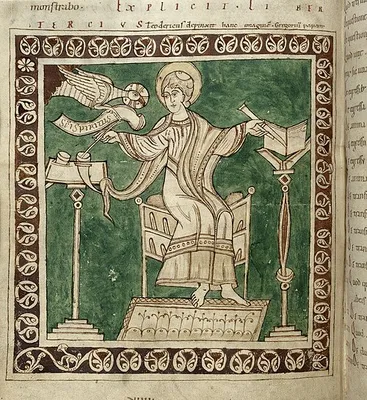
Pope Gregory I
Gregory I, a highly influential Pope, significantly shaped Western Christianity through his writings and administrative reforms.
Pope Gregory I, also known as Saint Gregory the Great, served as the Bishop of Rome from 590 to 604. Born into a prominent Roman senatorial family, he initially pursued a secular career, becoming the Prefect of Rome. However, he later embraced a monastic life, converting his family estate into a monastery. Before his papacy, he served as a papal ambassador in Constantinople. During his time as Pope, Gregory's administration was highly effective, surpassing imperial efforts in improving the welfare of the Roman populace. He played a crucial role in re-establishing papal authority in regions like Spain and France and initiated missionary efforts, notably sending Augustine of Canterbury to England. His influence extended to reshaping alliances among various barbarian groups, aligning them with Roman Christianity and thus impacting the development of medieval Europe. He also actively combated the Donatist heresy.
Early Life and Education
Born around 540 in Rome, Gregory hailed from a wealthy and noble family with strong ties to the Church. His father, Gordianus, was a senator and former Prefect of Rome. Gregory received a comprehensive education, excelling in subjects such as grammar, rhetoric, literature, and law, indicating preparation for a public career. He rose rapidly in civil service, eventually holding the high office of Prefect of Rome at the age of thirty. Despite his family's prominence, Gregory's life was marked by the turbulent political and social conditions of the time, including the aftermath of the Plague of Justinian and ongoing conflicts in Italy.
Monasticism and Spiritual Influence
Following his father's death, Gregory transformed his family's villa into a monastery dedicated to Saint Andrew. He deeply respected monastic life and the vow of poverty, which influenced his approach to discipline, as illustrated by an incident involving a monk who stole money. Gregory believed in the possibility of spiritual remediation even after death, as evidenced by his arranging for Masses to be offered for the deceased monk. His own mother and paternal aunts were recognized for their piety, with some being venerated as saints. Gregory's commitment to spiritual pursuits was profound, viewing monasticism as the 'ardent quest for the vision of our Creator'.
Papal Ministry and Administrative Impact
Gregory's papacy was characterized by significant administrative and spiritual leadership. He served as a papal ambassador in Constantinople, gaining valuable experience in imperial politics and diplomacy. Upon becoming Pope, he implemented reforms that greatly improved the welfare of the Roman people, often exceeding the efforts of the reigning emperors. He was instrumental in restoring papal influence in areas like Spain and France and in dispatching missionaries, such as Augustine of Canterbury, to convert new territories to Christianity. His efforts in aligning various Germanic tribes, including the Franks, Lombards, and Visigoths, with Roman Christianity played a pivotal role in shaping the religious and political landscape of early medieval Europe. He also actively confronted theological challenges, such as the Donatist heresy.
Literary Contributions and Legacy
Gregory was an exceptionally prolific writer, producing more works than any previous pope. His writings earned him the epithet 'Saint Gregory the Dialogist' in Eastern Christianity due to his 'Dialogues,' a work exploring spiritual matters. During the Middle Ages, he was widely known as 'the Father of Christian Worship' for his extensive revisions of Roman liturgy. His contributions to the Divine Liturgy of the Presanctified Gifts were so substantial that he is often considered its principal author. He is recognized as one of the four Great Latin Church Fathers, alongside Augustine, Jerome, and Ambrose. Canonized shortly after his death, he is one of only three popes, alongside Leo I and Nicholas I, to be historically designated 'the Great'.
Key Ideas
- Spiritual remediation and the pursuit of divine vision through monasticism
- Reformation of Roman liturgy and worship practices
- Diplomatic and administrative strategies to expand Christian influence and papal authority
Books by Pope Gregory I
2 free public domain books · Read online or download