De abstinentia

 78
78

De abstinentia
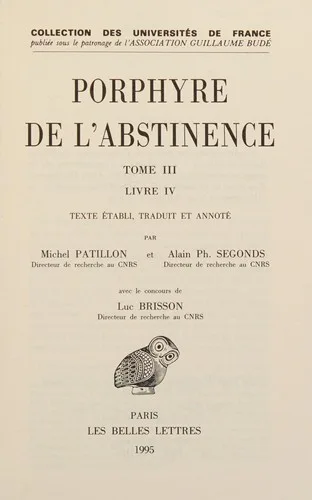
Porphyry’s *De abstinentia* presents a rigorous philosophical defense of vegetarianism, a stance that remains remarkably relevant centuries after its initial composition in the late 3rd century CE. The text’s strength lies in its systematic deconstruction of the justifications for animal sacrifice and meat consumption, framing the argument within the ethical and spiritual framework of Neoplatonism. Porphyry’s methodical approach, referencing Pythagorean and Platonic thought, offers a compelling intellectual challenge to the prevailing practices of his time. He skillfully delineates the rational capacities of animals, arguing against their exploitation as mere resources. A notable passage is his detailed analysis of different levels of soul and their implications for ethical treatment, which forms the bedrock of his ethical vegetarianism. However, the work’s dense philosophical arguments, deeply embedded in the specific intellectual currents of late antiquity, can present a barrier to the contemporary reader unfamiliar with Neoplatonic terminology and logical structures. While the translation and scholarly apparatus are crucial for accessibility, the sheer weight of philosophical discourse might, at times, obscure the immediate ethical appeal. Nevertheless, *De abstinentia* offers a powerful historical and philosophical perspective on a perennial ethical debate.
Verdict: A vital, albeit demanding, philosophical cornerstone for understanding the ancient roots of ethical dietary choices.
📝 Description
78
Porphyry wrote *De abstinentia* around 270 CE, arguing against animal sacrifice and meat consumption.
Porphyry's *De abstinentia*, composed in the late 3rd century CE, presents a philosophical case against animal sacrifice and the eating of meat. The work draws significantly from Pythagorean and Platonic thought to build its arguments. It is not simply a text on diet, but a broader inquiry into spiritual purity, the nature of the soul, and the relationship between humans, the divine, and other living beings. Porphyry engages with contemporary philosophical schools and religious customs, advocating for a vegetarian life based on reasoned ethical and philosophical principles.
This treatise is of interest to students of ancient philosophy, especially Neoplatonism and Pythagoreanism. It is relevant for those studying the history of ethics, the philosophical roots of vegetarianism, and comparative studies of ancient religions. The text also offers insights for modern readers considering the ethics of diet and compassion. It emerged during a time of intellectual ferment in the Roman Empire, a period where Neoplatonism was influential and various religious and philosophical ideas coexisted.
Written in late antiquity, *De abstinentia* comes from a milieu where Neoplatonism, influenced by Porphyry's teacher Plotinus, was a prominent philosophical current. The Roman Empire was a site of diverse religious practices and philosophical schools, including mystery cults and various ethical traditions. Porphyry's work responded to the common practice of animal sacrifice, positioning his arguments for abstinence within this complex religious and philosophical landscape. It stands as a reasoned defense of a vegetarian ethic rooted in philosophical principles.
💡 Why Read This Book?
• Understand the philosophical underpinnings of vegetarianism as articulated by Porphyry, a student of Plotinus, and how it connects to Neoplatonic ideals of purity and the soul, moving beyond simple health or environmental concerns. • Examine the historical context of the late 3rd century CE, noting Porphyry's engagement with Pythagorean and Platonic ethics in refuting prevailing animal sacrifice practices within the Roman Empire. • Grasp the concept of *apatheia* as presented by Porphyry, learning how abstaining from meat was seen as a means to achieve greater spiritual tranquility and detachment from bodily desires.
⭐ Reader Reviews
Honest opinions from readers who have explored this book.
❓ Frequently Asked Questions
What is the primary philosophical tradition influencing Porphyry's *De abstinentia*?
The primary philosophical tradition is Neoplatonism, heavily influenced by Pythagorean and Platonic thought. Porphyry, a student of Plotinus, integrates concepts of the soul, purification, and divine order into his arguments against animal sacrifice and meat consumption.
When was *De abstinentia* originally written?
*De abstinentia* was originally written by Porphyry in the late 3rd century CE, likely around the 270s CE, during the height of Neoplatonic philosophy's influence.
Does Porphyry argue for vegetarianism based on modern health concerns?
No, Porphyry's arguments for abstaining from meat and animal sacrifice are rooted in ethics, metaphysics, and spiritual purity. He posits that animals possess reason and souls, and that consuming them hinders the pursuit of *apatheia* and divine connection.
What is the concept of *apatheia* as discussed in *De abstinentia*?
*Apatheia* refers to a state of freedom from disturbing passions and emotional turmoil. Porphyry suggests that a diet free from animal products contributes to achieving this state of mental and spiritual equanimity, aligning with philosophical ideals.
Who was Porphyry?
Porphyry (c. 234 – c. 305 CE) was a prominent Neoplatonist philosopher, a disciple of Plotinus, and a significant figure in late antique philosophy. He is known for his commentaries on Plato and Aristotle, and his own philosophical writings, including *De abstinentia*.
How does *De abstinentia* relate to ancient religious practices?
The book directly engages with and critiques the widespread practice of animal sacrifice prevalent in various ancient religions of the Roman Empire. Porphyry offers a philosophical alternative rooted in Pythagorean ideals, emphasizing reverence for life over ritualistic slaughter.
🔮 Key Themes & Symbolism
Ethical Vegetarianism
The central theme is the ethical imperative to abstain from animal flesh and sacrifice. Porphyry argues that animals possess rational souls, making their slaughter a violation of natural order and divine justice. This ethical framework is grounded not in sentimentality but in philosophical reasoning derived from Pythagorean and Platonic traditions, positing that harming sentient beings obstructs one's own spiritual progress and purity.
Spiritual Purity and Asceticism
Abstinence from meat is presented as a crucial component of spiritual purification. Porphyry links dietary choices to the attainment of *apatheia* (freedom from passions) and closer communion with the divine. This aligns with broader ascetic practices in ancient philosophy and religion, where detachment from bodily appetites was seen as essential for intellectual and spiritual clarity.
The Nature of the Soul
A significant portion of the work is dedicated to exploring the different kinds of souls and their capacities, particularly in animals. Porphyry differentiates between human reason, animal rationality, and the vegetative soul, using these distinctions to build his case against treating animals as mere objects or sacrifices. Understanding the soul's hierarchy is key to Porphyry's ethical system.
Critique of Ritual Sacrifice
Porphyry systematically critiques the prevailing religious practice of animal sacrifice in the Roman world. He argues that such rituals are misguided and dishonor the gods, proposing that true piety lies in reverence for life and philosophical contemplation rather than bloody offerings. This critique positions *De abstinentia* as a philosophical challenge to established religious norms.
💬 Memorable Quotes
Direct passages from the work, attributed to the author.
“It is better to be a victim of injustice than to commit it.”
— This principle, echoing Socratic ethics, underscores Porphyry's view that active participation in causing harm (through slaughter) is a greater moral failing than suffering harm. It frames ethical action as a means of preserving one's own soul's integrity.
“The universe is not without the animals that are nourished by flesh.”
— This statement acknowledges the existence of carnivorous animals within the natural order but distinguishes their necessity for survival from voluntary human consumption. Porphyry implies that human ethical capacity allows for a choice beyond mere biological imperative.
“We do not say that it is necessary to abstain from all living things.”
— This clarifies Porphyry's nuanced position. He is not advocating for a complete cessation of all harm to living beings but specifically targets the unnecessary consumption of animals for food and sacrifice, distinguishing between levels of sentience and ethical obligation.
“The gods are pleased with the virtues of men, not with the blood of beasts.”
— This highlights Porphyry's theological argument: divine favor is earned through moral character and philosophical pursuit, not through appeasement via animal sacrifice. It shifts the focus from ritualistic appeasement to ethical living as true worship.
“The reasoning soul is common to man and to beasts.”
— This is a core premise for Porphyry's ethics. By asserting that animals possess a form of reasoning soul, he establishes a basis for moral consideration, arguing that beings capable of experiencing life and possessing some form of rationality deserve ethical treatment.
🌙 Esoteric Significance
Tradition
As a central to Neoplatonist ethical thought, *De abstinentia* fits squarely within the Western esoteric tradition's emphasis on purification and spiritual ascent. It aligns with Pythagorean ideals concerning the transmigration of souls and reverence for life, which influenced many later esoteric schools. While not explicitly Kabbalistic or Hermetic, its philosophical underpinnings concerning the soul's journey and its relationship with the material world resonate with themes found across these traditions.
Symbolism
The primary symbolic motif is the act of abstention itself, representing a conscious choice to transcend base appetites and align oneself with higher, rational principles. The animal sacrifice, conversely, symbolizes the material world's cycle of violence and ignorance. The concept of the soul, particularly the 'reasoning soul' shared with animals, acts as a symbolic bridge, suggesting that harm to others reflects a flawed understanding of interconnectedness and the divine.
Modern Relevance
Contemporary thinkers in animal ethics, vegan philosophy, and certain mindfulness and ascetic practices draw upon Porphyry's arguments. His detailed philosophical reasoning provides a historical and intellectual precedent for ethical vegetarianism and veganism, moving beyond mere dietary trends to explore the profound ethical implications of human-animal relationships and the pursuit of inner peace.
👥 Who Should Read This Book
• Students of ancient philosophy, particularly Neoplatonism and Pythagoreanism, seeking primary source material on ethical reasoning and cosmology from the 3rd century CE. • Ethical vegans and vegetarians interested in the historical and philosophical roots of their practice, understanding arguments that predate modern environmental or health-focused rationales. • Comparative religion scholars examining ritual practices in the Roman Empire and philosophical critiques of sacrifice during late antiquity.
📜 Historical Context
Porphyry’s *De abstinentia*, composed around 270 CE, emerged from the vibrant intellectual milieu of late antique Neoplatonism. This era was characterized by a complex interplay of pagan philosophy, mystery religions, and the nascent stages of Christian thought. Porphyry, a student of Plotinus, the founder of Neoplatonism, was deeply immersed in a philosophical system that emphasized spiritual ascent and detachment from the material world. The dominant philosophical currents included Neoplatonism, Stoicism, and various Gnostic traditions, all of which explored ethics, cosmology, and the human condition. In contrast to the widespread polytheistic practices involving animal sacrifice, Porphyry's work offered a reasoned, philosophical argument for vegetarianism, drawing heavily on Pythagorean traditions. His treatise engaged with prevailing societal norms, providing a sophisticated ethical and metaphysical justification for abstaining from meat and sacrifice, positioning it as essential for spiritual purity and philosophical living.
📔 Journal Prompts
Porphyry's distinction between human reason and animal rationality: explore its implications for ethical frameworks.
The concept of *apatheia* as a goal; how does dietary choice relate to emotional equanimity?
Reflect on the perceived hierarchy of beings in ancient thought versus contemporary ecological perspectives.
Analyze the argument that committing injustice is worse than suffering it, as applied to animal consumption.
Consider the role of purity in spiritual disciplines across different traditions, using Porphyry's views as a reference.
🗂️ Glossary
Neoplatonism
A philosophical system developed by Plotinus in the 3rd century CE, building upon Plato's ideas. It emphasizes a hierarchical structure of reality emanating from a single, transcendent source ('The One') and seeks spiritual and intellectual ascent through contemplation.
Pythagoreanism
An ancient Greek philosophical and religious tradition attributed to Pythagoras. Known for its emphasis on mathematics, music, asceticism, and beliefs in the transmigration of souls (metempsychosis).
Apatheia
A Greek term often translated as 'impassivity' or 'freedom from passion.' In Stoic and Neoplatonic philosophy, it signifies a state of mental tranquility achieved by overcoming destructive emotions and irrational desires.
Metempsychosis
The doctrine of the transmigration of souls; the belief that after death, the soul begins a new life in a new body, which may be human, animal, or even plant. Central to Pythagorean and Platonic thought.
Rational Soul
In Porphyry's context, this refers to the capacity for reason, logic, and self-awareness. He argues that this faculty is not exclusive to humans but is present in animals to varying degrees, forming the basis for ethical consideration.
Asceticism
A lifestyle characterized by severe self-discipline and abstention from all forms of indulgence, typically for religious or spiritual reasons. It aims at achieving spiritual purity or closeness to the divine.
Platonic
Relating to the philosophy of Plato, an ancient Greek philosopher. Key concepts include the Theory of Forms, the immortality of the soul, and the pursuit of knowledge and virtue.
🔮 Readers Also Liked
Browse all →









More by Porphyry
All books →



More Free Occult Philosophy Books
View all →