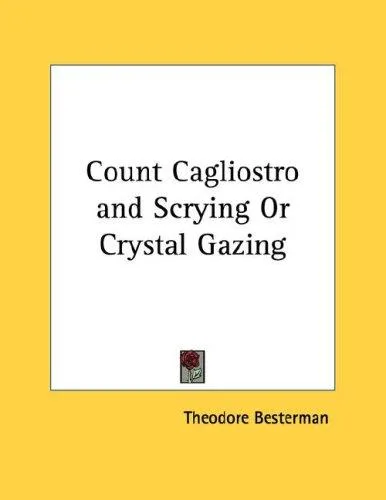
Count Cagliostro and Scrying Or Crystal Gazing
 61
61

Count Cagliostro and Scrying Or Crystal Gazing



Sophia Crane, Associate Editor: Theodore Besterman masterfully dissects the arcane practice of scrying, grounding its mystical allure in historical context, particularly through the controversial figure of Count Cagliostro. This work is an indispensable resource for anyone intrigued by the history of divination and visionary arts. Besterman's rigorous scholarship unravels the complexities of crystal gazing, offering profound insights into its psychological and esoteric dimensions. The book is a compelling read for practitioners seeking to understand the roots of their craft, as well as for scholars of occultism and esoteric traditions. It provides a rare, clear window into a practice often obscured by myth and misinterpretation.
📝 Description
61
Theodore Besterman’s 1947 study examines Count Cagliostro’s role in crystal gazing.
Theodore Besterman’s study, first published in 1947, dissects the history and practice of scrying, particularly through the figure of Count Cagliostro. Cagliostro, a notorious figure in 18th-century occult circles, becomes the focal point for Besterman’s investigation into crystal gazing.
The book traces the philosophical and practical aspects of scrying, detailing the rituals and symbolism employed by practitioners. Besterman analyzes how these elements were understood to facilitate visionary experiences. He connects the practice to humanity’s long-standing desire to access knowledge beyond ordinary perception, examining the psychological dimensions involved in seeking such insights.
This work situates crystal gazing within a broader history of divinatory practices that have long been a part of esoteric traditions. Such methods were often employed to seek guidance, foretell futures, or gain access to hidden knowledge, aligning with a persistent human interest in the non-material. Besterman’s focus on Cagliostro connects this practice to a specific, albeit controversial, historical figure associated with occultism and esoteric societies.
💡 Why Read This Book?
Uncover the historical secrets of scrying and crystal gazing, directly linked to the legendary Count Cagliostro. Explore the esoteric traditions and psychological depths of divination. Ideal for occult scholars, historical researchers, and modern practitioners seeking a foundational understanding of visionary practices. Gain insights into the human desire to perceive hidden realities.
⭐ Reader Reviews
Honest opinions from readers who have explored this book.
❓ Frequently Asked Questions
What is scrying?
Scrying is an ancient divinatory practice involving gazing into a reflective surface, such as a crystal ball, mirror, or water, to receive visions, insights, or messages from the subconscious or other realms. It is a form of clairvoyance.
Who was Count Cagliostro?
Count Cagliostro was a charismatic and controversial Italian adventurer, occultist, and alchemist of the 18th century, known for his purported magical abilities and involvement in various esoteric societies and rituals, including those related to scrying.
Is this book for beginners?
Yes, while rich in historical detail and esoteric nuance, Besterman's clear prose makes the subject accessible to serious beginners interested in the history and practice of divination, provided they have a genuine interest in the occult.
What kind of historical research is presented?
The book draws upon historical accounts, diaries, and scholarly analysis of the period, offering a well-researched perspective on the practice of scrying and Cagliostro's association with it.
Does the book offer practical scrying techniques?
While primarily historical and analytical, the book provides context and understanding of historical techniques, which can inform modern practitioners. It focuses more on the 'why' and 'how' of historical practice than direct instruction.
🔮 Key Themes & Symbolism
The Enigma of Count Cagliostro
This theme studies the complex and often contradictory persona of Count Cagliostro, a figure who embodied the mystique of the 18th-century occult revival. Besterman meticulously examines Cagliostro's purported involvement in various secret societies and his reputation as a master of arcane arts, particularly his alleged expertise in scrying. The exploration focuses on separating fact from legend, analyzing his influence on contemporary esoteric thought and practice, and understanding how his life story became intertwined with the very essence of hidden knowledge and mystical pursuit.
The Art and Psychology of Scrying
Beyond the historical figure, this theme dissects the practice of scrying itself. It explores the philosophical underpinnings of visual divination, examining how the act of gazing into a reflective medium can unlock subconscious perceptions and facilitate visionary experiences. Besterman investigates the psychological mechanisms at play, the role of suggestion, expectation, and altered states of consciousness. The book illuminates the symbolic language of scrying, the common motifs observed, and the interpretations attributed to them, offering a deep dive into this ancient method of seeking hidden truths.
Historical Context of Esotericism
This theme situates Cagliostro and the practice of scrying within the broader range of 18th-century European esotericism. It examines the intellectual and spiritual currents of the Enlightenment, the rise of secret societies, and the persistent fascination with alchemy, magic, and divination. Besterman sheds light on the social and cultural milieu that fostered such practices, highlighting the tension between burgeoning rationalism and the enduring human attraction to the mystical. Understanding this context is crucial to appreciating the significance and reception of figures like Cagliostro and practices like crystal gazing.
💬 Memorable Quotes
Direct passages from the work, attributed to the author.
“In the shimmering depths, secrets whispered across time are revealed.”
— This evokes the mystical allure of scrying, portraying it as a conduit to ancient wisdom and hidden knowledge that transcends temporal boundaries.
“Cagliostro’s legacy is a range woven with threads of charlatanism and genuine arcane mastery.”
— This acknowledges the controversial nature of Cagliostro, suggesting that his true abilities and intentions remain ambiguous, a blend of deception and profound occult knowledge.
“The crystal becomes a gateway, not to another world, but to the vast uncharted territories of the mind.”
— This emphasizes the internal, psychological aspect of scrying, positioning the crystal as a tool for exploring one's own subconscious and higher faculties.
“To gaze is to invite revelation, to surrender to the unseen currents of existence.”
— This speaks to the active, intentional nature of scrying, framing it as an act of conscious openness to mystical experiences and the underlying forces of reality.
💡 Key Ideas
Editorial paraphrase of the work's core concepts — not direct quotes.
The mirror reflects not only the external world but also the depths of the soul.
This quote suggests that scrying is a dual process, engaging both external observation and internal introspection, highlighting the psychological dimension of visionary practices.
🌙 Esoteric Significance
Tradition
This book is deeply rooted in the Western Esoteric Tradition, particularly its branches concerned with divination, occultism, and ceremonial magic. It connects to traditions of Hermeticism, Alchemy, and Rosicrucianism, which often incorporated visionary practices as a means of spiritual attainment. The focus on scrying aligns with practices found in various mystical schools that sought direct communion with divine or subtle energies, using tools to bridge the material and spiritual realms.
Symbolism
Key symbols explored include the crystal ball itself, representing clarity, purity, and a portal to other realms; mirrors, symbolizing reflection, self-knowledge, and portals; and the visions themselves, often rich with archetypal imagery, divine figures, and symbolic landscapes. Cagliostro's persona also acts as a potent symbol of the magician, the alchemist, and the enigmatic seeker of forbidden knowledge, embodying the allure and danger of the occult path.
Modern Relevance
In an age increasingly focused on mindfulness, consciousness studies, and the exploration of altered states, the historical practices of scrying offer profound relevance. Besterman's work provides a historical and theoretical framework for understanding the human impulse towards visionary perception. It encourages modern seekers to explore the potential of their own consciousness and the enduring human fascination with uncovering hidden truths, offering a bridge between ancient mystical techniques and contemporary psychological and spiritual exploration.
👥 Who Should Read This Book
This book is a valuable collection for several distinct groups. For the **occult scholar and historian**, it offers meticulous research and a deep dive into a specific, fascinating period of esoteric practice. **Aspiring practitioners of divination** will find invaluable historical context, understanding the roots and philosophical underpinnings of scrying. **Seekers of hidden knowledge** and those interested in the psychology of consciousness will be captivated by the exploration of visionary states. Even **curious general readers** with an interest in historical figures and the enduring mysteries of the human mind will find 'Count Cagliostro and Scrying' an enlightening and engaging read.
📜 Historical Context
Theodore Besterman's work emerges from a rich period of occult revival and historical inquiry into esoteric traditions. Written against the backdrop of the late 19th and early 20th centuries, a time when scholars and practitioners alike were dissecting the history of magic, mysticism, and secret societies, this book reflects a growing academic interest in previously marginalized subjects. The 18th century, the era of Count Cagliostro, was a fascinating crucible of Enlightenment rationalism and persistent belief in the supernatural. It was a time of secret lodges, alchemical pursuits, and a widespread fascination with divination, making Cagliostro’s life and practices a compelling subject for historical and esoteric analysis. Besterman’s research navigates this complex intellectual landscape, offering a scholarly yet evocative portrayal of a central moment in the history of occult thought.
📔 Journal Prompts
Reflect on your personal relationship with mystery and the unknown. How does the idea of 'hidden knowledge' appeal to you?
Imagine yourself as an 18th-century seeker of esoteric wisdom. What questions would you pose to a scryer like Cagliostro?
Consider the concept of 'reflection' in your life – both literal (mirrors, surfaces) and metaphorical (self-reflection, past events). What insights might these reflections offer?
If you were to attempt scrying, what symbolic imagery do you anticipate encountering, and what might it represent for you?
How does the historical context of Cagliostro's era illuminate the enduring human desire for divination and spiritual insight?
🗂️ Glossary
Scrying
The practice of gazing into a reflective surface, such as a crystal ball or mirror, to obtain visions or divinatory information. It is a form of clairvoyance aimed at perceiving hidden realities.
Crystal Gazing
A specific form of scrying that utilizes a crystal ball as the primary reflective medium for inducing visions and accessing subconscious or spiritual insights.
Divination
The practice of seeking knowledge of the future or the unknown by supernatural means, often involving interpretation of omens, signs, or visions.
Esotericism
A broad category of mystical and occult traditions, often characterized by secret teachings, symbolic language, and a pursuit of direct experience with the divine or ultimate reality.
Alchemy
An ancient philosophical and protoscientific tradition practiced throughout Europe, Africa, and Asia. It was concerned with the transmutation of base metals into gold, the discovery of a universal elixir, and spiritual purification.
This book appears in 3 collections
🔮 Readers Also Liked
Browse all →








More by Theodore Besterman
All books →
From the “Tarot” Collection
View all →








More Free Divination & Tarot Books
View all →