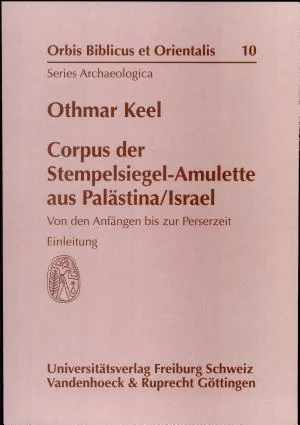
Corpus der Stempelsiegel-Amulette aus Palästina/Israel
 80
80

Corpus der Stempelsiegel-Amulette aus Palästina/Israel
The first volume of Othmar Keel's "Corpus der Stempelsiegel-Amulette aus Palästina/Israel," published in 1995, set a significant precedent for cataloging ancient Near Eastern glyptic art. Its enthusiastic reception by specialists underscores its foundational importance. The subsequent volumes, like the one published in 2013, continued to be lauded, with G. Holbl noting in the Zeitschrift des Deutschen Palastina-Vereins the work's enduring value. This corpus is not merely a collection but a critical scholarly tool. Its strength lies in its meticulous documentation and systematic approach to a vast array of artifacts, offering unparalleled access to the material culture of ancient Palestine and Israel. A potential limitation for the non-specialist reader is the dense academic prose, which, while precise, can be challenging. Nevertheless, the detailed cataloging of scarab seals and other stamped amulets provides direct access to the iconography and epigraphy of the periods covered. The work is an indispensable resource for anyone seriously studying the religious and cultural landscape of the ancient Levant.
This corpus is an essential reference for serious academic study.
📝 Description
80
### What It Is ### Who It's For ### Historical Context ### Key Concepts
💡 Why Read This Book?
• Gain direct insight into the iconographic and epigraphic evidence from ancient Palestine/Israel by examining the detailed catalog of scarab seals and amulets, as presented in the foundational 1995 volume. • Understand the scholarly reception and ongoing importance of this multi-volume project, as evidenced by reviews like G. Holbl's in the Zeitschrift des Deutschen Palastina-Vereins, which highlights its sustained academic impact. • Access a comprehensive corpus of artifacts that illuminate the religious beliefs and cultural practices of the ancient Levant, providing primary source material for comparative studies.
⭐ Reader Reviews
Honest opinions from readers who have explored this book.
❓ Frequently Asked Questions
What is the primary focus of the Corpus der Stempelsiegel-Amulette aus Palästina/Israel?
The corpus systematically catalogs and analyzes stamp seals and amulets found in Palestine and Israel, providing detailed descriptions, images, and scholarly commentary on these artifacts.
When was the first volume of this corpus published?
The first volume of the 'Corpus der Stempelsiegel-Amulette aus Palästina/Israel' was first published in 1995.
Who is the author of this extensive catalog?
The author responsible for this significant scholarly undertaking is Othmar Keel.
What kind of reception did the initial volume receive?
The initial volume, published in 1995, was enthusiastically welcomed by the academic and specialist community.
Are there later volumes in this series?
Yes, the project has continued with subsequent volumes, with at least one published as late as 2013.
What scholarly journal has reviewed the later volumes?
The Zeitschrift des Deutschen Palastina-Vereins has published reviews of the later volumes, with G. Holbl being a notable reviewer.
🔮 Key Themes & Symbolism
Iconography of Ancient Seals
The corpus meticulously documents the visual motifs and symbols found on stamp seals from Palestine and Israel. These range from anthropomorphic figures and zoomorphic representations to geometric patterns and divine symbols. Analysis of these images provides crucial insights into the religious beliefs, mythological narratives, and cultural cosmology prevalent in the Levant during various historical periods. The systematic presentation allows for comparative studies of iconography across different regions and eras.
Epigraphy and Inscriptions
Beyond the imagery, many seals bear inscriptions, often in ancient Semitic scripts such as Phoenician, Aramaic, or Hebrew. This work offers a critical examination of these epigraphs, including personal names, titles, and dedications. Deciphering these inscriptions is vital for understanding the social structure, personal piety, and administrative practices of the time. The corpus serves as a primary resource for scholars of ancient linguistics and paleography.
Material Culture and Provenance
Each artifact cataloged is detailed in terms of its material (e.g., steatite, carnelian, faience), dimensions, and archaeological provenance. This focus on material culture allows for an understanding of trade networks, craft specialization, and the technology of seal production. Establishing the origin and context of these seals helps to reconstruct the historical and economic range of ancient Palestine and Israel, differentiating local production from imported items.
Religious and Cultural Practices
The stamp seals and amulets were not merely decorative but often served ritualistic or apotropaic functions. Their motifs and inscriptions frequently allude to deities, protective spirits, and cultic activities. By compiling and analyzing these objects, the corpus sheds light on the syncretic religious landscape, the presence of foreign cults, and the personal devotional practices of individuals in ancient societies. It offers a tangible link to the spiritual lives of past peoples.
💬 Memorable Quotes
Direct passages from the work, attributed to the author.
“The first catalog volume... was enthusiastically welcomed by the specialist community.”
— This reflects the immediate academic validation of Keel's comprehensive cataloging effort, signaling its importance as a foundational scholarly tool.
“The undertaking has lost neither significance nor fascination.”
— This suggests the ongoing relevance and allure of studying these ancient seals, indicating their continued ability to captivate researchers and inform our understanding of the past.
“G. Holbl writes in the Zeitschrift des Deutschen Palastina-Vereins...”
— This citation points to the sustained scholarly discourse surrounding the corpus, with prominent figures reviewing and engaging with the work in respected academic journals.
“The work explores the meaning and function of stamp seals and amulets.”
— This captures the core purpose of the corpus: to move beyond mere description and engage with the symbolic, religious, and practical roles these objects played.
💡 Key Ideas
Editorial paraphrase of the work's core concepts — not direct quotes.
The effect of the present fourth Corpus volume... for research.
This paraphrased sentiment highlights the direct and significant contribution of the corpus volumes to ongoing academic research in relevant fields.
🌙 Esoteric Significance
Tradition
While the corpus is a work of mainstream archaeology and epigraphy, its detailed examination of symbols and inscriptions on amulets touches upon traditions that informed later esoteric thought, particularly concerning divine imagery, protective symbols, and personal piety in the ancient Levant. It provides the raw material for understanding the visual language that would later be reinterpreted in Hermetic, Kabbalistic, or Gnostic contexts, though Keel's work itself remains strictly academic.
Symbolism
Specific symbols frequently encountered in the corpus, such as the ankh (symbol of life), various divine figures (e.g., Baal, Asherah), and zoomorphic representations (lions, scarabs), carry deep symbolic weight. Scarabs, for instance, were potent symbols of rebirth and regeneration, linked to the Egyptian god Khepri. The presence of these symbols on seals suggests their use not just for authentication but as potent talismans intended to invoke divine favor or protection.
Modern Relevance
Contemporary scholars of ancient religions, comparative mythology, and the history of magic frequently cite Keel's corpus. Its systematic cataloging provides an indispensable reference for understanding the visual and textual evidence of ancient Near Eastern religious practices. Modern practitioners of certain Western esoteric traditions may also consult the corpus to gain a deeper, historically grounded understanding of symbols and motifs that have been incorporated into their own symbolic systems.
👥 Who Should Read This Book
• Archaeologists and epigraphers specializing in the ancient Near East who require a comprehensive catalog of Palestinian and Israeli stamp seals and amulets. • Researchers in comparative religion and ancient history seeking primary source material on the iconography and inscriptions of the Levant during antiquity. • Students of ancient scripts and languages needing detailed examples of Phoenician, Aramaic, and Hebrew inscriptions found on seals and amulets.
📜 Historical Context
The publication of Othmar Keel's "Corpus der Stempelsiegel-Amulette aus Palästina/Israel" began in 1995, a period when the study of ancient Near Eastern archaeology and epigraphy was well-established but still actively seeking comprehensive cataloging of its material evidence. The field was dominated by meticulous archaeological excavation reports and specialized monographs, with scholars like Pierre Bordreuil and Albert van der Kooj actively contributing to the study of West Semitic epigraphy and glyptics. Keel's project aimed to consolidate a vast and often scattered corpus of artifacts, providing a systematic framework for their analysis. The enthusiastic reception of the first volume, as noted by the author, indicates a significant scholarly need for such a resource, filling a gap in accessibility and comparative study. While not facing overt censorship, the rigorous academic nature of the work positioned it firmly within the discipline of Near Eastern studies, rather than popular esoteric circles, although its subject matter inherently touches upon ancient religious beliefs.
📔 Journal Prompts
The iconography of scarab seals and their connection to concepts of regeneration.
Analysis of personal names and titles found in the epigraphy of the seals.
Comparison of divine imagery on seals from different regions of Palestine/Israel.
The material composition of seals and its implications for trade networks.
The apotropaic function of amulets as suggested by their symbols and inscriptions.
🗂️ Glossary
Stamp Seal
A small object, typically made of stone or faience, engraved with a design or inscription, used to impress a mark onto clay or other soft material, often for authentication or decoration.
Amulet
An object believed to have magical properties, intended to protect the wearer or owner from harm or evil.
Scarab
A type of amulet or seal carved in the form of a scarab beetle, particularly popular in ancient Egypt and the Levant, often symbolizing rebirth and protection.
Iconography
The visual images and symbols used in a work of art or the study or interpretation of these.
Epigraphy
The study of inscriptions, especially ancient ones; the decipherment and interpretation of ancient texts written on durable materials.
Provenance
The place of origin or chronological source of a work of art or artifact.
Levant
The geographical region east of the Mediterranean Sea, often encompassing modern-day Syria, Lebanon, Jordan, Israel, and Palestine.
This book appears in 1 collection
🔮 Readers Also Liked
Browse all →









From the “Amulets” Collection
View all →





More Free Occult Philosophy Books
View all →