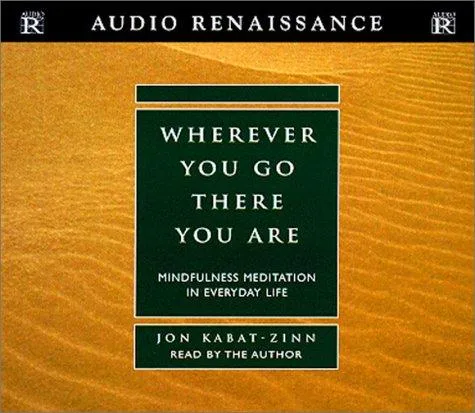
Wherever You Go, There You Are
 72
72

Wherever You Go, There You Are
Kabat-Zinn’s enduring contribution, first appearing in 1994, is its remarkably direct translation of meditation's essence into actionable advice. The updated edition retains the original's unpretentious clarity. A particular strength is its consistent reminder that mindfulness isn't about emptying the mind, but about observing its contents with kindness—a crucial distinction often lost. For instance, the chapter on "The Stillness of the Body" offers a palpable anchor to physical presence. Its limitation, however, lies in its sheer accessibility; for those seeking the deeper philosophical underpinnings or intricate yogic lineages that inform such practices, this volume might feel somewhat superficial. Nonetheless, for the everyday practitioner grappling with the mind's incessant chatter, it provides a gentle, effective handrail. It remains a fundamental text for cultivating inner quietude.
📝 Description
72
Jon Kabat-Zinn published Wherever You Go, There You Are in 1994, offering a guide to daily mindfulness.
This book presents mindfulness as a way to live more fully in the present moment. Jon Kabat-Zinn structures the text with short chapters, each containing practical advice and reflections on awareness. It is not meant as a strict doctrine, but rather as an encouragement for individuals to observe their own minds and experiences.
The book is for anyone interested in reducing stress and reactivity in their lives. It provides tools for finding calm amidst daily pressures, appealing to both those new to meditation and experienced practitioners. Its accessible approach has made it a widely read text on the subject.
First appearing in 1994, the book arrived as interest in Eastern practices grew in the West. Kabat-Zinn's method, developed at the University of Massachusetts Medical School, offered a secular and medical perspective on mindfulness.
Wherever You Go, There You Are emerged from the burgeoning field of secular mindfulness in the late 20th century. It draws from Buddhist contemplative traditions, particularly Zen, adapting concepts like non-judgmental awareness and presence for a Western audience. Kabat-Zinn's work connects these ancient practices to contemporary stress reduction, bridging the gap between spiritual inquiry and practical application in daily life. Its publication marked a significant moment in making mindfulness widely accessible outside of traditional religious or strictly academic settings.
💡 Why Read This Book?
• You will learn to cultivate "beginner's mind," a concept directly from the book, enabling you to approach daily experiences with fresh curiosity and less preconceived judgment, transforming mundane moments. • You will gain practical techniques for "walking meditation" and "breathing" exercises, as detailed in the book, offering immediate tools to anchor yourself in the present moment even during stressful activities. • You will understand how to practice "non-judgmental awareness," a core tenet discussed extensively, allowing you to observe your thoughts and feelings without being overwhelmed, fostering greater emotional regulation.
⭐ Reader Reviews
Honest opinions from readers who have explored this book.
❓ Frequently Asked Questions
When was Jon Kabat-Zinn's 'Wherever You Go, There You Are' first published?
The original edition of 'Wherever You Go, There You Are' by Jon Kabat-Zinn was first published on December 5, 1994. The updated version, which includes a new introduction and afterword, reflects on its enduring impact over three decades.
What is the central message of 'Wherever You Go, There You Are'?
The central message is that mindfulness and meditation can be integrated into everyday life to reduce stress and increase presence. It emphasizes paying attention to the present moment non-judgmentally, regardless of circumstances.
How does 'Wherever You Go, There You Are' differ from other meditation books?
It distinguishes itself by offering practical, secular techniques rooted in a clinical setting (MBSR), making it highly accessible for beginners and those seeking stress reduction without a specific religious context.
What is 'beginner's mind' as described by Jon Kabat-Zinn?
Beginner's mind, a concept highlighted by Kabat-Zinn, refers to approaching each moment with the openness, curiosity, and lack of preconceptions of a novice, rather than relying on habitual patterns of thought.
Can mindfulness practices from this book help with chronic pain?
Yes, Kabat-Zinn pioneered Mindfulness-Based Stress Reduction (MBSR) at UMass Medical School, which has been shown to help individuals manage chronic pain by altering their relationship to discomfort and stress.
Is 'Wherever You Go, There You Are' suitable for advanced meditators?
While excellent for beginners, advanced meditators can also benefit by refining their understanding of core principles and finding renewed inspiration in the book's emphasis on the present moment and non-judgmental awareness.
🔮 Key Themes & Symbolism
Embracing the Present Moment
The core esoteric principle explored is the realization that the present moment is the only true reality. Kabat-Zinn guides readers to disengage from rumination on the past or anxiety about the future, directing attention to the "here and now." This practice is foundational in many contemplative traditions, aligning with concepts of "presence" found in Hermeticism and certain Gnostic ideas about escaping temporal illusion to grasp eternal truth.
Non-Judgmental Awareness
This theme focuses on observing thoughts, feelings, and sensations without labeling them as good or bad. It's a practice of detached observation, allowing one to witness the mind's activity without identification. This carries the Stoic ideal of distinguishing between impressions and judgments, and within esoteric philosophy, it relates to the alchemical process of separating the subtle from the gross, leading to greater clarity and self-understanding.
The Stillness Within
Kabat-Zinn posits that amidst the constant flux of external events and internal mental chatter, there exists an inherent stillness or core of being. Cultivating this inner quietude is presented not as an achievement but as a recognition of what is already present. This speaks to mystical traditions that speak of an "inner sanctuary" or the "divine spark" within the individual, accessible through deep introspection.
Mindfulness as a Path to Integration
The book presents mindfulness not merely as a technique but as a way of being that integrates one's inner life with outer actions. By being fully present, one can engage more authentically with life's challenges and joys. This holistic approach aligns with esoteric philosophies that seek to unify the spiritual, mental, and physical aspects of the human being, fostering a balanced and purposeful existence.
💬 Memorable Quotes
Direct passages from the work, attributed to the author.
“Wherever you go, there you are.”
— This deceptively simple phrase captures the book's central thesis: true peace and presence are not found in external circumstances or future destinations, but within one's own awareness, available right here, right now.
“You can’t stop the waves, but you can learn to surf.”
— This metaphor illustrates how life's challenges and mental disturbances are inevitable. Mindfulness offers the skill to navigate these experiences with greater ease and equanimity, rather than being overwhelmed by them.
“This moment is all you have.”
— An encouragement to anchor oneself in the present, recognizing that the past is gone and the future is uncertain. True living occurs only in this immediate experience, a concept central to many spiritual paths.
“Mindfulness means paying attention in a particular way: on purpose, in the present moment, and non-judgmentally.”
— This is Kabat-Zinn's foundational definition, outlining the active, intentional, and unbiased nature of mindful awareness, differentiating it from passive daydreaming or critical self-reflection.
“The real practice is to be in the midst of the storm, and to be able to find the stillness.”
— This highlights the practical application of mindfulness not just in calm moments, but particularly when facing difficulties, emphasizing the cultivation of inner resilience amidst external chaos.
🌙 Esoteric Significance
Tradition
While Kabat-Zinn’s work is secular, its roots draw heavily from Buddhist Vipassanā meditation, which itself has esoteric dimensions focused on insight into the nature of reality. It can be seen as a modern, explained manifestation of contemplative practices aimed at cultivating equanimity and direct experiential understanding. This aligns with the broader esoteric pursuit of inner transformation and liberation from suffering, echoing principles found in Hermeticism's emphasis on self-knowledge and Gnosticism's quest for spiritual awakening through inner awareness.
Symbolism
The "breath" is perhaps the most potent symbol, representing the constant, vital connection to the present moment and the life force itself. It serves as an accessible anchor, a universal "gateway" to awareness. The "body" also functions symbolically, grounding the practitioner in tangible reality, a stark contrast to the disembodied nature of constant mental rumination. It represents the "temple" or "vessel" through which experience is perceived, a focus in many somatic esoteric practices.
Modern Relevance
Kabat-Zinn's work is foundational for contemporary secular mindfulness movements, influencing fields from psychology (e.g., MBCT, MBSR-based therapies) to neuroscience research on attention and emotion regulation. Thinkers like Mark Williams and Zindel Segal, who developed Mindfulness-Based Cognitive Therapy, directly build upon his framework. His approach continues to inform corporate wellness programs, educational initiatives, and everyday individuals seeking practical tools for mental resilience in an increasingly complex world.
👥 Who Should Read This Book
• Individuals experiencing high levels of stress or anxiety seeking practical, secular techniques for immediate relief and long-term emotional regulation. • Students of comparative religion or philosophy interested in the practical, experiential application of Buddhist contemplative principles outside of a formal religious context. • Healthcare professionals and therapists looking for evidence-based mindfulness tools to integrate into their practice or personal well-being routines.
📜 Historical Context
Jon Kabat-Zinn's "Wherever You Go, There You Are" arrived in 1994, an important year for the popularization of mindfulness. It emerged amidst a growing cultural openness to Eastern contemplative traditions, fueled by figures like the Dalai Lama and Thich Nhat Hanh. Kabat-Zinn's particular genius lay in secularizing and operationalizing mindfulness through his Mindfulness-Based Stress Reduction (MBSR) program, first established at the University of Massachusetts Medical School in 1979. This clinical, scientifically-informed approach distinguished it from more overtly spiritual or philosophical texts. While Zen Buddhism formed a significant part of its inspiration, Kabat-Zinn presented it in a way that resonated broadly, bypassing potential resistance to religious dogma. The book’s phenomenal bestseller status contrasted with the more academic discourse surrounding meditation, signaling a significant public appetite for practical tools for mental well-being, distinct from conventional Western therapeutic models.
📔 Journal Prompts
The practice of "beginner's mind" in daily interactions.
Recognizing the "stillness of the body" during moments of stress.
Observing the "waves" of thoughts without attempting to stop them.
Finding "purpose" in paying attention to the present moment.
The "non-judgmental" observation of a recurring sensation.
🗂️ Glossary
Mindfulness
A specific way of paying attention: on purpose, in the present moment, and non-judgmentally. It involves a conscious awareness of one's thoughts, feelings, bodily sensations, and surrounding environment.
Beginner's Mind
Approaching every moment with openness, curiosity, and an absence of preconceptions, as if experiencing it for the first time, rather than through the lens of past experiences or expectations.
Non-judgmental Awareness
The practice of observing thoughts, feelings, and sensations as they arise without labeling them as 'good' or 'bad,' 'right' or 'wrong.' It fosters acceptance and reduces reactivity.
Present Moment
The immediate experience of 'now.' Mindfulness emphasizes anchoring attention here, recognizing that the past is gone and the future is yet to come, making the present the only point of true engagement.
Breathing
The conscious awareness of the physical sensation of inhalation and exhalation. It serves as a primary anchor for the mind, grounding the practitioner in the present moment.
The Stillness
An inherent quality of peace and presence believed to exist beneath the surface of mental activity and external circumstances. It is discovered through mindful attention.
Walking Meditation
A practice of bringing mindful awareness to the physical sensations and experience of walking, turning a routine activity into an opportunity for presence.