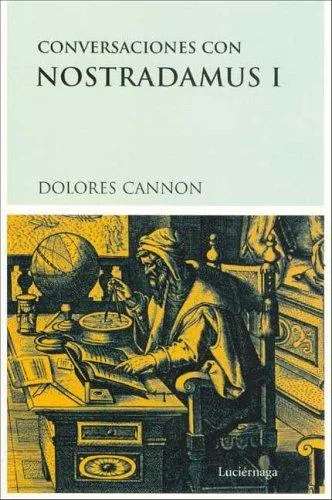
Conversations with Nostradamus. Volume I
 80
80

Conversations with Nostradamus. Volume I
Dolores Cannon's *Conversations with Nostradamus* offers a bold, if unconventional, approach to understanding the famous prophet. The strength of this volume lies in its consistent adherence to Cannon's unique methodology, providing a detailed, first-person narrative that attempts to demystify Nostradamus's life and work. The purported conversations reveal a thoughtful, even burdened, individual grappling with his prophetic abilities. However, the primary limitation is the inherent subjectivity of the source material; the claims made are verifiable only through the lens of belief in past-life regression and channeled communication. A particularly striking aspect is the detailed discussion of Nostradamus's motivations for writing his *Centuries*, presented as a desire to warn humanity rather than predict immutable fate. Ultimately, the book serves as a fascinating, albeit speculative, exploration of a historical enigma through a modern esoteric framework.
📝 Description
80
Dolores Cannon's 1992 book claims direct conversations with Nostradamus's spirit.
Dolores Cannon, a pioneer in past-life regression, authored Conversations with Nostradamus, Volume I. This book reports sessions where individuals, under hypnosis, identified as the spirit of Michel de Nostredame. These alleged dialogues form the core of the work, detailing Nostradamus's life, his reasons for writing the Centuries, and his views on historical and future events. Cannon's method aims to access this historical figure's consciousness directly, moving beyond mere interpretation of his cryptic quatrains. The book presents this information as if Nostradamus himself were recounting his experiences and insights.
The work is aimed at those interested in prophecy, esoteric history, and the nature of consciousness. Readers familiar with Cannon's regression techniques will find a familiar approach here, as the book taps into her established methodology for exploring past lives and channeled information. It also invites those curious about Nostradamus's legacy and the enduring mystery of his predictions to consider a new perspective.
Michel de Nostredame published his Centuries in 1555, during a time of great European upheaval. These quatrains have been a subject of intense study and debate for centuries, seen by some as divine prophecy and by others as dangerous heresy. This book engages with that tradition by attempting to bypass traditional interpretation through direct psychic communication. It positions itself within the lineage of those seeking to understand Nostradamus's enigmatic verses, but uses a modern spiritualist technique to achieve this.
💡 Why Read This Book?
• Gain a novel perspective on Nostradamus's *Centuries* by understanding their creation from a purported first-person viewpoint, moving beyond mere prediction to explore authorial intent. • Explore the concept of consciousness and prophecy through the lens of Dolores Cannon's regression technique, potentially offering new frameworks for understanding psychic phenomena. • Understand the historical backdrop of 16th-century France, as presented through alleged personal accounts, providing context for the societal forces that may have influenced Nostradamus's work.
⭐ Reader Reviews
Honest opinions from readers who have explored this book.
❓ Frequently Asked Questions
What is the primary method used in 'Conversations with Nostradamus, Volume I' to gather information?
The book utilizes Dolores Cannon's specialized technique of hypnotic past-life regression. Individuals under hypnosis are guided to access memories and consciousness, with the central premise being that some subjects can connect with the spirit of Nostradamus himself.
When was 'Conversations with Nostradamus, Volume I' first published?
This volume was first published in 2020, making it a contemporary exploration of a historical figure.
Does this book offer literal translations of Nostradamus's quatrains?
No, the book does not focus on literal translation. Instead, it presents 'conversations' with Nostradamus that interpret his intentions, life, and the broader meaning behind his prophecies.
Who is Dolores Cannon and why is her background relevant?
Dolores Cannon was a renowned past-life regression therapist and author. Her extensive work in exploring consciousness and memory through hypnosis forms the foundation for this book's unique approach.
What historical period does the book's context primarily refer to?
The historical context centers around the life and times of Michel de Nostredame in 16th-century France, specifically the period surrounding the publication of his famous *Centuries* in 1555.
Can readers expect verifiable historical facts about Nostradamus's life?
While the book is grounded in the historical figure of Nostradamus and his 1555 publication, the 'conversations' themselves are presented as channeled information, not as direct historical documentation.
🔮 Key Themes & Symbolism
The Nature of Prophecy
The work challenges conventional views of prophecy as fixed prediction. Through the alleged voice of Nostradamus, it suggests his quatrains were intended as warnings and guidance, rather than immutable pronouncements of fate. The book explores the idea that prophecy might be a form of energetic blueprint that can be altered by human consciousness and choice. This perspective reframes the seer's role from a passive announcer of destiny to an active participant in shaping future possibilities, offering a more nuanced understanding of precognitive abilities within esoteric thought.
Consciousness Beyond Time
A central theme is the exploration of consciousness transcending linear time. Dolores Cannon's methodology posits that through deep hypnotic states, individuals can access the consciousness of past or future incarnations, or even communicate with entities across temporal divides. In this book, the 'spirit' of Nostradamus communicates from a timeless perspective, offering insights not bound by a single lifetime. This concept aligns with esoteric ideas of a unified consciousness or Akashic field, suggesting that awareness is not limited by the physical constraints of birth and death.
The Seer's Intentions
This volume aims to illuminate the personal motivations behind Nostradamus's cryptic writings. Instead of focusing solely on deciphering specific predictions, the 'conversations' explore his life experiences, his spiritual journey, and the ethical considerations he faced as a prophet. It presents him as a soul dedicated to assisting humanity's evolution, grappling with the burden of foreknowledge and the responsibility of conveying difficult truths. This theme provides a more human and relatable portrait of the historical figure, emphasizing his role as a spiritual guide.
Hypnotic Regression as a Tool
The book itself is a evidence of the efficacy of Dolores Cannon's regressive hypnosis technique. It demonstrates how this method can be employed to access what is believed to be deeper layers of consciousness and memory, including purported past-life experiences or direct communication with historical or spiritual figures. The success of these 'conversations' hinges on the premise that hypnosis can unlock non-ordinary states of awareness, allowing for unique forms of knowledge acquisition and personal exploration that traditional historical or academic methods cannot achieve.
💬 Memorable Quotes
Direct passages from the work, attributed to the author.
“My purpose was to plant seeds of awareness, not to dictate the harvest.”
— This alleged statement from Nostradamus suggests his prophecies were intended as catalysts for human consciousness and action, rather than deterministic forecasts. It highlights a proactive, guiding role for the seer, emphasizing the potential for free will to shape future outcomes.
“The future is not a stone tablet; it is a flowing river.”
— This metaphor illustrates the book's perspective on prophecy as dynamic and mutable. It implies that while potential futures can be perceived, they are not fixed and can be influenced or changed by present actions and collective consciousness.
“Underneath the symbols lies the human heart, seeking understanding.”
— This interpretation points to the universal human desire for meaning and connection that underlies even the most cryptic prophecies. It suggests that Nostradamus's work, despite its esoteric nature, is rooted in fundamental human concerns and aspirations.
“Time is a construct for the mind, not a prison for the soul.”
— This highlights the esoteric concept that the soul's consciousness operates outside the linear constraints of earthly time. It supports the idea that communication or remembrance across different eras is possible from a soul perspective.
“I wrote in the language of my time, hoping understanding would dawn in yours.”
— This alleged quote reflects the challenge of interpreting historical prophecies. It suggests that Nostradamus anticipated that his work would require interpretation by future generations, using their own evolving understanding and context.
🌙 Esoteric Significance
Tradition
This work engages with the Western esoteric tradition, particularly the lineage of prophecy and divination that includes figures like Merlin and later occultists. It touches upon themes found in Hermeticism and Renaissance Neoplatonism concerning the nature of divine inspiration and the human capacity to perceive cosmic patterns. By presenting Nostradamus's work through channeled communication, it aligns with modern esoteric practices of mediumship and channeled information, expanding upon the historical understanding of prophetic figures within a contemporary metaphysical framework.
Symbolism
The *Centuries* themselves are deeply symbolic, using allegorical language and veiled references. The 'quatrain' form is a structural symbol of containment and coded message. Within the context of this book, symbols are interpreted not just as historical markers but as energetic keys intended to unlock consciousness. The act of prophecy is presented as a symbolic language of the soul, communicating timeless truths about human experience and spiritual evolution, moving beyond literal interpretation to a symbolic understanding of consciousness.
Modern Relevance
Contemporary interest in Nostradamus persists, fueled by global uncertainties and a fascination with predictive arts. Thinkers and practitioners in fields ranging from comparative mythology to New Age spirituality continue to analyze his prophecies. Dolores Cannon's work, including this volume, contributes to a modern resurgence of interest in channeled material and past-life regression as valid avenues for spiritual inquiry, influencing those who explore consciousness studies and alternative forms of wisdom acquisition.
👥 Who Should Read This Book
• Students of prophecy and divination seeking alternative interpretations of Nostradamus's *Centuries*, particularly those interested in the author's purported personal intent. • Practitioners and enthusiasts of Dolores Cannon's methods of past-life regression and channeled communication who wish to explore her work with a significant historical figure. • Readers interested in comparative esoteric studies who want to examine how historical prophetic texts are reinterpreted through contemporary metaphysical lenses.
📜 Historical Context
Michel de Nostredame published his *Centuries*, a collection of quatrains, in 1555, a period marked by intense religious conflict and societal upheaval in France. This era was also characterized by a burgeoning interest in astrology and occult sciences, alongside significant Christian theological debates. Nostradamus's work emerged within this milieu, drawing both fervent followers and sharp criticism. Some contemporaries, like the physician and astrologer Symphorien Champier, engaged with similar esoteric inquiries, though Nostradamus's prophecies gained a unique and enduring notoriety. The *Centuries* were viewed by many through the lens of apocalyptic expectation prevalent in the 16th century. Reception was mixed; while some saw divine inspiration, others, particularly during times of religious persecution, viewed his work with suspicion, leading to occasional attempts to suppress or reinterpret his writings to fit prevailing orthodoxies. This volume, published centuries later in 2020, revisits this historical figure through the lens of modern esoteric techniques.
📔 Journal Prompts
Nostradamus's intention behind his quatrains as seeds of awareness.
The concept of the future as a flowing river versus a stone tablet.
The human heart seeking understanding beneath symbolic language.
The soul's experience of time as distinct from the mind's construct.
Personal reflections on the burden and gift of foresight.
🗂️ Glossary
Quatrain
A stanza or poem consisting of four lines. Nostradamus famously organized his prophecies into collections called 'Centuries,' each containing groups of quatrains.
Past-Life Regression
A therapeutic technique, pioneered by Dolores Cannon, that uses hypnosis to access memories of previous lifetimes claimed to be stored in the subconscious mind.
Channeled Information
Communication received from a non-physical source or consciousness, often facilitated through a human medium, believed to offer wisdom or insights.
The Centuries
The primary work of Nostradamus, published in installments starting in 1555, containing thousands of four-line prophecies (quatrains) written in a cryptic style.
Esoteric
Intended for or likely to be understood by only a small number of people with a specialized knowledge or interest; relating to the occult or mystical.
Metaphysical
Based on or involving a theory that is not based on physical observation. In this context, it refers to the study of the fundamental nature of reality, consciousness, and existence.
Prophecy
The foretelling of future events; a prediction. In an esoteric context, it can also refer to divine inspiration or insight into spiritual truths.
🔮 Readers Also Liked
Browse all →









More by Dolores Cannon
All books →





More Free Occult Philosophy Books
View all →