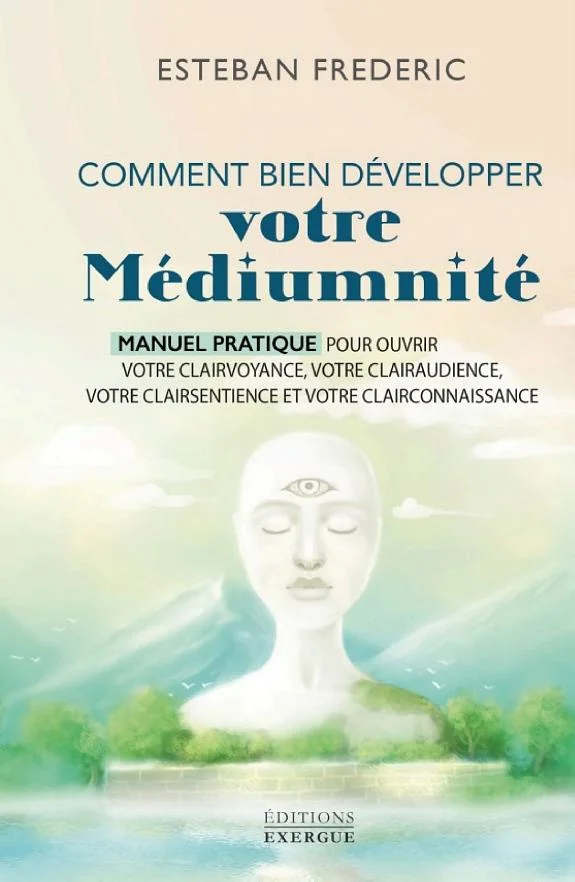
Comment bien développer votre médiumnité - Manuel pratique pour ouvrir votre clairvoyance, votre clairaudience, votre clairsentience et votre clairconnaissance
 75
75

Comment bien développer votre médiumnité - Manuel pratique pour ouvrir votre clairvoyance, votre clairaudience, votre clairsentience et votre clairconnaissance
Esteban Frédéric’s *Comment bien développer votre médiumnité* offers a refreshingly structured approach to what can often feel like an esoteric free-for-all. Frédéric’s strength lies in his methodical breakdown of psychic senses—clairvoyance, clairaudience, clairsentience, and clairconnaissance—treating them not as mystical accidents but as trainable faculties. He steers clear of overly romanticized notions, grounding the practice in practical exercises. A particularly effective passage details techniques for energetic cleansing, emphasizing the importance of self-care before and after attempted psychic work. The primary limitation is the book's reliance on a 2026 publication date, meaning its reception and impact within broader spiritualist circles are yet to be fully assessed. Despite this, for the aspiring medium seeking clarity and discipline, this manual provides a solid, accessible foundation.
📝 Description
75
Esteban Frédéric's 2026 manual details practical methods for developing psychic perception.
This practical manual breaks down mediumship into its four main components: clairvoyance, clairaudience, clairsentience, and clairconnaissance. Frédéric presents psychic sensitivity not as a rare gift, but as a natural human faculty that anyone can cultivate through focused practice. The book offers structured guidance for individuals curious about their psychic potential, whether they are beginners or have already experienced intuitive flashes. It addresses common skepticism and includes exercises designed to build confidence and discernment in developing these senses.
The work places mediumship within a broader historical and cultural context, referencing figures like shamans and mystics. Frédéric acknowledges the long human fascination with intermediaries to the spirit world and traces how the understanding of psychic abilities has evolved. The book draws implicitly on traditions that have long recognized psychic phenomena, from ancient shamanism to the 19th-century Spiritualist movements.
This book engages with the Western esoteric tradition, particularly the lineage of Spiritualism and its predecessors. It frames psychic abilities as extensions of natural human faculties, a perspective common in movements that seek to integrate spiritual experience with empirical observation. By detailing the four main forms of psychic perception, Frédéric offers a structured approach to developing these senses, aligning with the goal of many esoteric paths to consciously expand awareness and perception beyond the ordinary.
💡 Why Read This Book?
• Learn specific techniques for developing clairvoyance, clairaudience, clairsentience, and clairconnaissance, as detailed in Frédéric's practical exercises, offering a tangible pathway to enhanced intuition. • Understand the historical and cultural context of mediumship, referencing figures from ancient shamanism to 19th-century Spiritualism, providing a richer perspective than generic spiritual guides. • Gain practical advice on ethical psychic development and discernment, crucial for navigating the unseen, a critical component emphasized throughout the manual.
⭐ Reader Reviews
Honest opinions from readers who have explored this book.
❓ Frequently Asked Questions
What are the four main psychic abilities discussed in 'Comment bien développer votre médiumnité'?
The book focuses on clairvoyance (clear seeing), clairaudience (clear hearing), clairsentience (clear feeling), and clairconnaissance (clear knowing), presenting them as distinct yet interconnected avenues of psychic perception.
When was 'Comment bien développer votre médiumnité' first published?
Esteban Frédéric's practical guide was first published on May 13, 2026, making it a contemporary exploration of psychic development.
Is this book suitable for absolute beginners in mediumship?
Yes, the manual is designed for individuals curious about their psychic potential, offering a structured approach and actionable guidance for beginners seeking to understand and cultivate their abilities.
Does the book explain how to protect oneself when developing psychic senses?
Indeed, the work addresses the importance of grounding and energetic protection, providing readers with methods to ensure safe and effective engagement with psychic phenomena.
What is the core message regarding the nature of mediumship in this book?
The central message is that mediumship is a natural human faculty that can be cultivated through focused practice and understanding, rather than an exclusive gift.
Who is Allan Kardec mentioned in relation to this book?
Allan Kardec, a prominent figure in Spiritism, is quoted in the original blurb, linking the book's exploration of mediumship to established spiritualist traditions.
🔮 Key Themes & Symbolism
Cultivating Psychic Senses
The book presents a systematic method for nurturing the four primary psychic faculties: clairvoyance, clairaudience, clairsentience, and clairconnaissance. It moves beyond theoretical discussions to offer practical exercises designed to enhance a reader's intuitive awareness. Frédéric emphasizes that these abilities are latent within most individuals and can be awakened and strengthened through diligent practice, intention, and disciplined attention to subtle energetic cues. The focus is on practical application and skill-building for tangible results.
Discernment and Ethics in Mediumship
A significant theme is the critical importance of discernment and ethical conduct when engaging with psychic phenomena. Frédéric stresses that developing mediumship requires not only opening oneself to impressions but also learning to evaluate their source and validity. The manual advocates for grounding, energetic protection, and maintaining a balanced perspective to avoid misinterpretation or negative influences. This ethical framework ensures that the development of psychic abilities is approached responsibly and beneficially.
Historical Framework of Mediumship
The work contextualizes modern psychic development within a historical continuum, acknowledging humanity's long-standing fascination with spiritual intermediaries. By referencing figures like shamans and mystics, and implicitly the Spiritualist movement of the 19th century, Frédéric situates the practice within a lineage of spiritual exploration. This historical perspective aims to legitimize the pursuit of mediumship and demonstrate its enduring relevance across cultures and epochs, countering contemporary skepticism with historical precedent.
Integration of Psychic and Physical Reality
Frédéric advocates for an integrated approach where psychic development complements, rather than divorces from, everyday physical reality. The book's practical exercises are designed to be integrated into daily life, fostering a seamless connection between intuitive insights and practical decision-making. This holistic view encourages readers to view their psychic abilities as natural extensions of their being, enhancing their overall perception and interaction with the world.
💬 Memorable Quotes
Direct passages from the work, attributed to the author.
“The medium intrigues throughout the ages, perceived alternately as a sorcerer or a shaman.”
— This reflects the historical duality of perception surrounding individuals with psychic abilities, often met with fear and suspicion or reverence, highlighting the complex societal relationship with mediumship.
“His capacity to enter into contact with the invisible and to read into the depths of the human soul confers a singular aura.”
— This highlights the perceived unique power and mystique associated with mediums, stemming from their alleged ability to bridge the physical and non-physical realms and access deeper human consciousness.
“A practical manual to open your clairvoyance, clairaudience, clairsentience, and clairconnaissance.”
— This directly states the book's purpose: to serve as a hands-on guide for developing the core faculties of psychic perception, emphasizing practicality and accessibility.
💡 Key Ideas
Editorial paraphrase of the work's core concepts — not direct quotes.
Les esprits ne sont pas silencieux ; seuls ceux qui n'écoutent pas ne les entendent pas.
This quote, attributed to Allan Kardec, posits that the spiritual realm is constantly communicating, and the perceived silence is a result of human inattentiveness or lack of developed receptivity.
Spiritual contact is not a gift for the few, but a faculty to be cultivated.
This paraphrased concept suggests the book's core philosophy: that mediumship is an innate potential within most people, achievable through dedicated training and practice.
🌙 Esoteric Significance
Tradition
This work aligns with the broader Western Esoteric tradition, specifically drawing from the practical, experiential branches that emphasize the development of inner faculties. While not explicitly tied to a single lineage like Hermeticism or Kabbalah, it shares their focus on unlocking human potential and understanding subtle energies. It departs from more ritualistic or purely philosophical traditions by offering a direct, hands-on manual for cultivating psychic senses, making it accessible to a wider audience seeking practical application.
Symbolism
The core symbols are the four psychic senses themselves: clairvoyance (seeing), clairaudience (hearing), clairsentience (feeling), and clairconnaissance (knowing). These represent different modes of perception beyond the five physical senses. The book likely uses metaphors of 'opening,' 'listening,' and 'awareness' to symbolize the process of developing these abilities. The underlying concept is that of an inner 'eye,' 'ear,' 'heart,' or 'mind' that can perceive subtle realities, akin to the concept of the Third Eye in some Eastern traditions.
Modern Relevance
Frédéric's work is relevant to contemporary practices in energy healing, intuitive coaching, and mindfulness-based spiritual development. Modern thinkers and practitioners in fields like consciousness studies and parapsychology, as well as individuals exploring Neo-Spiritualism or New Age philosophies, can find value in its structured approach. The emphasis on practical exercises and ethical discernment speaks to current trends seeking grounded, accessible methods for personal spiritual growth and exploration of consciousness.
👥 Who Should Read This Book
['• Aspiring mediums and psychics seeking a structured, practical guide to developing clairvoyance, clairaudience, clairsentience, and clairconnaissance.', '• Individuals interested in exploring their intuition and spiritual potential beyond conventional belief systems.', '• Students of esoteric traditions looking for actionable techniques to enhance their perceptive abilities and understanding of consciousness.']
📜 Historical Context
Esteban Frédéric's *Comment bien développer votre médiumnité*, published in 2026, emerges in an era where interest in esoteric practices and personal spirituality continues to grow, often fueled by online communities and a search for meaning beyond material existence. This work builds upon a long tradition of psychic exploration, particularly the resurgence of interest in mediumship that gained significant traction during the 19th century with the rise of Spiritualism. Figures like Allan Kardec, whose work on Spiritism heavily influenced public discourse on the afterlife and psychic communication, provide a foundational reference point. Frédéric’s manual implicitly engages with this legacy, offering a modern, practical framework that contrasts with some of the more theatrical or less structured approaches of earlier eras. While contemporary society has largely moved past the widespread public séances of the late 1800s, there is a persistent undercurrent of curiosity and a desire for verifiable personal experience, which Frédéric’s structured approach aims to satisfy. The book navigates a landscape where scientific skepticism still prevails, yet alternative healing and consciousness studies are increasingly accepted, placing it at an interesting intersection.
📔 Journal Prompts
The four psychic senses: which feels most accessible now?
Reflecting on the historical perception of mediums as sorcerers or shamans.
Your personal definition of 'listening' to the unseen.
How can clairsentience inform daily decision-making?
Practicing discernment: identifying subtle impressions.
🗂️ Glossary
Clairvoyance
The psychic ability to 'see' images, scenes, or symbols in the mind's eye, representing information from non-physical sources.
Clairaudience
The psychic ability to 'hear' sounds, words, or messages from non-physical sources, often perceived as an inner voice or external sound.
Clairsentience
The psychic ability to 'feel' emotions, energies, or physical sensations from people, places, or situations, often experienced as intuition or empathy.
Clairconnaissance
The psychic ability to 'know' information intuitively, receiving insights or facts without a clear sensory or logical process.
Mediumnité
The capacity to act as a medium, facilitating communication between the physical world and the spirit world or non-physical realms.
Discernment
The faculty of judging well, particularly in the context of psychic work, involving the ability to distinguish between genuine impressions and misinterpretations.
Grounding
A practice used to stabilize one's energy, connect with the physical body and the Earth, often employed to maintain balance during psychic work.
This book appears in 1 collection
🔮 Readers Also Liked
Browse all →







From the “Clairsentience” Collection
View all →







More Free Occult Philosophy Books
View all →