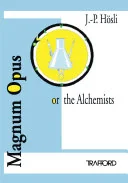
Magnum Opus
 78
78

Magnum Opus
Hosli's *Magnum Opus* offers a peculiar premise: the alchemical Great Work rediscovered, once for spiritual enlightenment and again for financial expediency. The narrative structure, framing the story as a scientific report, is an intriguing choice, suggesting a modern attempt to rationalize or secularize esoteric pursuits. A particular strength lies in its juxtaposition of the sincere adept's arduous path with the opportunist's technologically-assisted shortcut, highlighting a contemporary tension between genuine spiritual striving and superficial acquisition. However, the novel's conclusion, featuring an atomic explosion and gargantuan laughter, feels somewhat abrupt, leaving the thematic resolution hanging. The work explores the potential for the esoteric to be both deeply personal and cynically exploited. It is a curious exploration of ancient aims in a modern, often materialistic, world.
📝 Description
78
Johannes Peter Hosli's *Magnum Opus* recounts the alchemical Great Work's rediscovery in 2003.
First published in 2003, Johannes Peter Hosli's *Magnum Opus* presents a narrative that appears to be a scientific account. It details the discovery of the alchemical Great Work on two separate occasions. The first instance involves a genuine adept undertaking a spiritual quest for enlightenment. The second discovery is made by an opportunist who exploits the adept's legacy for financial gain, notably with the assistance of a "faultless Sun computer."
The novel is for readers interested in how alchemy, spirituality, and modern technology intersect. Those who enjoy allegorical storytelling and narratives that fuse historical esoteric traditions with contemporary elements will find it noteworthy. It suits individuals curious about reinterpreting or even mimicking ancient mystical pursuits in a digital age.
Hosli's novel engages with the enduring fascination surrounding the *Magnum Opus*, the alchemists' Great Work traditionally focused on creating the Philosopher's Stone and achieving spiritual transformation. While literal alchemy largely ceased by the late 18th century, its symbolic and spiritual dimensions persisted in occult circles. This tradition influenced thinkers like Carl Jung, who analyzed alchemical symbolism extensively. Hosli reinterprets the Great Work, suggesting it could be a source of tangible, even financial, reward, contrasting true spiritual fulfillment with material success.
💡 Why Read This Book?
• Gain a unique perspective on the alchemical *Magnum Opus*, moving beyond historical practice to its symbolic and even contemporary material implications, as explored through the contrast between the adept and the opportunist. • Understand how ancient esoteric concepts like the Great Work can be reinterpreted in the context of modern technology, exemplified by the "faultless Sun computer" assisting the opportunist. • Experience a narrative that critiques the commodification of spiritual knowledge, contrasting genuine spiritual fulfillment with the pursuit of financial freedom derived from alchemical legacies.
⭐ Reader Reviews
Honest opinions from readers who have explored this book.
❓ Frequently Asked Questions
When was Johannes Peter Hosli's *Magnum Opus* first published?
Johannes Peter Hosli's *Magnum Opus* was first published in 2003, positioning it as a contemporary work engaging with historical esoteric themes.
What is the central theme of *Magnum Opus*?
The central theme is the dual discovery of the alchemical *Magnum Opus*, the Great Work, explored as both a path to spiritual enlightenment and a means to financial freedom.
How does the book blend science and alchemy?
The novel is disguised as a scientific account, using this framing to explore the alchemical Great Work and its 'discovery' in a modern context, contrasting spiritual adepts with opportunistic figures.
What is the significance of the 'faultless Sun computer'?
The 'faultless Sun computer' represents modern technology being used by an opportunist to achieve the goals of the alchemical *Magnum Opus*, highlighting the contrast between traditional spiritual paths and modern acquisition.
What kind of spiritual quest is described?
The book describes a spiritual quest for enlightenment, represented by a 'true adept' on a 'tedious road to the enlightenment by the true and eternal sun'.
Does the book offer practical alchemical instructions?
No, the book is a fictional narrative disguised as a scientific account, not a practical guide. It explores the concepts and outcomes of the alchemical *Magnum Opus* allegorically.
🔮 Key Themes & Symbolism
The Dual Nature of the Great Work
The narrative presents the alchemical *Main work* not as a singular pursuit but as having a bifurcated manifestation. One path leads to profound spiritual fulfillment and enlightenment, embodied by the 'true adept' seeking the 'true and eternal sun.' The other path, taken by an opportunist, exploits the legacy of the Great Work for material gain, facilitated by modern technology like a 'faultless Sun computer.' This dichotomy questions whether the ultimate aim of esoteric knowledge is internal transformation or external acquisition.
Esotericism Meets Modernity
Hosli situates the ancient alchemical quest within a contemporary framework, suggesting that the principles or perceived outcomes of the Great Work can be encountered, or at least mimicked, in the modern era. The presence of advanced computing alongside alchemical pursuits highlights the ongoing human drive for transformation and mastery, whether spiritual or technological, and the potential for these seemingly disparate realms to intersect or collide.
Spiritual Legacy and Exploitation
The novel explores how a spiritual legacy, such as the adept's proof of the Great Work, can be inherited and repurposed. While the adept sought enlightenment, the opportunist leverages the same testament for 'financial freedom.' This theme examines the ethical considerations of interpreting and utilizing esoteric knowledge, contrasting genuine spiritual endeavor with its potential for commercial or personal exploitation in the 21st century.
The Paradox of Enlightenment
The narrative implicitly examines the paradox of enlightenment. The 'true adept' finds it through a 'tedious road,' suggesting it is a difficult, earned state. Conversely, the opportunist's 'financial freedom' is presented as a consequence of finding the adept's testament, hinting at a more accessible, perhaps superficial, form of 'achievement' derived from external means rather than internal work. The story questions the very definition of success and fulfillment.
💬 Memorable Quotes
Direct passages from the work, attributed to the author.
“The Main work of the alchemists had been found twice.”
— This opening premise immediately establishes the core conflict: the Great Work, a concept deeply rooted in spiritual and material transformation, is presented as a discovery that can occur in different eras and with vastly different motivations.
“A true adept who was seeking spiritual fulfilment on his tedious road to the enlightenment by the true and eternal sun.”
— This phrase captures the essence of traditional alchemical pursuit, emphasizing the arduous, internal journey towards spiritual illumination as the primary goal, distinct from mere material gain.
“An opportunist who found his financial freedom thanks to the adept's testament and a faultless Sun computer.”
— This highlights the novel's juxtaposition of ancient esoteric goals with modern technological means, suggesting that the pursuit of 'freedom' can be achieved through both spiritual discipline and technological leverage.
“The story ends with an encounter of the two leading characters, an atomic explosion, and a gargantuan laughter.”
— This describes the climactic resolution, implying a dramatic and perhaps chaotic confrontation between the spiritual and opportunistic approaches to the *Main work*, leaving the reader with a sense of unresolved, possibly cosmic, irony.
“Disguised as a scientific account, the novel tells the story...”
— This framing device suggests a modern attempt to analyze or present esoteric concepts within a rational, empirical structure, blurring the lines between fiction, science, and occult lore.
🌙 Esoteric Significance
Tradition
The work engages with the Western Hermetic tradition, specifically focusing on the concept of the *Main work* or Great Work, central to alchemy. It departs from strict alchemical texts by framing the Great Work allegorically within a fictional narrative that blends spiritual enlightenment with modern technological and financial pursuits, offering a contemporary, perhaps critical, reinterpretation of traditional esoteric goals.
Symbolism
Key symbols include the 'true and eternal sun,' representing ultimate spiritual illumination and divine union in alchemical symbolism, and the 'adept's testament,' signifying the transmission of esoteric knowledge. The 'faultless Sun computer' acts as a modern, materialistic counterpoint, suggesting technology can mimic or corrupt the alchemical process, highlighting the tension between internal spiritual alchemy and external, potentially superficial, achievement.
Modern Relevance
Contemporary thinkers and practitioners exploring the intersection of spirituality, consciousness, and technology find resonance in Hosli's narrative. It speaks to modern debates about the commodification of spiritual practices and the potential for digital tools to either aid or distract from genuine self-transformation. The novel's exploration of legacy and exploitation remains relevant in a world where ancient wisdom is increasingly accessible yet often superficially engaged with.
👥 Who Should Read This Book
• Students of Western Esotericism: Those studying the history and philosophy of alchemy and Hermeticism will find a unique fictional lens through which to examine the *Main work* and its potential interpretations. • Comparative Literature Enthusiasts: Readers interested in how spiritual and mystical themes are adapted and recontextualized in contemporary fiction, particularly when juxtaposed with scientific or technological concepts. • Philosophically Inclined Readers: Individuals who enjoy narratives that explore the nature of enlightenment, the ethics of knowledge acquisition, and the contrast between spiritual fulfillment and material success.
📜 Historical Context
Published in 2003, Johannes Peter Hosli's *Main work* arrived during a period of renewed interest in esoteric traditions, often filtered through academic study and popular fiction. While the literal practice of alchemy waned by the late 18th century, its symbolic and psychological dimensions, notably explored by Carl Jung in the mid-20th century, continued to fascinate. Hosli's work engages with this enduring allure, placing the alchemical Great Work into a narrative that contrasts genuine spiritual seeking with opportunistic material gain, amplified by modern technology. The era saw a proliferation of esoteric literature and online communities dedicated to exploring Hermeticism and related traditions, making *Main work*'s themes relevant to contemporary discussions about spirituality's role in a secular, technologically advanced world.
📔 Journal Prompts
The adept's 'tedious road to enlightenment' versus the opportunist's 'financial freedom': What constitutes true achievement?
Reflect on the 'adept's testament' and its dual interpretation as spiritual legacy and financial resource.
Consider the role of the 'faultless Sun computer' as a symbol of modern tools in esoteric pursuits.
Analyze the final 'atomic explosion' and 'gargantuan laughter' in the context of the narrative's thematic clash.
Explore the concept of the 'true and eternal sun' as a metaphor for ultimate spiritual goals.
🗂️ Glossary
Main work
Latin for 'Great Work,' this refers to the primary goal of alchemy, traditionally involving the creation of the Philosopher's Stone and achieving spiritual transformation and perfection.
Adept
An individual who has attained a high level of knowledge and skill in a particular field, especially in esoteric or mystical disciplines; one who has achieved mastery.
Enlightenment
In spiritual contexts, a state of profound understanding, wisdom, and liberation from suffering or ignorance; often associated with spiritual awakening and transcendence.
True and Eternal Sun
A symbolic representation in alchemy and Hermeticism often denoting divine light, ultimate truth, spiritual perfection, or the unadulterated essence of the divine or the soul.
Adept's Testament
In the context of the book, this refers to the legacy or teachings left behind by the spiritual adept, which can be interpreted for spiritual guidance or exploited for material gain.
Faultless Sun Computer
A fictional technological device presented in the novel that aids the opportunist in achieving their goals, symbolizing modern tools applied to ancient esoteric aims.
Atomic Explosion
A literal event in the novel's climax, potentially symbolizing a catastrophic outcome or a radical, destructive transformation resulting from the clash of spiritual and material pursuits.
This book appears in 1 collection
🔮 Readers Also Liked
Browse all →








From the “Magnum Opus” Collection
View all →








More Free Occult Philosophy Books
View all →