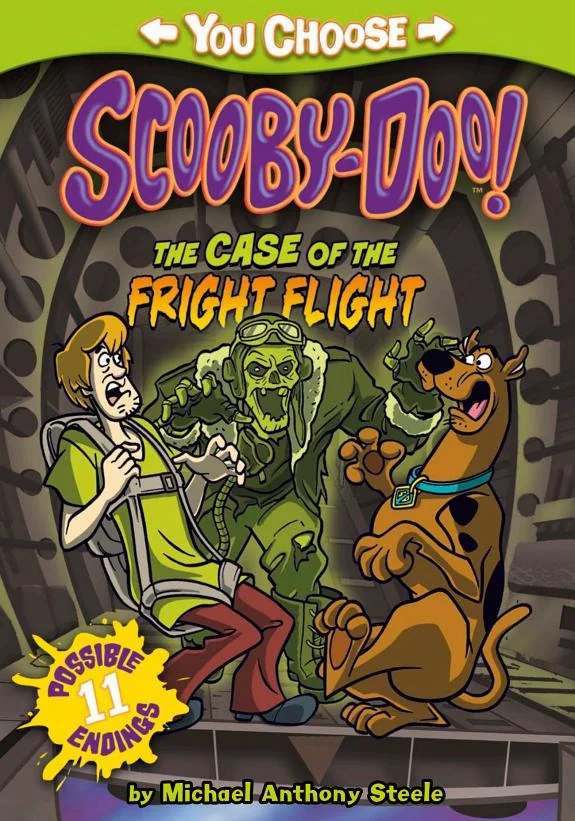
Case of the Fright Flight
 75
75

Case of the Fright Flight
Michael Anthony Steele’s "Case of the Fright Flight" offers a novel twist on the classic Scooby-Doo formula by placing agency squarely in the reader's hands. This interactive approach, a departure from passive consumption, is the book's most significant strength, transforming a familiar mystery into a personalized investigation. The inclusion of a World War II bomber adds a compelling historical layer, though the supernatural element feels somewhat conventional within the franchise's established tropes. A particularly effective passage involves the reader choosing whether the gang investigates the plane's cockpit or its bomb bay first, directly impacting the subsequent clues they uncover. While the narrative offers welcome engagement, the mystery's resolution, dependent on reader choice, can sometimes feel less cohesive than a curated plot. Nevertheless, for its innovative structure and familiar characters, "Case of the Fright Flight" provides an engaging experience for its target audience.
📝 Description
75
Michael Anthony Steele’s 2023 book places readers inside a supernatural aviation mystery.
In "Case of the Fright Flight," readers actively participate in solving a mystery involving a haunted World War II bomber plane. The story unfolds at an airshow, bringing the Scooby-Doo gang face-to-face with an unusual aerial phenomenon. The book’s core design lets readers make choices that shape the events and determine how the mystery concludes. This approach turns reading into a deductive process where different decisions lead to varied outcomes. The narrative uses the historical backdrop of World War II aviation to ground the supernatural elements, creating intrigue by connecting the present mystery to the past. The presence of a haunted bomber echoes classic ghost stories and the lasting impact of wartime artifacts. This interactive format appeals to young investigators and fans of mystery stories that mix adventure with the uncanny. It provides an accessible way for children, including reluctant readers, to practice critical thinking and decision-making within a familiar context.
While not a traditional esoteric text, "Case of the Fright Flight" taps into the popular occult trope of lingering psychic imprints or hauntings. The concept of a "haunted" machine, particularly from a period of intense human conflict like World War II, aligns with beliefs that objects can absorb emotional energy and manifest paranormal activity. The bomber plane acts as a vessel for past trauma or unresolved energies, a common theme in ghost lore and spiritualist traditions. The story uses this framework to create a mystery that blends the tangible historical setting with the intangible forces of the supernatural, inviting young readers to consider how the past can influence the present.
💡 Why Read This Book?
• You will learn to make critical choices that directly influence narrative outcomes, a skill honed by deciding the Mystery Inc. gang's next move in response to the haunted WWII bomber. • You will experience the unique satisfaction of actively solving a mystery, a feeling amplified by piecing together clues related to the 2016 publication's specific interactive plot points. • You will engage with a familiar fictional world in an entirely new way, becoming an active participant in the Scooby-Doo universe by guiding the gang's investigation of the fright flight.
⭐ Reader Reviews
Honest opinions from readers who have explored this book.
❓ Frequently Asked Questions
What is the main premise of "Case of the Fright Flight"?
The book features Scooby-Doo and the Mystery Inc. gang encountering a haunted World War II bomber plane during an airshow. The reader actively participates in deciding how the mystery unfolds and is solved.
Who is the author of "Case of the Fright Flight"?
The author is Michael Anthony Steele. The book was first published in 2016.
What makes this book different from other Scooby-Doo stories?
Its primary distinction is the interactive format. Readers make choices that determine the direction of the plot and the ultimate resolution of the mystery, unlike traditional linear narratives.
What historical elements are present in the book?
The story incorporates a World War II bomber plane, grounding the supernatural mystery in a specific historical context related to aviation from that era.
What age group is "Case of the Fright Flight" intended for?
It is primarily aimed at young readers, particularly fans of Scooby-Doo, who enjoy mystery stories and interactive or choose-your-own-adventure style books.
Can the reader truly influence the entire story?
Yes, the interactive nature means the reader's decisions guide the investigation, affecting the clues discovered and the path taken by the Mystery Inc. gang towards solving the case.
🔮 Key Themes & Symbolism
Reader Agency in Narrative
The book foregrounds the concept of reader agency, transforming the act of reading into an active process of decision-making. Unlike static narratives, "Case of the Fright Flight" empowers the audience to steer the plot, choosing investigative paths and influencing outcomes. This interactive mechanic transforms the reader into a collaborator in solving the mystery of the haunted WWII bomber, making the experience deeply personal and engaging. It challenges the traditional author-reader dynamic by distributing narrative control, encouraging critical thinking and consequence awareness through the choices presented.
The Lingering Past
The presence of a haunted World War II bomber plane taps into the theme of the past's persistent influence on the present. This element evokes a sense of historical resonance, suggesting that events and emotions from wartime can leave an indelible mark. The spectral aircraft serves as a tangible manifestation of this theme, embodying unresolved energies or echoes from its operational past. The mystery surrounding its haunting invites exploration into how historical contexts, particularly those associated with conflict and machinery like a bomber from the 1940s, can manifest in contemporary settings.
Mystery and Supernatural Elements
Fundamentally, the book explores classic mystery tropes through the lens of the supernatural, a hallmark of the Scooby-Doo universe. The haunted bomber introduces an element of the uncanny, prompting questions about the nature of ghosts and unexplained phenomena. The narrative encourages the reader to engage in deduction, separating potential supernatural occurrences from rational explanations, even within a framework that accepts spectral presences. This blend of the rational detective work of Mystery Inc. with the unexplained creates a unique tension.
Aviation and Technology
The specific inclusion of a World War II bomber plane highlights themes related to aviation and historical technology. The aircraft itself becomes a central character and locus of mystery. Its design, function, and historical context (WWII) are integral to the plot. The book uses this piece of machinery, a product of mid-20th-century engineering, as a vessel for supernatural events, contrasting the mechanical with the ethereal. This juxtaposition invites reflection on how powerful technologies can become imbued with symbolic meaning or perceived spectral energy.
💬 Memorable Quotes
Direct passages from the work, attributed to the author.
“It's up to the reader to decide how the mystery unfolds.”
— This core statement emphasizes the book's interactive design, positioning the reader as an active participant rather than a passive observer. It highlights the unique agency granted to the audience in shaping the narrative's direction and resolution.
“Scooby-Doo and the Mystery Inc. gang encounter a haunted World War II bomber plane.”
— This concisely sets the scene and introduces the central conflict: the familiar characters facing a supernatural challenge linked to a specific historical artifact, the WWII bomber.
“During an airshow...”
— This establishes the immediate setting, an airshow, providing a vibrant and potentially chaotic backdrop for the appearance of the mysterious, haunted aircraft and the subsequent investigation.
💡 Key Ideas
Editorial paraphrase of the work's core concepts — not direct quotes.
The reader must choose the gang's next step.
This paraphrased concept underscores the interactive mechanic, illustrating how the reader's choices directly influence the investigative process and the progression of the plot.
What secrets does the old bomber hold?
This paraphrased question captures the central enigma of the book, focusing the reader's attention on the haunted World War II aircraft and the mysteries it conceals.
🌙 Esoteric Significance
Tradition
This work does not align with any specific esoteric tradition like Hermeticism or Gnosticism. Its "esoteric" classification likely stems from its engagement with the uncanny and the supernatural, common themes in children's mystery fiction rather than formal occult studies. The presence of a "haunted" object and the investigation of unexplained phenomena touch upon archetypal narratives found across various spiritual and folk traditions, but lack a defined lineage or systematic framework.
Symbolism
The central symbol is the World War II bomber plane. In a broader sense, aircraft from this era can symbolize technological advancement, the destructive power of war, and the lingering presence of past conflicts. The "haunting" suggests that this specific machine carries an imprint of its history or the energies associated with wartime trauma. The Mystery Inc. gang, as symbols of rational inquiry and youthful courage, represent the human drive to confront and understand the unknown, even when it appears supernatural.
Modern Relevance
While not directly influential on contemporary esoteric movements, "Case of the Fright Flight" reflects a modern appetite for interactive storytelling and a continued interest in the supernatural as a genre for engaging younger audiences. Its relevance lies in its demonstration of how familiar narratives can be adapted to incorporate reader agency, a trend seen across digital games and interactive media. The book’s engagement with historical artifacts like WWII planes also echoes a broader cultural fascination with history and its potential to inform present-day mysteries.
👥 Who Should Read This Book
• Young fans of Scooby-Doo seeking an interactive mystery they can influence. • Children interested in aviation and historical elements woven into adventure stories. • Reluctant readers looking for an engaging format that requires active participation and decision-making.
📜 Historical Context
Published in 2016, "Case of the Fright Flight" emerged in a media landscape saturated with franchise reboots and interactive entertainment. While the Scooby-Doo franchise itself has a long history dating back to 1969, Steele's work taps into a modern trend of reader-response and "choose your own adventure" style narratives, which saw a resurgence in the 2010s. This approach contrasts with earlier, more linear adaptations of the franchise. The use of a World War II bomber plane situates the mystery within a historical period that continues to hold cultural fascination, often explored in various media. Unlike purely fantastical narratives, the specific grounding in WWII aviation provides a concrete element that distinguishes it from purely speculative fiction. Reception of such interactive children's books generally focuses on engagement and educational value, rather than critical literary analysis.
📔 Journal Prompts
The haunted World War II bomber's presence at the airshow.
The reader's choices in the investigation of the fright flight.
The contrast between the rational Mystery Inc. and the spectral phenomenon.
The historical context of the bomber plane.
How the reader's decisions shape the narrative's conclusion.
🗂️ Glossary
Mystery Inc. gang
The core group of teenage detectives and their dog from the Scooby-Doo franchise, known for solving mysteries involving supernatural pretenders.
Airshow
A public event where aircraft perform aerial displays and maneuvers, often featuring historical planes and demonstrations of flight.
Haunted
Describing a place or object believed to be inhabited by a ghost or supernatural entity, often associated with past events or strong emotions.
World War II bomber
A military aircraft designed during World War II specifically for the purpose of dropping bombs on targets.
Interactive narrative
A story format where the reader makes choices that affect the plot's progression and outcome, also known as a 'choose your own adventure' style.
Fright Flight
A descriptive term used in the book's title to imply a frightening or spectral aerial experience associated with the mystery.
Reader agency
The degree to which a reader can influence or control the narrative or outcome of a story, particularly in interactive formats.
This book appears in 1 collection
🔮 Readers Also Liked
Browse all →









From the “Ghosts” Collection
View all →






More Free Spiritualism & Afterlife Books
View all →