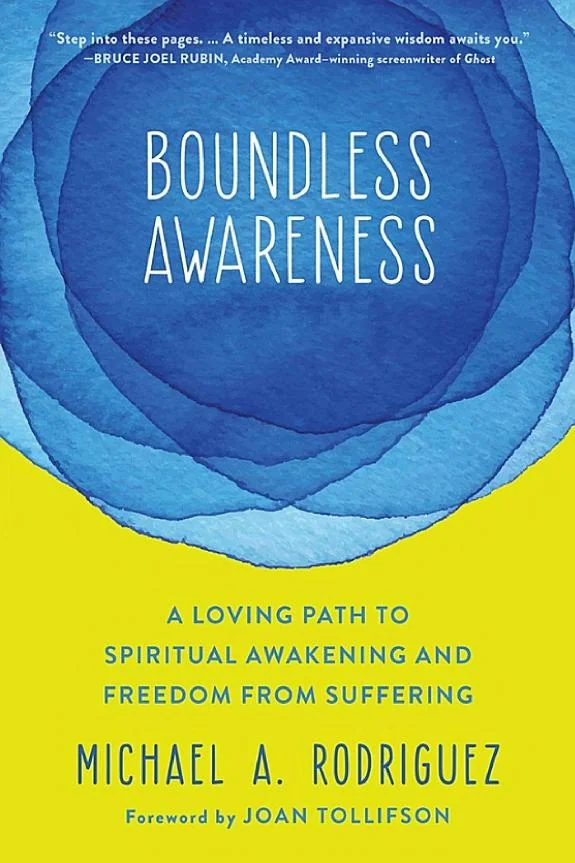
Boundless Awareness
 76
76

Boundless Awareness
Rodriguez's "Boundless Awareness" tackles the perennial problem of suffering with a refreshing directness. The author bypasses elaborate metaphysical frameworks to point straight at the experiential reality of consciousness. His strength lies in the clear, unpretentious prose that makes complex ideas accessible. The practical exercises, particularly those guiding readers to observe the nature of thoughts and emotions without identification, are well-structured and effective. However, the book occasionally tends towards oversimplification, particularly when addressing the integration of past traumas. While it correctly identifies the limitations of the ego, the process of "deconstructing self-delusions" could benefit from more nuanced guidance on navigating deeply ingrained patterns. The passage discussing the nature of attachment, though brief, highlights the book's core aim: to reveal an unshakeable peace beneath the surface of personal narratives. Ultimately, "Boundless Awareness" offers a potent, experience-oriented path for those weary of seeking solace externally.
📝 Description
76
Michael A. Rodriguez's 2018 book, "Boundless Awareness," teaches direct recognition of the self as unbounded consciousness.
Published in 2018, "Boundless Awareness" by Michael A. Rodriguez offers a direct path to spiritual liberation. The book focuses on recognizing oneself as pure, unbounded consciousness, moving away from abstract beliefs or complex rituals. Rodriguez aims to help readers lessen their identification with a limited ego, showing the peace and love that exist in fundamental awareness.
This book is for people feeling constant unease, anxiety, or unhappiness, especially those held back by their past, trauma, or emotional pain. It suits individuals ready to go beyond standard self-help or spiritual paths based on dogma. They seek an immediate, felt experience of their true nature. Those familiar with non-dual philosophies will find its ideas resonate.
Emerging in 2018, "Boundless Awareness" appeared during a time of growing interest in secular mindfulness and non-dual traditions. Unlike many books focusing on mindfulness for therapy, Rodriguez's work directly addresses the nature of selfhood. It draws implicitly from traditions like Advaita Vedanta and Western contemplative thought. The book's accessible language aims to connect esoteric teachings with modern life's common stresses, similar to how authors like Rupert Spira and Francis Lucille approach these subjects.
💡 Why Read This Book?
• You will learn to directly experience your own being as "abiding, loving, boundless awareness," a concept central to the book, offering a potent antidote to existential unease. • You will gain practical techniques for deconstructing "self-delusions," enabling you to release the grip of ego-centric suffering, a core aim articulated by Rodriguez. • You will understand how to integrate traumatic experiences and emotional attachments not as obstacles, but as phenomena witnessed within the vastness of awareness, a unique perspective offered since its 2018 publication.
⭐ Reader Reviews
Honest opinions from readers who have explored this book.
❓ Frequently Asked Questions
What is the core message of Michael A. Rodriguez's 'Boundless Awareness'?
The core message is that true freedom from suffering comes from recognizing your essential nature as boundless, loving awareness, rather than identifying with the limited ego or personal history.
Are there practical exercises in 'Boundless Awareness'?
Yes, the book includes practical exercises and meditations designed to guide readers toward direct experience of their true nature and to help deconstruct self-limiting beliefs.
Who is the intended audience for this book?
It is for individuals seeking relief from suffering, spiritual awakening, and a deeper understanding of self, particularly those open to non-dualistic perspectives and direct experiential realization.
When was 'Boundless Awareness' first published?
The book was first published on April 1, 2018.
How does this book differ from typical self-help or spiritual guides?
It focuses on direct experience and recognition of inherent awareness, rather than relying on belief systems, affirmations, or complex philosophical doctrines, aiming for a fundamental shift in self-perception.
Does the book address dealing with past traumas?
Yes, the book guides readers to understand how traumatic experiences and emotional attachments can be viewed and integrated from the perspective of boundless awareness, rather than being seen as insurmountable barriers.
🔮 Key Themes & Symbolism
The Nature of Awareness
This theme explores the concept of consciousness as the fundamental reality of existence. Rodriguez posits that awareness is not something we possess, but rather what we are. It is described as inherently peaceful, loving, and unlimited, independent of any personal experiences or mental content. The work encourages readers to shift their identification from the transient phenomena of thought and emotion to this stable, underlying ground of being, moving away from the illusion of a separate, isolated self.
Deconstruction of Self-Delusion
Central to the book's approach is the identification and dismantling of 'self-delusions' – the mistaken beliefs and identifications that create the sense of a limited, vulnerable ego. These delusions often stem from conditioning, past traumas, and societal influences. Rodriguez provides methods to observe these patterns without judgment, revealing their impermanent and constructed nature. The goal is to see through the false self, thereby dissolving the suffering that arises from its perceived limitations and fragility.
Integration of Experience
Rather than advocating for the suppression or denial of difficult emotions or traumatic memories, 'Boundless Awareness' suggests their integration within the larger context of consciousness. The book guides readers to recognize that these experiences, while potent, occur within and are witnessed by the boundless awareness. This perspective reframes suffering not as an inherent quality of experience, but as a product of misidentification. By seeing emotions and memories as temporary events in awareness, their power to define and limit the self is diminished.
Spiritual Awakening as Recognition
The book frames spiritual awakening not as an achievement or acquisition of new knowledge, but as a direct recognition of what already is. It posits that the peace and love associated with spiritual realization are not external states to be attained, but the inherent qualities of our true nature, obscured by the ego's narrative. Through practical application, readers are invited to 'wake up' to this ever-present reality, moving from a conceptual understanding to a lived, felt experience of wholeness.
💬 Memorable Quotes
Direct passages from the work, attributed to the author.
“Suffering arises from the belief in a separate self.”
— This highlights the book's central thesis: that the pain and anxiety we experience are rooted in our identification with a limited, isolated ego, rather than our true nature.
“Look directly at the experiencer, not just the experience.”
— This points to a practical exercise within the book, encouraging readers to turn their attention inward to the source of perception, rather than solely focusing on the objects or events being perceived.
“Love is not an emotion to be felt, but the very nature of awareness.”
— This interpretation challenges conventional understanding of love, presenting it as an intrinsic quality of our being, rather than a fleeting feeling dependent on external circumstances.
“The past and future exist only as thoughts in the present awareness.”
— This concept encourages radical presence, suggesting that our preoccupation with past regrets or future anxieties is a mental construct that can be observed and relinquished within the immediacy of the present moment.
💡 Key Ideas
Editorial paraphrase of the work's core concepts — not direct quotes.
The self is not a thing, but the space in which all things appear.
This quote emphasizes the non-dualistic perspective presented in the book, suggesting that our core identity is not the content of our experience (thoughts, feelings, body) but the awareness that perceives it all.
🌙 Esoteric Significance
Tradition
The work aligns with non-dualistic traditions, particularly Advaita Vedanta, emphasizing the identity of the individual self (Atman) with the ultimate reality (Brahman). It also echoes aspects of certain Western contemplative paths that focus on the immanence of the divine or absolute within consciousness. Rodriguez departs from more ritualistic or dogmatic esoteric systems by prioritizing direct, unmediated experience over prescribed practices or belief structures.
Symbolism
While not heavily reliant on overt symbolism, the book uses the concept of 'space' metaphorically to represent awareness – vast, empty, yet containing all phenomena. The 'light' often associated with awakening in esoteric literature functions implicitly as the inherent radiance or knowing quality of consciousness itself. The 'boundless' nature points to the dissolution of perceived limitations, a common motif in mystical experiences across traditions.
Modern Relevance
Rodriguez's approach is highly relevant to contemporary mindfulness and secular spirituality movements, offering a direct experiential path that complements or challenges therapeutic applications of awareness. Thinkers and practitioners exploring embodied consciousness, radical presence, and the limitations of cognitive self-understanding find resonance here. It informs modern non-dual inquiry, particularly among those seeking to integrate spiritual realization into everyday life without adherence to specific religious or cultural doctrines.
👥 Who Should Read This Book
• Individuals experiencing existential unease or persistent dissatisfaction, seeking relief from the burdens of personal history and emotional turmoil. • Students of non-dual philosophies (like Advaita Vedanta or Zen) interested in direct experiential pointers rather than purely intellectual understanding. • Seekers ready to move beyond conventional self-help or therapeutic models, looking for a fundamental shift in their perception of self and reality.
📜 Historical Context
Published in 2018, "Boundless Awareness" emerged within a landscape increasingly receptive to contemplative practices and non-dual philosophies, often presented in secularized or psychologically-oriented frameworks. While authors like Eckhart Tolle had popularized similar themes of presence and ego-transcendence, Rodriguez's work maintained a distinct focus on direct experiential recognition of awareness itself, drawing implicitly from traditions like Advaita Vedanta. It arrived at a time when online spiritual communities and accessible books were making these teachings more widely available, contrasting with the more guarded dissemination of such ideas in earlier eras. Contemporary authors such as Rupert Spira were also exploring similar non-dual territory, often engaging with philosophical underpinnings that Rodriguez largely bypassed in favor of direct pointing. The book's accessible style positioned it as a bridge between esoteric concepts and a general audience grappling with modern anxieties, avoiding the more academic or culturally specific language found in older spiritual texts.
📔 Journal Prompts
Reflect on the nature of 'boundless awareness' as the space for your thoughts.
Identify a 'self-delusion' that causes you suffering and observe its origins.
How does recognizing your awareness as loving change your response to difficult emotions?
Explore the feeling of 'abiding' in the present moment, independent of circumstances.
Consider an attachment or past experience as a phenomenon within awareness.
🗂️ Glossary
Boundless Awareness
The fundamental nature of reality and consciousness, described as unlimited, unchanging, and inherently loving, which is the true self.
Self-Delusion
The mistaken identification with the ego, personal history, thoughts, and emotions, leading to a false sense of separation and suffering.
Spiritual Awakening
The direct recognition and realization of one's true nature as boundless awareness, leading to liberation from suffering.
Ego
The constructed sense of a separate, individual self, characterized by personal narratives, beliefs, and identifications.
Integration
The process of understanding and accepting experiences, including trauma and emotions, from the perspective of boundless awareness, rather than being identified with them.
Abiding
Remaining present and stable within one's true nature, independent of the flux of thoughts, feelings, or external events.
Direct Experience
Knowing or realizing something through immediate perception and presence, rather than through conceptual thought or belief.
This book appears in 1 collection
🔮 Readers Also Liked
Browse all →








From the “Dream Yoga” Collection
View all →








More Free Occult Philosophy Books
View all →