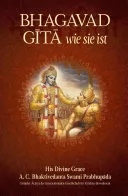
Bhagavad-gita wie sie ist
 73
73

Bhagavad-gita wie sie ist
A. C. Bhaktivedanta Swami Prabhupada's rendition of the Bhagavad Gita, "Bhagavad-gita As It Is," presents a specific interpretation rooted in the Gaudiya Vaishnava tradition. The strength of this translation lies in its devotional fervor and consistent thematic emphasis on Krishna as the Supreme Personality of Godhead. Prabhupada's commentary, while extensive, can sometimes feel repetitive, reiterating the same theological points across different chapters. A concrete example of this is the persistent focus on karma yoga as a means to devotional service, which, while central, might overshadow other valid interpretations of the Gita's diverse philosophical strands. The scholarly reader might wish for a more comparative approach to the text's vast interpretive history, but for those seeking a deeply devotional exegesis, this edition offers a focused and passionate engagement with the scripture.
📝 Description
73
A. C. Bhaktivedanta Swami Prabhupada translated the Bhagavad Gita as It Is in 1968.
The Bhagavad Gita, meaning "Song of the Divine," is a Sanskrit scripture central to Hindu philosophy. It records a conversation between Prince Arjuna and Lord Krishna on the battlefield of Kurukshetra. The text discusses duty, devotion, and the nature of reality, offering guidance for various spiritual paths.
Composed between the 5th and 2nd centuries BCE, the Bhagavad Gita emerged during a time of intellectual and religious change in ancient India. It combines ideas from Upanishadic thought, Samkhya, and Yoga philosophies. Its place within the epic Mahabharata helped it spread widely and become part of the larger Hindu narrative, setting it apart from earlier Vedic hymns and rituals.
The Bhagavad Gita synthesizes elements from various Indian philosophical traditions, including Upanishadic thought, Samkhya, and Yoga. It articulates concepts such as Dharma, Karma, Bhakti, Jnana, and Moksha, and explores the relationship between the soul (Atman) and the Supreme Being (Brahman). The text details paths to spiritual realization, highlighting selfless action (Karma Yoga) and loving devotion (Bhakti Yoga) as effective means.
💡 Why Read This Book?
• Understand the concept of Dharma as presented by Krishna to Arjuna on the battlefield of Kurukshetra, gaining insight into fulfilling one's prescribed duties with detachment. • Explore the nature of Karma Yoga, the path of selfless action, as detailed in the Bhagavad Gita, learning how to act without attachment to results. • Grasp the significance of Bhakti Yoga, the path of devotion, as elucidated in the Gita's dialogues, offering a direct route to spiritual connection.
⭐ Reader Reviews
Honest opinions from readers who have explored this book.
❓ Frequently Asked Questions
What is the historical period when the Bhagavad Gita was likely composed?
The Bhagavad Gita is generally believed to have been composed between the 5th and 2nd centuries BCE, a period of significant philosophical development in ancient India, integrating earlier Vedic and Upanishadic ideas.
Who are the main characters in the Bhagavad Gita?
The primary speakers are Lord Krishna, considered the Supreme Personality of Godhead, and His friend and disciple, Prince Arjuna, who faces a moral dilemma on the battlefield of Kurukshetra.
What is the central message of the Bhagavad Gita?
Its central message revolves around understanding one's duty (Dharma), the nature of the soul, and the various paths to spiritual liberation, emphasizing selfless action, devotion, and knowledge.
How does the Bhagavad Gita relate to the Mahabharata?
The Bhagavad Gita forms a section within the epic Mahabharata, specifically the Bhishma Parva, presenting a philosophical discourse that occurs just before the great war begins.
What does "Bhagavad Gita" literally translate to?
The title "Bhagavad Gita" literally translates from Sanskrit to "Song of the Divine" or "Song of the Lord."
What are the main yogic paths discussed in the Gita?
The text extensively discusses Karma Yoga (the path of action), Bhakti Yoga (the path of devotion), and Jnana Yoga (the path of knowledge) as routes to spiritual realization.
🔮 Key Themes & Symbolism
Dharma and Duty
The text profoundly examines Dharma, often translated as duty or righteousness, as the core principle governing existence. Arjuna's crisis on the battlefield of Kurukshetra serves as the catalyst for Krishna's discourse on fulfilling one's prescribed duties without attachment to personal outcomes. This concept extends beyond mere social roles to an innate, cosmic order, emphasizing the importance of performing actions aligned with one's spiritual nature and societal position for maintaining balance and achieving inner harmony.
The Nature of the Soul (Atman)
A central tenet is the eternal, unchanging nature of the soul (Atman). Krishna explains to Arjuna that the soul is unborn, undying, and unaffected by birth or death, unlike the temporary physical body. This understanding is presented as crucial for overcoming fear and attachment to worldly concerns. The Gita posits that realizing the Atman's true identity leads to liberation from the cycle of birth and death (samsara).
Paths to Liberation
The Bhagavad Gita outlines multiple paths to achieve Moksha, or spiritual liberation. It elaborates on Karma Yoga, the path of selfless action performed without expectation of reward; Bhakti Yoga, the path of intense devotion and surrender to the Divine; and Jnana Yoga, the path of knowledge and philosophical inquiry into the nature of reality. Krishna often emphasizes the interconnectedness of these paths, suggesting that sincere practice in one can lead to proficiency in others.
The Supreme Being
The identity and nature of the Supreme Being are extensively discussed, with Krishna revealing Himself as the ultimate reality and source of all existence. The text presents a monotheistic understanding where the Divine is both transcendent and immanent, the creator, sustainer, and destroyer of the cosmos. This perspective elevates devotion (Bhakti) as a direct and potent means of attaining union with the Divine.
💬 Memorable Quotes
Direct passages from the work, attributed to the author.
““The living entities in this material world are eternally the servants of Me.””
— This statement highlights a core theological assertion of the text, positing a hierarchical spiritual relationship where all beings are fundamentally connected to and dependent upon the Divine, emphasizing service as a natural state.
““One who has taken his birth is sure to die, and after death one is sure to take birth again.””
— This verse addresses the cyclical nature of existence, the transmigration of the soul, and the inevitability of death and rebirth within the material realm, framing the spiritual quest as a means to transcend this cycle.
““Engage yourself in the prescribed duties, for by doing work, one is certainly advanced.””
— This principle underscores the importance of Karma Yoga, advocating for diligent performance of one's responsibilities as a means of spiritual progress, irrespective of the fruits of labor.
““One who sees inaction in action and action in inaction is intelligent among men.””
— This enigmatic verse points to the subtle understanding of action and inaction required for true spiritual insight, suggesting that one must perceive the underlying spiritual reality beyond superficial activity.
““By devotion one can understand Me as I am, knowing Me directly, and by such understanding one can enter into My kingdom.””
— This highlights the supreme efficacy of Bhakti Yoga, asserting that through sincere devotion and love, one can achieve direct realization of the Divine and attain spiritual liberation.
🌙 Esoteric Significance
Tradition
The Bhagavad Gita is a cornerstone text for many traditions within Hinduism, particularly Vaishnavism. Esoterically, it aligns with yogic and Vedantic lineages that seek direct experience of the Absolute. Its emphasis on inner transformation, the nature of consciousness, and the interconnectedness of the microcosm and macrocosm places it within a broader pan-Indian esoteric framework that predates and influences later Indian Tantric and Siddha traditions.
Symbolism
Key symbols include the battlefield of Kurukshetra, representing the human consciousness where internal conflicts between duty and desire manifest. Krishna's chariot symbolizes the human body, with the senses as horses, the mind as the reins, and the intellect as the driver, all guided by the soul. The concept of the lotus-eyed Krishna signifies divine perception and the unfolding of spiritual awareness.
Modern Relevance
Contemporary spiritual seekers, yoga practitioners, and scholars of comparative religion frequently engage with the Bhagavad Gita. Its principles of Karma Yoga and mindfulness have influenced modern yoga movements globally. Thinkers and authors in the New Age and self-help genres often draw upon its teachings on detachment, inner peace, and finding purpose, demonstrating its enduring relevance in contemporary spiritual discourse.
👥 Who Should Read This Book
• Students of Eastern philosophy and comparative religion seeking to understand the foundational texts of Hinduism and their influence on global thought. • Yoga practitioners interested in the philosophical underpinnings of their practice, particularly the concepts of Karma Yoga and the nature of the self. • Individuals grappling with ethical dilemmas and seeking a framework for understanding duty, purpose, and righteous action in their lives.
📜 Historical Context
The Bhagavad Gita, likely composed between the 5th and 2nd centuries BCE, emerged during a dynamic period in ancient Indian intellectual history. It synthesized diverse philosophical currents, drawing from the Upanishads, Samkhya, and early Yoga traditions. This period saw a flourishing of heterodox movements like Buddhism and Jainism, which offered alternative paths to liberation, challenging the established Brahmanical rituals. The Gita's integration into the vast epic Mahabharata, specifically the Bhishma Parva, was crucial for its survival and widespread adoption, providing a narrative framework that made its complex philosophical teachings accessible. Its discourse on duty and spiritual practice offered a compelling synthesis that resonated broadly, securing its place as a primary scripture within Hinduism, distinct from the earlier Vedic hymns and ritualistic Brahmanas.
📔 Journal Prompts
Arjuna's dilemma on the battlefield: Reflect on a moment when duty conflicted with personal inclination.
The nature of the Atman: Consider the distinction between your physical form and your enduring consciousness.
Karma Yoga in practice: How can daily tasks be performed with detachment from their outcomes?
Krishna's divine manifestations: Contemplate the concept of the Supreme Being as the source of all existence.
The three paths: Explore which path—action, devotion, or knowledge—currently calls most strongly to you.
🗂️ Glossary
Atman
The eternal, unchanging self or soul, considered to be the true essence of an individual, distinct from the physical body and mind.
Brahman
The ultimate reality, the supreme cosmic spirit, the ground of all being in Hindu philosophy, often understood as the impersonal Absolute.
Dharma
One's duty, righteousness, moral law, or essential nature; the principle that upholds cosmic order and individual conduct.
Karma
Action, work, or deed, and its resulting consequences; the law of cause and effect that governs the cycle of rebirth.
Moksha
Liberation or release from the cycle of birth, death, and rebirth (samsara); spiritual salvation.
Samsara
The continuous cycle of birth, death, and reincarnation, driven by karma and ignorance, from which liberation (moksha) is sought.
Yoga
A spiritual discipline or path aimed at uniting the individual consciousness with the Divine or ultimate reality; includes paths like Karma, Bhakti, and Jnana Yoga.