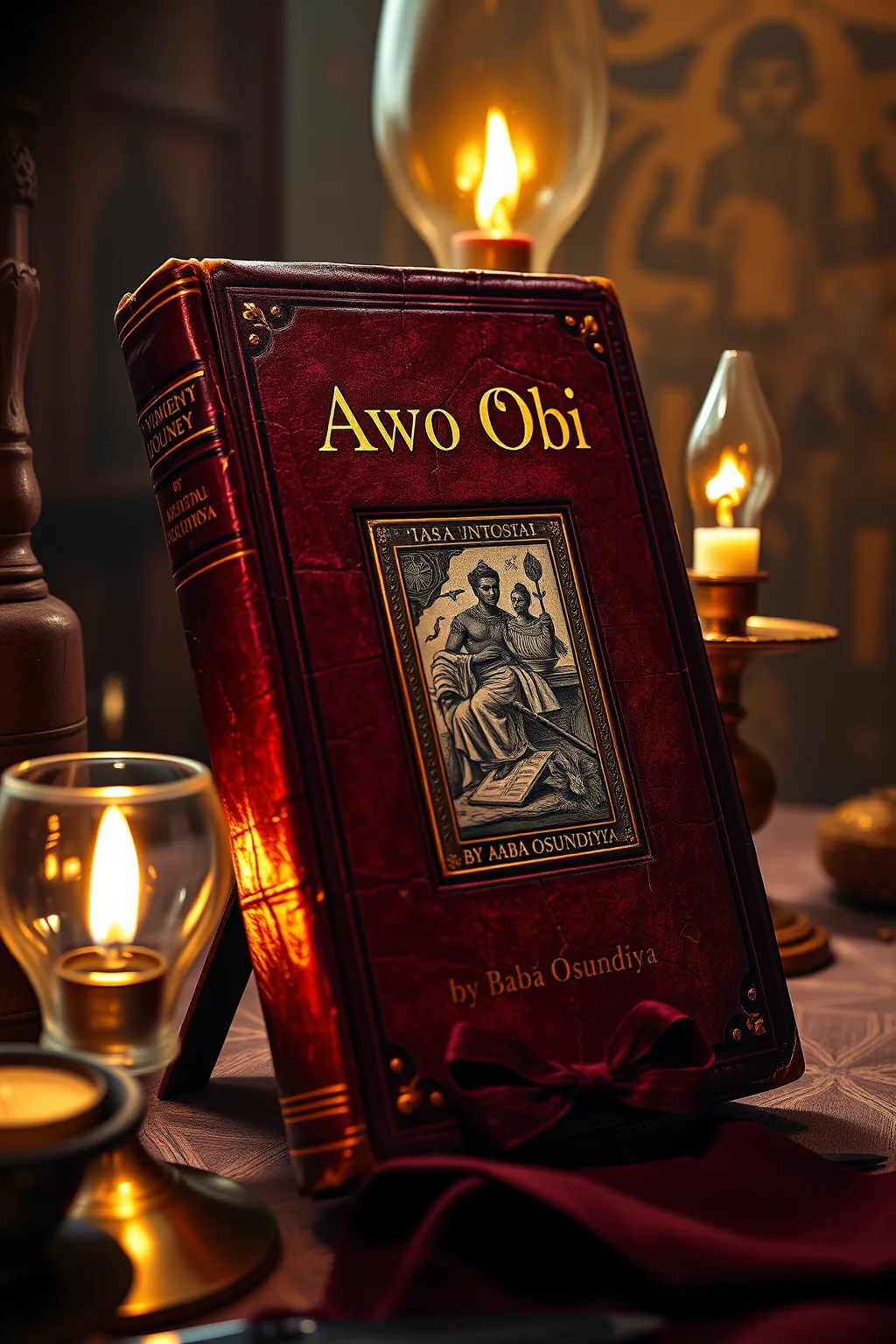
Awo Obi
 78
78

Awo Obi
Baba Osundiya's 'Awo Obi' presents a sober, direct exposition of Ifa divination, eschewing hyperbole for clarity. The work succeeds in its primary aim: to codify and explain the practical mechanics of the divination process. Its strength lies in the detailed, step-by-step descriptions of rituals and the interpretation of signs, offering a valuable resource for practitioners and scholars alike. The initial publication in 2001 provided much-needed textual grounding for a tradition deeply rooted in oral transmission. However, the book's density can be a barrier; the sheer volume of technical detail, while essential, might overwhelm readers not already immersed in the practice. A particular passage detailing the sequence of casting the 'opele' chain offers a clear example of the text's practical, instructional focus. While invaluable for its specificity, readers seeking a more philosophical or comparative overview might find it lacking broader contextualization. For serious students of Ifa, 'Awo Obi' is an indispensable, albeit demanding, reference.
📝 Description
78
Baba Osundiya published 'Awo Obi' in 2001, a text detailing Ifa divination.
Published in 2001, Baba Osundiya's 'Awo Obi' addresses the spiritual and practical aspects of Ifa divination. The book moves beyond simple theory to engage directly with Ifa's core principles and methods. It guides both initiates and scholars through the complex divination systems, the sacred verses known as ese Ifa, and the spiritual forces that are invoked. A primary goal of this work is to clarify elements of Ifa traditionally passed down orally, serving as a written reference for those wishing to deepen their understanding and practice.
This volume is primarily for Ifa practitioners, especially those in initiation or aiming to improve their grasp of divination protocols. It also speaks to scholars of African Traditional Religions, comparative mythology, and anthropology who need a detailed and reliable source on Ifa systems. Individuals interested in West African spiritual traditions, Yoruba cosmology, and the philosophical basis of divination will find 'Awo Obi' a valuable resource. The book is intended for those seeking an accurate and academic approach to these sacred arts.
The 2001 release of 'Awo Obi' coincided with a resurgence of global interest in African Traditional Religions, a time when many such practices had faced suppression. While Ifa's transmission has always been primarily oral, the early 21st century highlighted a growing need for written materials to support the diaspora and academic research. The book provides a structured alternative to more general or sometimes misleading accounts of Ifa found in popular writing. It aims to represent the tradition from an internal perspective, catering to scholars and practitioners who require more precise information than was generally available, particularly regarding specific elements of the tradition.
Awo Obi is situated within the rich tradition of Ifa, a complex divination system originating with the Yoruba people of West Africa. Ifa is not merely a method of fortune-telling but a comprehensive spiritual and philosophical framework. It encompasses cosmology, ethics, history, and healing, all encoded within a vast corpus of poetry and prose (ese Ifa). The tradition relies heavily on the babalawo (male diviners) or iyanifa (female diviners) who interpret the patterns cast through various instruments, often connecting the client with spiritual forces and ancestral guidance. This book contributes to the written documentation of a tradition historically preserved through oral transmission and initiation.
💡 Why Read This Book?
• Gain a precise understanding of the divination process, including the specific casting techniques and interpretation of the 'Odu' as detailed in the text, offering a level of procedural clarity not found in general spiritual guides. • Learn the foundational role of 'Obi' as a divinatory tool and its symbolic connection to communication with the divine, providing a concrete entry point into the specific symbolism of Ifa that informs its practice. • Understand the function and significance of the 'ese Ifa' (sacred verses) within the divination ritual, illustrating how these poetic narratives are actively employed in consultation, a practical application unique to Ifa studies.
⭐ Reader Reviews
Honest opinions from readers who have explored this book.
❓ Frequently Asked Questions
What is the primary focus of 'Awo Obi' by Baba Osundiya?
'Awo Obi' focuses on the practical and spiritual aspects of Ifa divination. It details the methodologies, sacred verses ('ese Ifa'), and the role of the diviner ('Babalawo') in communicating with spiritual forces, particularly Orunmila.
When was 'Awo Obi' first published, and why is this significant?
The book was first published in 2001. This date is significant as it marks a period of increasing scholarly and diasporic interest in African Traditional Religions, providing a much-needed written resource for a tradition primarily transmitted orally.
Who would benefit most from reading 'Awo Obi'?
Practitioners of Ifa, initiates seeking to deepen their knowledge, scholars of African Traditional Religions, and anthropologists studying divination systems would benefit most from this detailed guide.
Does 'Awo Obi' explain the use of the 'opele' divination chain?
Yes, the work provides detailed explanations of the divination process, which includes the use of tools like the 'opele' (divination chain) and the interpretation of the signs it produces within the Ifa system.
What are 'ese Ifa' as discussed in 'Awo Obi'?
'Ese Ifa' are the sacred verses, poems, or songs within the Ifa tradition. 'Awo Obi' explores their role as diagnostic and prescriptive tools used by the 'Babalawo' during divination sessions.
Is 'Awo Obi' suitable for someone completely new to Ifa?
While comprehensive, the book is quite technical. Newcomers might find it challenging without prior guidance, but its detailed explanations of concepts like 'Obi' and the 'Odu' offer a structured entry point for dedicated learners.
🔮 Key Themes & Symbolism
The Mechanics of Obi Divination
The core of 'Awo Obi' lies in its meticulous breakdown of the divination process using 'Obi' and the 'opele' chain. It elucidates the physical actions required, the sequencing of readings, and the foundational significance of the kola nut itself as a conduit. The text emphasizes that the correct execution of these physical steps is paramount for accurate spiritual communication, detailing how the fall of the 'Obi' or the pattern of the 'opele' directly translates into specific messages from Orunmila. This practical focus distinguishes it from purely theoretical explorations of divination.
Structure and Interpretation of Odu
'Awo Obi' systematically presents the 256 'Odu', the fundamental signs of Ifa divination. It goes beyond mere listing, offering insights into the hierarchical structure and the complex system of interpretation associated with each sign. The text explains how individual 'Odu' function as matrices of knowledge, containing narratives, proverbs, and prescriptions relevant to the inquirer's situation. Understanding the interplay between primary and secondary 'Odu' is presented as crucial for a comprehensive divination reading, making the 'Odu' the central organizing principle of the book's content.
The Role of the Babalawo
The book underscores the profound responsibility and specialized knowledge required of the 'Babalawo', the priest-diviner. Osundiya details the spiritual preparation, ethical considerations, and technical skills necessary for performing divination accurately and respectfully. The 'Babalawo' is portrayed not merely as a fortune-teller but as a spiritual counselor and custodian of ancestral wisdom, tasked with interpreting divine messages through the intricate language of Ifa. The text serves as a guide for aspiring 'Babalawo', outlining the path to mastery in this sacred office.
Ese Ifa as Spiritual Lexicon
Baba Osundiya highlights the 'ese Ifa' as the living scripture of the Ifa tradition. These poetic verses are presented not as static texts but as dynamic keys to understanding the 'Odu'. The book explains how specific 'ese Ifa' are recited and interpreted in context during a divination session, offering guidance, warnings, or solutions. The vast corpus of 'ese Ifa' is depicted as a comprehensive repository of Yoruba cosmology, ethics, and history, providing a rich source of wisdom for both the diviner and the supplicant.
💬 Memorable Quotes
Direct passages from the work, attributed to the author.
“The fall of the Obi is the voice of Orunmila speaking.”
— This statement emphasizes the sacred nature of the divination tool and the belief that the physical manifestation of the 'Obi's' casting directly conveys the wisdom of the divination deity, Orunmila.
“Each Odu is a world of wisdom, a map for the soul's journey.”
— This interpretation highlights the comprehensive and guiding nature of the Ifa divination signs ('Odu'), suggesting they offer clear insights and direction for an individual's life path.
“The ese Ifa are the ancient pathways to truth.”
— This highlights the function of the sacred verses ('ese Ifa') as a traditional and authoritative means of accessing spiritual knowledge and revelation within the Ifa system.
“To practice Awo Obi is to walk in balance between worlds.”
— This interpretation captures the essence of the practice as a mediating role, requiring the practitioner to skillfully engage with both the physical and spiritual realms.
💡 Key Ideas
Editorial paraphrase of the work's core concepts — not direct quotes.
The Babalawo must listen not just with ears, but with the heart and the spirit.
This paraphrased concept stresses the deep spiritual attunement and intuitive understanding required of a diviner, beyond simple auditory perception, to truly grasp the messages conveyed through Ifa.
🌙 Esoteric Significance
Tradition
This work is firmly rooted in the Ifa divination system, a central to Yoruba traditional religion originating in West Africa. Ifa is not merely a divinatory practice but a comprehensive spiritual and philosophical framework encompassing cosmology, ethics, healing, and ancestral veneration. 'Awo Obi' fits within this lineage by detailing the practical application of Ifa's divinatory aspect, emphasizing the connection to Orunmila, the deity of wisdom and divination, and the use of specific tools and verses that are integral to this ancient tradition.
Symbolism
The primary symbol explored is 'Obi', the kola nut, which serves as a direct means of communication with the divine. Its physical properties and the manner of its casting are imbued with symbolic meaning, representing messages and spiritual states. Another key motif is the 'Odu', the 256 divinatory signs, each a complex symbol representing archetypal forces, life situations, and cosmic principles. The 'ese Ifa', the sacred verses, function as symbolic narratives and prescriptions, acting as a symbolic lexicon for interpreting the divine will.
Modern Relevance
Contemporary practitioners of Ifa, particularly those in the diaspora seeking to maintain authentic practice, draw heavily on texts like 'Awo Obi' for foundational knowledge. Scholars of comparative religion and African studies continue to reference it for its detailed exposition of divination mechanics. Furthermore, modern spiritual movements that incorporate elements of West African spirituality often find in 'Awo Obi' a resource for understanding core principles of divination and cosmology, bridging the gap between ancestral knowledge and contemporary spiritual seeking.
👥 Who Should Read This Book
• Initiates and aspiring priests of Ifa seeking a comprehensive, text-based guide to the practical aspects of divination, including the correct use of 'Obi' and the interpretation of 'Odu'. • Scholars of African Traditional Religions and comparative mythology looking for an authoritative source on the mechanics and symbolism of the Ifa divination system. • Individuals interested in West African cosmology and spiritual practices who wish to understand the foundational role of divination in Yoruba culture and its relationship to deities like Orunmila.
📜 Historical Context
The publication of Baba Osundiya's 'Awo Obi' in 2001 arrived at a critical juncture for the study and practice of Ifa. The early 21st century witnessed a significant resurgence of interest in African Traditional Religions, both within Africa and in the diaspora, partly as a counter-narrative to colonial religious impositions and partly due to scholarly re-evaluation. While Ifa has a deep history, much of its intricate methodology had been primarily preserved through oral tradition, making written texts like 'Awo Obi' important for standardization and accessibility. This period saw scholars like Rowland Abiodun actively engaging with Yoruba cosmology and art, creating an intellectual climate receptive to detailed works on specific traditions. The book offered a counterpoint to more generalized or, at times, sensationalized accounts of African spirituality, aiming to provide an insider’s perspective on the complex divination system. Its emergence provided a crucial textual anchor for practitioners and academics seeking a precise understanding of Ifa's operational logic, especially concerning the use of 'Obi' and the interpretation of the 'Odu'.
📔 Journal Prompts
The physical casting of the Obi and its meaning.
Interpretation protocols for the 256 Odu.
The Babalawo's ethical responsibilities during divination.
Symbolic significance of the ese Ifa in practice.
Orunmila's role as depicted in Awo Obi.
🗂️ Glossary
Obi
Refers to the kola nut, a sacred fruit used in divination to communicate with the divine. Its falling pattern provides answers to questions posed during a ritual.
Babalawo
Literally 'father of secrets,' a highly initiated priest and diviner in the Ifa tradition, responsible for interpreting divine messages for the community.
Orunmila
The Yoruba Orisha (deity) of wisdom, knowledge, divination, and destiny. He is considered the primary source of Ifa divination wisdom.
Odu
The 256 major signs or chapters of the Ifa divination system. Each Odu contains vast amounts of symbolic information, verses, and prescriptions.
Ese Ifa
The sacred verses, poems, or chants associated with each Odu. They are narrative, didactic, and prescriptive, forming the core body of Ifa knowledge.
Opele
A divination chain consisting of eight halves of seeds or nuts, used by the Babalawo to cast divination signs.
Awo
Meaning 'secret' or 'mystery,' often referring to the hidden knowledge and practices within spiritual traditions like Ifa.
🔮 Readers Also Liked
Browse all →





![Paul Foster Case The Tarot ( A Key To The Wisdom Of The Ages)[ebook Pdf]](/img/thumb/paul-foster-case-the-tarot-a-key-to-the-wisdom-of-the-ages-ebook-pdf.webp)


More by Baba Osundiya
All books →
More Free Divination & Tarot Books
View all →