Atlantis and Other Lost Civilizations
 71
71

Atlantis and Other Lost Civilizations
Snedden's "Atlantis and Other Lost Civilizations" tackles a subject rife with both genuine historical inquiry and rampant speculation. The author’s strength lies in his methodical approach, attempting to sift through the layers of myth surrounding Plato's Atlantis and similar legends. He successfully highlights the enduring appeal of these narratives while consistently pointing towards the limitations of current evidence. For instance, the discussion comparing Plato's description with geological theories of sea-level rise offers a grounded perspective. However, the book occasionally feels constrained by its commitment to academic rigor, sometimes underserving the sheer wonder these stories evoke. The analysis of Lemuria, for example, feels more like a debunking than an exploration of its cultural impact. Despite this, Snedden provides a valuable, albeit cautious, overview for those seeking a balanced perspective on humanity's fascination with forgotten epochs.
📝 Description
71
Robert Snedden's 2008 book examines Atlantis and other vanished cultures beyond simple myth.
Robert Snedden's "Atlantis and Other Lost Civilizations" offers a comparative study of submerged lands and vanished cultures. The work moves beyond simplistic myth to examine archaeological evidence and ancient texts, investigating accounts of civilizations that predate recorded history. It focuses on their proposed locations, societal structures, and the theories surrounding their demise.
The book presents a structured approach to understanding these enduring narratives, distinguishing between historical speculation and verifiable findings. It is aimed at readers intrigued by the persistent legends of advanced ancient societies, particularly those seeking a more analytical perspective than purely speculative accounts. Students of archaeology, ancient history, mythology, and comparative religion will find this volume useful. Those curious about the potential for undiscovered historical narratives and the methodologies used to explore them will find this book engaging.
Snedden's work engages with the long tradition of inquiry into Atlantis, famously introduced by Plato around 360 BCE. It places these discussions within the broader context of 'lost world' narratives that gained traction in the late 19th and early 20th centuries. The book acknowledges the speculative nature of this discourse while attempting to ground discussions in available archaeological and geological data, though definitive proof for many proposed sites remains elusive.
The exploration of Atlantis and other lost civilizations has long been a subject within esoteric traditions, particularly Theosophy and Anthroposophy. These movements often interpret ancient myths and legends as containing hidden spiritual or historical truths about humanity's past. Snedden's work, while aiming for a more analytical approach, engages with the very narratives that these esoteric schools have historically drawn upon to construct theories of forgotten golden ages and advanced pre-diluvian societies. The book sits at the intersection of historical inquiry and the enduring human fascination with origins and hidden knowledge.
💡 Why Read This Book?
• Understand the historical origins of the Atlantis myth, tracing its first mention by Plato around 360 BCE, to differentiate between philosophical allegory and literal interpretation. • Evaluate theories of global cataclysms proposed as explanations for lost civilizations, learning how geological evidence, or lack thereof, informs these hypotheses. • Explore the cultural impact of 'lost world' narratives from the late 19th century onward, recognizing how they reflect societal anxieties and aspirations of their time.
⭐ Reader Reviews
Honest opinions from readers who have explored this book.
❓ Frequently Asked Questions
Does "Atlantis and Other Lost Civilizations" present definitive proof of Atlantis's existence?
No, the book does not present definitive proof. It examines the historical accounts, primarily Plato's dialogues from around 360 BCE, and explores various theories and archaeological findings that have been linked to the legend.
What historical periods does the book cover regarding lost civilizations?
The book covers a broad range, starting with Plato's ancient Greek accounts and extending through later speculative theories, particularly those popular in the late 19th and early 20th centuries.
Are there alternative theories discussed besides Plato's Atlantis?
Yes, the work addresses other legendary lost lands and civilizations, such as Lemuria and Mu, comparing their narratives and proposed locations with available evidence.
What is the author's approach to archaeological evidence for these lost civilizations?
Robert Snedden takes a critical approach, evaluating proposed archaeological connections to these legends against established scientific and historical understanding, often highlighting the lack of conclusive evidence.
Is this book suitable for someone new to the topic of Atlantis?
Yes, it provides a good introduction for newcomers by laying out the foundational myths and the history of their interpretation, offering a balanced perspective.
Does the book discuss any potential scientific explanations for widespread ancient myths?
The book explores scientific concepts like global cataclysms and geological changes, such as sea-level rise, as potential inspirations or frameworks for understanding myths of lost civilizations.
🔮 Key Themes & Symbolism
The Platonic Narrative
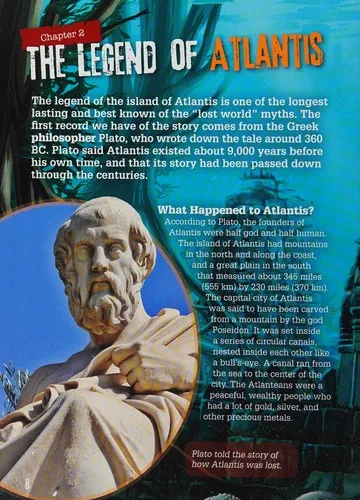
The enduring legacy of Plato's dialogues, *Timaeus* and *Critias*, serves as the primary touchstone for discussions on Atlantis. The book scrutinizes the details provided by Plato, written around 360 BCE, examining whether they represent historical record, philosophical allegory, or a combination thereof. It acknowledges Plato's description of a powerful naval force and advanced society, exploring how these elements have fueled centuries of speculation and quests for a physical location for this legendary island continent.
Cataclysmic Theories
A significant thread woven through the study of lost civilizations is the concept of catastrophic destruction. Whether through immense floods, volcanic eruptions, or seismic events, the idea of a sudden, global-scale disaster wiping out advanced societies resonates powerfully. The book evaluates geological and historical evidence for such events, considering how natural phenomena might have inspired or been misinterpreted within these ancient narratives, leading to persistent myths of vanished worlds.
Archaeological Speculation
The search for tangible proof of Atlantis and other lost civilizations often leads to archaeological sites, some ancient, some modern. This theme explores how various discoveries—from underwater structures to megalithic ruins—have been interpreted as evidence for these forgotten cultures. The work critically assesses these claims, distinguishing between scientifically validated findings and speculative interpretations that often stretch the available data to fit pre-existing theories.
The Psychology of Myth
Beyond the physical search, the book touches upon why these stories of lost civilizations remain so compelling. It considers the psychological and cultural functions these myths serve, perhaps representing a longing for a lost golden age, a cautionary tale against societal hubris, or a projection of humanity's desire for profound, hidden histories. This aspect looks at the enduring human fascination with origins and forgotten pasts.
💬 Memorable Quotes
Direct passages from the work, attributed to the author.
“Plato's dialogues remain the foundational text for any serious discussion of Atlantis.”
— This highlights the critical importance of Plato's writings, specifically *Timaeus* and *Critias* from approximately 360 BCE, as the origin point for the Atlantis legend, underscoring their role in subsequent historical and speculative inquiries.
“The allure of a pre-diluvian golden age persists across cultures.”
— This observation points to a cross-cultural psychological phenomenon, suggesting that the idea of a highly advanced civilization lost to a great flood or cataclysm is a recurring theme in human mythology and consciousness.
“Geological shifts offer potential, albeit speculative, explanations for vanished lands.”
— This acknowledges that while definitive proof is absent, scientific concepts like tectonic plate movement and sea-level changes provide plausible frameworks for understanding how landmasses could disappear or become submerged over vast geological timescales.
“Distinguishing between mythic resonance and empirical evidence is paramount.”
— This emphasizes the need for critical analysis when examining stories of lost civilizations, urging readers to separate the cultural and psychological appeal of the narratives from the requirement for verifiable factual support.
“Many proposed sites for lost civilizations lack conclusive archaeological backing.”
— This pragmatic statement addresses the frequent disconnect between popular theories about the locations of Atlantis or other lost lands and the actual findings from archaeological excavations and scientific surveys.
🌙 Esoteric Significance
Tradition
While not strictly an esoteric text itself, the book engages with themes that are central to various esoteric traditions, particularly those focused on ancient wisdom and hidden histories. It touches upon ideas common in Theosophy and certain branches of occultism that posit advanced, pre-historic civilizations possessing profound knowledge. Snedden's work serves as a critical examination of the evidence base for these traditions' foundational myths, offering a counterpoint to purely faith-based acceptance and encouraging a more analytical perspective on ancient legends.
Symbolism
The concept of Atlantis itself functions as a powerful symbol within esoteric thought, often representing a lost golden age, a highly evolved spiritual or technological society, or a cautionary tale of hubris leading to divine retribution. The idea of a civilization 'sunken' beneath the waves can symbolize lost knowledge or a submerged consciousness. Similarly, the recurring theme of global cataclysms symbolizes cyclical destruction and renewal, a core concept in many ancient cosmologies and esoteric philosophies, representing the end of one era and the potential for a new beginning.
Modern Relevance
Contemporary interest in lost civilizations, often fueled by online communities and alternative history channels, continues to draw upon the narratives Snedden analyzes. Thinkers and practitioners exploring ancient mysteries, consciousness studies, and speculative archaeology often reference Atlantis and similar legends. While Snedden's critical approach might temper some of the more extreme claims, the underlying archetypes—lost wisdom, advanced ancient technology, and cyclical world ages—remain potent influences in modern esoteric thought and popular culture.
👥 Who Should Read This Book
• Students of comparative mythology and ancient history seeking to understand the origins and evolution of the Atlantis legend, particularly its Platonic roots from around 360 BCE. • Critical thinkers interested in the intersection of archaeology, geology, and legend, who want to evaluate the evidence presented for various lost civilization theories. • Readers fascinated by persistent cultural narratives and the psychological underpinnings of myths about advanced ancient societies and global cataclysms.
📜 Historical Context
Robert Snedden's "Atlantis and Other Lost Civilizations" emerges from a long lineage of inquiry into Plato's Atlantis, a concept first introduced around 360 BCE. The late 19th and early 20th centuries saw a surge in popular interest, fueled by authors like Ignatius Donnelly and his 1882 book *Atlantis: The Antediluvian World*, which presented Atlantis as a literal historical place and the mother of all civilizations. This period was marked by pseudoscientific explorations and theories, often clashing with established archaeological and geological understanding. Snedden's work engages with this legacy, attempting to apply a more critical, evidence-based approach in contrast to the speculative fervor of figures like Helena Blavatsky, who incorporated Atlantean narratives into Theosophy. While Donnelly's work spurred popular imagination, Snedden aims for a more grounded analysis, acknowledging the lack of definitive proof and the potential allegorical nature of Plato's account.
📔 Journal Prompts
Plato's description of Atlantis: allegory or history?
The recurring theme of cataclysms in lost civilization myths.
Evaluating archaeological claims related to pre-historic cultures.
The psychological appeal of 'golden age' narratives.
Connecting ancient myths to geological evidence.
🗂️ Glossary
Atlantis
A legendary island civilization first described by the Greek philosopher Plato in his dialogues *Timaeus* and *Critias* (circa 360 BCE). It is often depicted as a powerful naval force that predated recorded history before sinking into the ocean.
Plato's Dialogues
Philosophical works by Plato, most notably *Timaeus* and *Critias*, which contain the earliest known written account of the myth of Atlantis, serving as the primary source for subsequent interpretations.
Cataclysm
A violent, natural upheaval, such as a flood, earthquake, or volcanic eruption, often invoked in theories about the destruction of ancient civilizations like Atlantis.
Lemuria
A hypothetical lost continent proposed in the 19th century, typically located in the Indian or Pacific Ocean. It is often described as a homeland for early human ancestors in esoteric and pseudoscientific literature.
Mu
Another name for a hypothesized lost continent, often associated with Augustus Le Plongeon's interpretations of Mayan texts. Like Lemuria, it is featured in theories of ancient, advanced civilizations.
Archaeological Evidence
Material remains, such as artifacts, structures, and human or animal remains, used by archaeologists to reconstruct past human activity and history. The interpretation of such evidence is central to validating or refuting claims about lost civilizations.
Antediluvian
Literally meaning 'before the flood,' this term is often used in reference to civilizations or events believed to have existed before a great biblical or mythological flood, such as those proposed for Atlantis.
🔮 Readers Also Liked
Browse all →









More by Robert Snedden
All books →
More Free Occult Philosophy Books
View all →