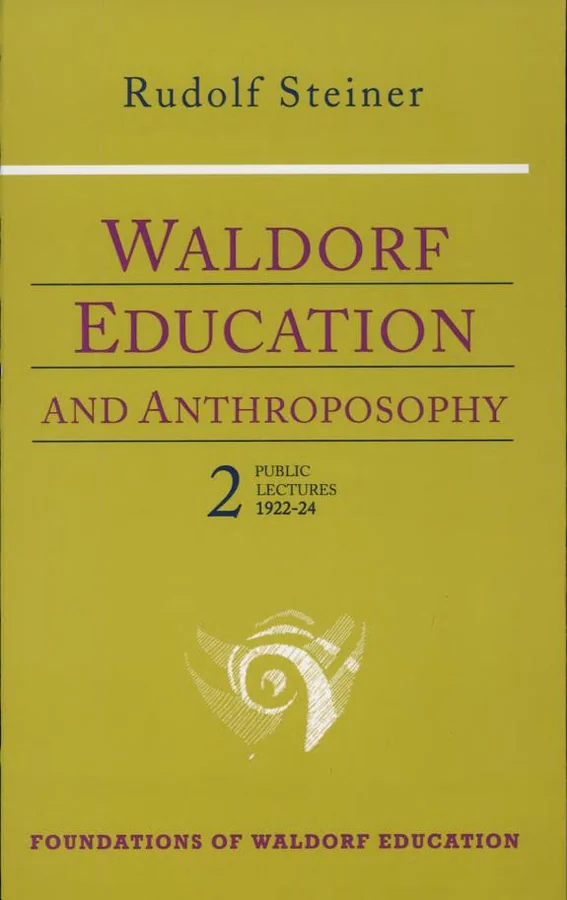
Waldorf Education and Anthroposophy 2
 74
74

Waldorf Education and Anthroposophy 2
Waldorf Education and Anthroposophy 2 offers a detailed, albeit dense, exposition of Rudolf Steiner's pedagogical system. The strength lies in its direct engagement with Steiner's original lectures and writings, providing a primary source perspective on Anthroposophical education. However, the book’s dense prose and reliance on esoteric terminology can make it challenging for newcomers to grasp the core tenets without prior familiarity with Anthroposophy. A particular passage discussing the role of 'karma' in a child's learning trajectory, while central to Steiner's thought, might prove opaque to readers outside this specific philosophical framework. The work is best approached as an advanced text for those already immersed in Steiner's broader philosophical landscape. It serves as a valuable resource for dedicated scholars but lacks accessibility for a general audience.
📝 Description
74
Waldorf Education and Anthroposophy 2, published in 2004, further details Rudolf Steiner's educational philosophy.
This volume expands on the educational philosophy and spiritual science Rudolf Steiner developed. It continues the discussion from the first book, concentrating on the practical and theoretical foundations of Steiner's pedagogical methods. The text examines how his concepts, stemming from Anthroposophy, aim to support complete human growth from childhood to adolescence. It covers the curriculum, the teacher's role, and the spiritual principles that guide the Waldorf approach.
Individuals interested in the Anthroposophical roots of Waldorf education will find this book useful. This includes educators, parents, and students of esoteric philosophy. It is for those who want to understand Steiner's ideas more deeply than a basic overview of Waldorf schools allows. Anyone curious about the spiritual science behind a specific educational movement and its response to children's developmental needs today will find the content valuable.
Rudolf Steiner founded the first Waldorf school in 1919, a time of significant societal change. His work arose from Anthroposophy, a spiritual philosophy asserting a spiritual reality attainable through inner development. Steiner's educational theories contrasted with the prevailing materialistic or secular philosophies of the early 20th century. His ideas were met with both strong approval and significant doubt, especially from established academic and religious groups.
💡 Why Read This Book?
• Gain insight into the seven-year developmental stages as conceived by Rudolf Steiner, understanding how Waldorf curricula align with these specific phases of human growth, as detailed in sections on childhood development. • Explore the Anthroposophical concept of the 'etheric body' and its supposed influence on learning and vitality, a unique perspective on subtle anatomy not found in conventional psychology. • Understand the practical application of spiritual science in education, particularly the integration of arts and practical work, as presented in discussions of pedagogical methods.
⭐ Reader Reviews
Honest opinions from readers who have explored this book.
❓ Frequently Asked Questions
What is Anthroposophy and how does it relate to Waldorf education?
Anthroposophy is a spiritual philosophy founded by Rudolf Steiner, which views human beings as having physical, soul, and spiritual components. Waldorf education is the pedagogical application of Anthroposophy, aiming to educate the whole child – intellect, feeling, and will – in alignment with their spiritual and developmental needs.
When was the first Waldorf school established?
The first Waldorf school was established by Rudolf Steiner in Stuttgart, Germany, in 1919, following a request from Emil Molt, director of the Waldorf-Astoria cigarette factory.
What are the key differences between Waldorf education and mainstream schooling?
Waldorf education emphasizes imagination, creativity, and experiential learning, often delaying formal academic instruction in reading and writing. It integrates arts and crafts throughout the curriculum and avoids standardized testing and a purely materialistic worldview, contrasting with the more academic and often standardized approach of mainstream schools.
What does Rudolf Steiner mean by 'spiritual science'?
Spiritual science, or Anthroposophy, refers to Steiner's system of understanding reality through inner spiritual perception and development, going beyond what can be known through the senses or conventional scientific methods. It posits a spiritual dimension to existence and human consciousness.
Are Rudolf Steiner's ideas considered controversial?
Yes, Steiner's ideas, particularly those related to Anthroposophy and its spiritual science aspects, are considered controversial by many mainstream scientific, academic, and religious institutions due to their non-materialistic and esoteric nature.
What is the significance of the seven-year stages in Waldorf education?
Steiner believed human development occurs in distinct seven-year cycles. Waldorf education structures its curriculum and teaching methods to correspond to the perceived physical, emotional, and spiritual needs of children in each of these stages, from birth to adulthood.
🔮 Key Themes & Symbolism
Holistic Child Development
This theme examines the Anthroposophical view of the child as a complex being encompassing physical, emotional, and spiritual dimensions. The work details how Waldorf pedagogy aims to nurture these interconnected aspects through a curriculum designed to meet specific developmental stages, often divided into seven-year cycles. It contrasts with purely intellectual or materialistic approaches to education, emphasizing the development of 'head, heart, and hands' as integral to a complete human formation.
Anthroposophy as a Foundation
The book underscores Anthroposophy, Rudolf Steiner's spiritual science, as the essential philosophical and spiritual underpinning for Waldorf education. It explains how concepts such as the etheric, astral, and ego bodies inform the understanding of child development and learning processes. This spiritual framework guides the curriculum's content, methodology, and the teacher's role in fostering spiritual awareness alongside academic and practical skills.
Pedagogical Methods and Curriculum
This section explores the practical implementation of Steiner's ideas in the classroom. It explores the Waldorf curriculum's unique structure, which emphasizes artistic expression, storytelling, practical crafts, and movement alongside traditional academic subjects. The focus is on experiential learning and cultivating imagination, aiming to equip students with inner capacities rather than solely transmitting factual knowledge.
The Teacher's Role
The work illuminates the elevated and spiritually informed role of the Waldorf teacher. Beyond instruction, teachers are seen as guides who must understand the spiritual nature of the child and the developmental tasks of each age. This involves cultivating their own inner development and artistic capacities to serve as role models and facilitators of the child's holistic growth.
💬 Memorable Quotes
Direct passages from the work, attributed to the author.
“The child's development unfolds in seven-year periods.”
— This concept highlights Steiner's view of human maturation as occurring in distinct stages, each with unique physical, emotional, and spiritual characteristics that inform educational approaches.
“Imagination is the faculty that builds the spiritual world.”
— This statement emphasizes the crucial role of imagination in Waldorf education, not merely as a creative tool but as a means of perceiving and interacting with spiritual realities.
“The teacher must cultivate their own inner life.”
— This underscores the Anthroposophical view of the teacher as a spiritual practitioner, whose personal inner development is essential for effectively guiding students.
“The etheric body sustains life and is the vehicle of formative forces.”
— This refers to a subtle energetic body in Anthroposophy, believed to be responsible for growth, healing, and the shaping of physical form, influencing the child's vitality.
“Education should awaken the whole human being.”
— This expresses the holistic aim of Waldorf pedagogy, seeking to develop intellect, emotion, and physical/spiritual will in balance, rather than focusing solely on cognitive skills.
🌙 Esoteric Significance
Tradition
Waldorf education is deeply rooted in the esoteric tradition of Anthroposophy, which Rudolf Steiner developed. Anthroposophy itself draws from various esoteric streams, including Theosophy (from which Steiner initially emerged), Hermeticism, Gnosticism, and Eastern mysticism, synthesizing them into a distinct spiritual-scientific worldview. It positions itself as a path of inner development and knowledge acquisition that transcends empirical science, aiming to reveal the spiritual nature of the cosmos and humanity.
Symbolism
Central to Waldorf pedagogy, derived from Anthroposophy, are concepts like the 'etheric body' and 'astral body,' representing subtle energetic forces that influence physical and emotional life. The seven-year stages of development are another key symbolic framework, mapping out predictable phases of human unfolding. The emphasis on artistic activities like painting, music, and form drawing serves not just pedagogical ends but also as symbolic pathways to engage with spiritual archetypes and forces.
Modern Relevance
Contemporary movements in holistic education, alternative pedagogy, and consciousness studies often reference or draw inspiration from Steiner's work. Thinkers exploring the integration of spiritual development with education, the role of imagination in cognition, and the limitations of purely materialistic worldviews frequently engage with Anthroposophical principles. Practices in biodynamic farming and anthroposophical medicine also demonstrate the enduring, albeit niche, influence of Steiner's broader philosophical system.
👥 Who Should Read This Book
• Educators and parents seeking to understand the philosophical and spiritual underpinnings of the Waldorf method beyond its surface-level practices. • Students of esoteric philosophy and spiritual science interested in how Anthroposophy is applied in a practical field like education. • Researchers in comparative education or the history of alternative movements looking for primary source material on Steiner's pedagogical theories.
📜 Historical Context
Rudolf Steiner introduced his unique educational philosophy, the basis of Waldorf schools, in Stuttgart, Germany, in 1919. This was in the aftermath of World War I, a period marked by societal disruption and a search for new social and spiritual paradigms. Steiner's approach, rooted in his spiritual science known as Anthroposophy, offered a counterpoint to the increasingly materialistic and rationalistic educational trends of the early 20th century, such as those advocated by figures like John Dewey in the United States. Steiner's ideas proposed a holistic development of the child, integrating spiritual, intellectual, artistic, and practical capacities. The reception of Waldorf education was diverse; while it gained a dedicated following among those seeking a more spiritual and humanistic approach to learning, it also faced criticism and skepticism from established scientific and religious authorities who found its metaphysical underpinnings difficult to accept or verify.
📔 Journal Prompts
Anthroposophy's view of the child's seven-year development stages.
The teacher's cultivation of inner life as depicted in the text.
The role of imagination in Waldorf pedagogy.
The concept of the etheric body's influence on learning.
How the Waldorf curriculum balances intellectual, artistic, and practical learning.
🗂️ Glossary
Anthroposophy
A spiritual philosophy and practice developed by Rudolf Steiner, seeking to understand the spiritual nature of the human being and the universe through inner perception and spiritual research.
Waldorf Education
A holistic educational approach based on Anthroposophy, founded by Rudolf Steiner, emphasizing the development of the whole child—intellect, emotion, and will—through integrated arts, academics, and practical skills.
Etheric Body
In Anthroposophy, a subtle energetic body responsible for life forces, growth, reproduction, and healing; believed to be the vehicle of formative forces that shape the physical body.
Astral Body
In Anthroposophy, a subtle energetic body associated with consciousness, feeling, instinct, and the capacity for subjective experience and soul life.
Seven-Year Stages
Rudolf Steiner's concept of human development occurring in distinct phases, typically divided into seven-year cycles (e.g., 0-7, 7-14, 14-21), each with specific developmental tasks and needs.
Spiritual Science
Rudolf Steiner's term for his approach to exploring the spiritual realms and the spiritual nature of reality through disciplined inner development and direct perception.
Holistic Development
An approach to education that seeks to nurture the complete human being, addressing intellectual, emotional, physical, social, and spiritual aspects of growth in a balanced manner.
This book appears in 1 collection
🔮 Readers Also Liked
Browse all →





From the “Anthroposophy” Collection
View all →






More Free Theosophy & Anthroposophy Books
View all →