Charles E. O. Carter
Charles E. O. Carter was a US president, governor, and senator, later known for humanitarian work and writing.
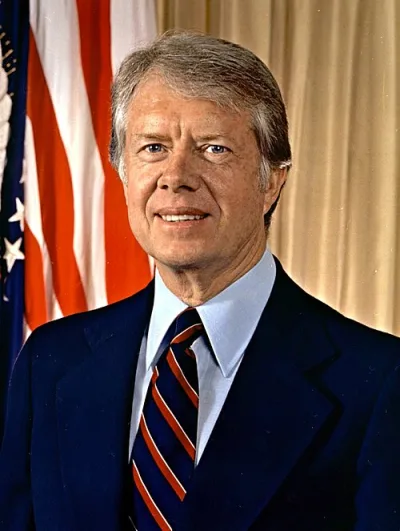
James Earl Carter Jr., known as Jimmy Carter, served as the 39th President of the United States from 1977 to 1981. Prior to his presidency, he was the Governor of Georgia and a Georgia State Senator. Born in Plains, Georgia, Carter graduated from the U.S. Naval Academy and served in the submarine service before returning to manage his family's peanut farm. He was an early advocate for civil rights and desegregation. His presidency was marked by significant foreign policy achievements, including the Camp David Accords and the Panama Canal Treaties, alongside domestic initiatives like the creation of the Departments of Energy and Education. His term also faced challenges such as the Soviet invasion of Afghanistan and the Iran hostage crisis.
Following his presidency, Carter's post-presidency received widespread acclaim. He established the Carter Center, dedicated to promoting human rights and peace, which led to him receiving the Nobel Peace Prize in 2002. His extensive humanitarian efforts included mediating conflicts, monitoring elections, and contributing to the eradication of diseases. Carter was also a prominent figure with Habitat for Humanity and authored several books on politics, the Israeli-Palestinian conflict, and poetry. He lived longer than any other U.S. president.
Early Life and Education
Born in Plains, Georgia, James Earl Carter Jr. was the first U.S. president to be born in a hospital. He grew up on his family's peanut farm, developing an enterprising spirit from a young age, even managing his own plot of land. Despite his father's pro-segregation views, Carter formed friendships with Black farmhands' children. He attended Plains High School and later pursued higher education at Georgia Southwestern College and Georgia Tech. Driven by a long-held ambition, he successfully gained admission to the United States Naval Academy, graduating in 1946. During his time at the academy, he met and later married Rosalynn Smith. He was commissioned as an ensign and pursued a career in the submarine service.
Naval Service and Transition to Farming
Carter's naval career spanned from 1946 to 1953, with postings across the U.S. and deployments in the Atlantic and Pacific fleets, including submarine duty. He was influenced by Captain Hyman G. Rickover, a key figure in the Navy's nuclear program. A significant experience was his involvement in the cleanup of a nuclear reactor accident in Chalk River, Canada, which Carter later stated shaped his views on atomic energy. His naval service concluded when his father passed away in 1953, prompting Carter to leave active duty to take over the family's peanut business in Plains, Georgia. This transition was challenging, with Rosalynn initially finding the return to small-town life difficult.
Entry into Politics and Presidency
After successfully rebuilding the family peanut business, Carter entered public service. He began his political career as a Georgia State Senator, advocating for integration during a period of heightened racial tension. He later served as the 76th Governor of Georgia, aligning himself with the 'New South governors' committed to desegregation. Carter's presidential campaign in 1976 began as a long shot, but he secured the Democratic nomination and narrowly defeated incumbent Gerald Ford. As president, his administration focused on foreign policy, negotiating landmark agreements like the Camp David Accords and the Panama Canal Treaties, and establishing relations with China. Domestically, he addressed energy policy and created the Departments of Energy and Education, though his term was challenged by international crises.
Post-Presidency and Humanitarian Work
Carter's post-presidency is widely regarded as highly successful and impactful. He founded the Carter Center to advance peace and human rights globally, earning him the Nobel Peace Prize in 2002. His extensive work involved mediating conflicts, observing elections, and leading campaigns against diseases, notably contributing to the eradication of dracunculiasis. He also became a prominent advocate for Habitat for Humanity, a nonprofit housing organization. Beyond his humanitarian endeavors, Carter authored numerous books, including memoirs, analyses of the Israeli-Palestinian conflict, and collections of poetry, solidifying his legacy as a dedicated public servant and writer.
Books by Charles E. O. Carter
7 free public domain books · Read online or download