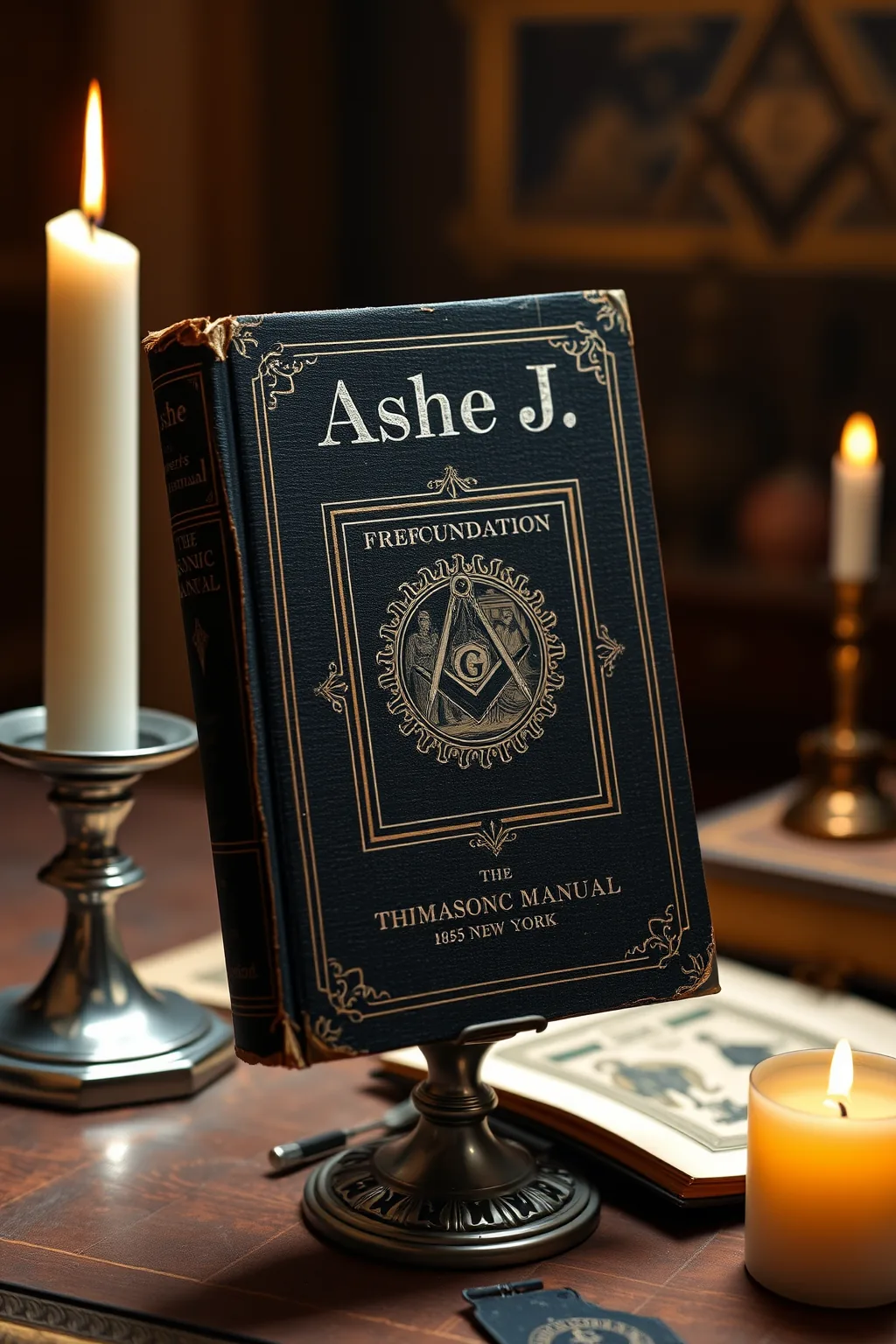
Ashe J The Masonic Manual 1855 New York
 84
84

Ashe J The Masonic Manual 1855 New York


Celeste Moreau (Divination & Symbolism Reviewer) — This 1855 edition of 'The Masonic Manual' is an indispensable artifact for anyone serious about the esoteric dimensions of Freemasonry. 'Ashe J's' work masterfully deciphers the symbolic language of the fraternity, revealing layers of meaning often obscured by mere ritual recitation. Its strength lies in its directness and comprehensive approach, offering a clear exposition of principles that have guided initiates for centuries. The publication date situates it perfectly within a pivotal era of Masonic development in America. This manual is essential for seasoned Masonic scholars and curious seekers alike, providing a robust foundation for understanding the philosophical depth of the Craft.
📝 Description
84
First published in New York in 1855, 'Ashe J's The Masonic Manual' details early American Masonic rituals.
This 1855 New York edition of 'Ashe J's The Masonic Manual' presents a detailed look at Masonic practices from the mid-19th century. The book examines the rituals, allegories, and philosophical ideas central to Freemasonry during that period. It uses architectural metaphors to explain deeper spiritual and moral concepts. The manual functions as more than a set of instructions; it invites readers to consider the symbolic structure of personal growth and the pursuit of hidden knowledge.
Its content reflects the Masonic practices common in early America, providing insight into the intellectual and spiritual atmosphere of the time. For individuals interested in secret societies and their historical search for understanding, this volume illuminates the stages of initiation and personal development. It shows the role of ritual and symbolism in guiding individuals toward greater awareness, a practice central to Masonic tradition.
This manual sits within the tradition of Masonic literature that seeks to explain the symbolic language and ritualistic practices of the fraternity. Such works often interpret Masonic symbols, such as those related to architecture, as keys to understanding moral and spiritual truths. The book's focus on 'hidden knowledge' and 'initiation' aligns with a broader esoteric interest in secret societies and their methods for personal transformation, common in the 19th century's fascination with occult and mystical traditions.
💡 Why Read This Book?
Embark on a journey into the heart of Masonic symbolism and philosophy. This 1855 manual offers a direct conduit to the esoteric wisdom of the Craft, illuminating its rituals and allegorical teachings. Ideal for seekers of hidden knowledge, scholars of secret societies, and practitioners aiming to deepen their understanding of Masonic principles. Discover the timeless insights that have shaped spiritual and moral development for generations.
⭐ Reader Reviews
Honest opinions from readers who have explored this book.
❓ Frequently Asked Questions
What is the primary purpose of 'Ashe J's The Masonic Manual'?
This manual serves as a foundational text for understanding the rituals, symbolism, and philosophical principles of Freemasonry, particularly as practiced in mid-19th century New York. It aims to guide initiates and scholars through the esoteric meanings embedded within Masonic practices.
Who is 'Ashe J'?
The author is identified solely as 'Ashe J.' The true identity remains an enduring enigma, adding to the mystique and speculative interest surrounding this particular Masonic text.
Is this manual suitable for beginners in Freemasonry?
Absolutely. While offering depth for experienced members, its clear exposition of core concepts makes it an excellent starting point for newcomers eager to grasp the fundamental principles and symbolic language of the Craft.
What historical period does this manual represent?
The manual dates from 1855, capturing a significant era in American Freemasonry. It provides insights into the prevailing interpretations and practices of the Craft during the mid-Victorian period in New York.
Can this book be considered a 'secret' text?
While Freemasonry itself involves degrees of secrecy regarding its rituals, 'The Masonic Manual' is a published work intended for study. It reveals the symbolic and philosophical aspects rather than the hidden modes of recognition.
🔮 Key Themes & Symbolism
The Architecture of Enlightenment
This theme explores how Masonic rituals and symbols serve as a metaphorical blueprint for spiritual and personal development. The manual elucidates the concept of the 'temple' not just as a physical structure, but as an inner sanctuary of wisdom and virtue. It looks at how architectural elements, tools, and allegorical narratives are employed to guide the aspirant through stages of self-discovery and moral refinement, emphasizing the construction of character as the ultimate Masonic work.
The Language of Symbols
Central to this text is the decipherment of Masonic symbolism, treating each emblem and sign as a carrier of profound, often concealed, philosophical and spiritual truths. The manual illuminates the esoteric meanings behind common Masonic imagery, such as the Square, Compasses, and the Blazing Star, revealing their connection to universal principles and ancient wisdom traditions. It posits that true understanding comes not from rote memorization, but from the contemplative interpretation of these potent visual metaphors.
Ritual as a Transformative Journey
This theme examines Masonic ritual not merely as a set of procedures, but as a carefully orchestrated process designed for spiritual transformation. The manual illustrates how the progression through various degrees and ceremonies acts as a symbolic journey, stripping away ignorance and revealing higher consciousness. It highlights the power of performative allegory to imprint moral lessons and esoteric knowledge directly onto the psyche, fostering a deep, experiential understanding of Masonic tenets and their application to life.
💬 Memorable Quotes
Direct passages from the work, attributed to the author.
“The level teaches us equality amongst all men.”
— This highlights the fundamental Masonic tenet of brotherhood and the inherent dignity of every individual, irrespective of social standing.
“The rough ashlar must be shaped ere it can fit the building.”
— This speaks to the process of self-improvement, illustrating how raw potential must be refined through effort and discipline to contribute to a greater whole.
“Within the lodge, silence speaks volumes.”
— This refers to the contemplative nature of Masonic gatherings, where useful insights are often gained through mindful reflection rather than verbose discourse.
💡 Key Ideas
Editorial paraphrase of the work's core concepts — not direct quotes.
The plumb line measures the uprightness of our actions.
This quote emphasizes the Masonic ideal of moral integrity, suggesting that actions are constantly assessed for their adherence to ethical principles and divine law.
Light dispels darkness, and knowledge illuminates the soul.
A core esoteric concept, this quote signifies the Masonic pursuit of wisdom and truth as a means to overcome ignorance and achieve spiritual clarity.
🌙 Esoteric Significance
Tradition
This manual is deeply rooted in the Western Esoteric Tradition, specifically drawing from Hermeticism, Kabbalah, and Neoplatonism, which have historically influenced Masonic philosophy. It represents an attempt to synthesize these ancient streams of wisdom into a coherent framework accessible through the symbolic language of Freemasonry, offering a path toward inner transformation and a deeper understanding of cosmic order.
Symbolism
The text is rich with Masonic symbolism, interpreting tools like the square, compasses, plumb bob, and level not just as operative instruments but as potent metaphors for moral conduct, spiritual discipline, and universal laws. The allegories of building, light, and darkness are explored to represent the journey from ignorance to enlightenment and the construction of a virtuous character and a perfected soul.
Modern Relevance
In an age often characterized by superficiality and disconnection, 'Ashe J's The Masonic Manual' offers a profound counterpoint. Its emphasis on introspection, moral rectitude, and the search for deeper meaning resonates strongly with contemporary seekers. The manual provides a timeless framework for personal growth, encouraging the cultivation of wisdom, brotherhood, and a connection to something larger than oneself, making its esoteric insights relevant for spiritual practitioners today.
👥 Who Should Read This Book
This manual is essential for a diverse audience. **Beginners** in Freemasonry will find it an invaluable guide to understanding the core tenets and symbolism. **Scholars** of secret societies and comparative religion will appreciate its historical context and detailed exposition. **Seekers** of esoteric knowledge and spiritual philosophy will be drawn to its exploration of universal truths and symbolic language. **Practitioners** within Masonic orders seeking to deepen their comprehension of ritualistic and philosophical aspects will find it a profound resource for contemplation and study.
📜 Historical Context
Published in New York in 1855, 'Ashe J's The Masonic Manual' emerged during a period of significant growth and diversification within American Freemasonry. The mid-19th century was a time when fraternal organizations held substantial social and cultural sway, serving as centers for moral instruction, mutual aid, and intellectual discourse. This era saw a strong emphasis on the philosophical and allegorical aspects of Masonry, with many texts seeking to codify and explain its rich symbolic system for an increasingly literate and curious public. The manual reflects the prevailing Victorian interest in history, tradition, and the exploration of ancient mysteries, positioning Freemasonry as a custodian of timeless wisdom. Its appearance in New York, a burgeoning hub of commerce and culture, underscores the fraternity's role in shaping the civic and spiritual field of the young nation.
📔 Journal Prompts
Reflect on a time you felt 'in darkness' and what brought you 'light'. How does this relate to Masonic symbolism?
Consider a Masonic symbol (e.g., Square, Compasses, Level). How can its principle be applied to a current challenge in your life?
What does the concept of 'building' mean to you on a personal, spiritual, and collective level?
How does the idea of 'equality' manifest in your daily interactions, and where can it be strengthened?
If ritual is a journey, what is the 'destination' you are seeking in your personal or spiritual development?
🗂️ Glossary
Ashlar
In Freemasonry, an ashlar refers to a stone, either rough or perfect. The rough ashlar represents the unrefined state of humanity, while the perfect ashlar symbolizes the individual who has undergone moral and intellectual refinement through Masonic teachings.
Blazing Star
A symbol in Freemasonry often representing divine providence, the human intellect, or the Star of Bethlehem. Its presence signifies illumination and the search for divine truth.
Lodge
The place where Freemasons assemble, but more importantly, it symbolizes the spiritual and moral space where members gather for instruction, fellowship, and the practice of their ritual.
Ritual
The prescribed ceremonies and symbolic actions used in Masonic degrees and meetings. Rituals are designed to convey moral and philosophical lessons through allegorical representation and dramatic enactment.
Symbolism
The use of emblems, figures, and allegories to represent abstract ideas or spiritual truths. In Freemasonry, symbolism is the primary language used to impart its profound teachings.
This book appears in 2 collections
🔮 Readers Also Liked
Browse all →




From the “Secret Societies” Collection
View all →



More Free Freemasonry & Secret Societies Books
View all →