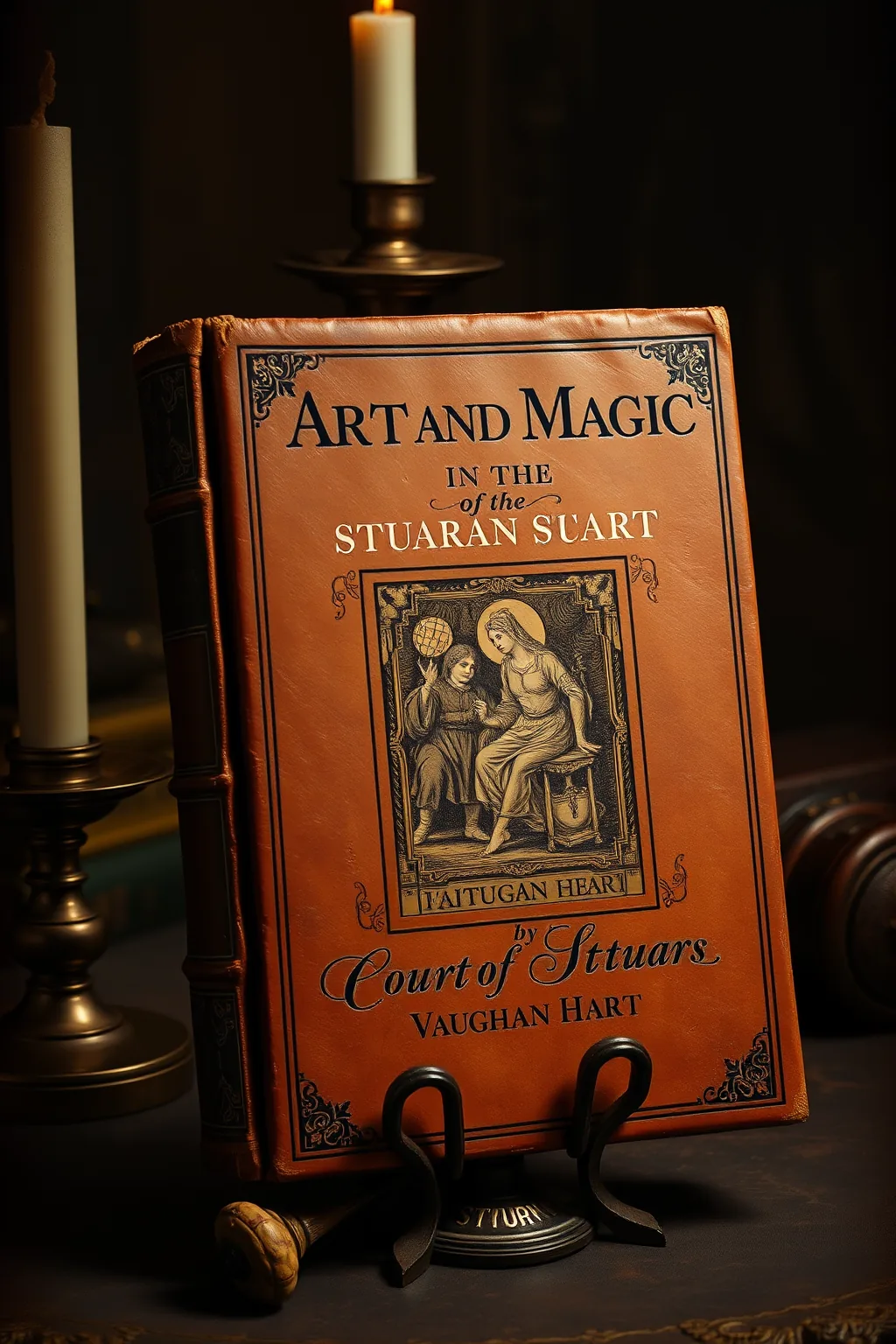
Art and Magic in the Court of the Stuarts
 84
84

Art and Magic in the Court of the Stuarts
Vaughan Hart's Art and Magic in the Court of the Stuarts offers a compelling argument for the integral role of esoteric thought in shaping the visual and intellectual culture of early modern Britain. The book excels in demonstrating how concepts drawn from Hermeticism and alchemy permeated artistic production, moving beyond superficial decorative elements to influence underlying design principles and thematic concerns. A particularly strong section details the symbolic architecture of sites like Greenwich Palace, revealing layers of meaning tied to cosmic order and royal ideology. However, the dense academic prose, while precise, can occasionally obscure the more vibrant connections Hart seeks to illuminate, making the narrative feel at times more like a catalog of influences than a flowing historical account. The discussion of astrological influences on courtly masques, while informative, would benefit from more explicit visual analysis to fully convey their impact. Despite these minor reservations, Hart provides a valuable corrective to purely secular readings of Stuart art and design, revealing a world where the magical and the mundane were deeply intertwined. It is an essential text for understanding the period's intellectual underpinnings.
📝 Description
84
Vaughan Hart's 2008 book examines how magic influenced art at the Stuart court.
Art and Magic in the Court of the Stuarts by Vaughan Hart investigates the connection between artistic creation and occult practices during the Stuart reigns in England and Scotland, 1603-1714. The book moves past simple aesthetics to show how magical beliefs, alchemy, and astrology shaped intellectual and creative output. Hart argues for the widespread nature of esoteric thought, demonstrating its effect on architecture, poetry, court spectacles, and philosophy. It highlights how prominent figures engaged with these ideas, influencing culture through a mix of the visible and the hidden.
This work is for scholars of early modern British history, art history, and the history of magic. Readers interested in European intellectual history, particularly the beliefs that informed artistic expression and politics, will find it valuable. Those curious about the intersection of power, art, and unconventional belief systems will discover ample material. It suits academics and dedicated amateurs who appreciate detailed research and reasoned arguments.
The Stuart period was a time of significant intellectual change, with the Scientific Revolution beginning to question older worldviews. Within this context, esoteric traditions like Hermeticism, alchemy, and astrology remained influential. These practices were not confined to private study but were integrated into courtly life. The book details how monarchs and their courts engaged with these disciplines, affecting artistic and architectural projects, as well as philosophical discussions.
💡 Why Read This Book?
• Gain insight into the esoteric underpinnings of Stuart art and architecture, understanding how concepts like 'as above, so below' informed designs commissioned by figures like Charles I. • Discover the pervasive influence of alchemical ideas on artistic themes of transformation and perfection during the 17th century, a perspective rarely found in general art history surveys. • Learn how astrological correspondences were practically applied in courtly life and artistic patronage, providing context for events like the patronage of Inigo Jones's architectural projects.
⭐ Reader Reviews
Honest opinions from readers who have explored this book.
❓ Frequently Asked Questions
What is the primary focus of Vaughan Hart's Art and Magic in the Court of the Stuarts?
The book investigates the profound connections between artistic creation, architectural design, and esoteric beliefs such as Hermeticism, alchemy, and astrology within the Stuart courts of England and Scotland during the 17th century.
Which specific historical period does the book cover?
It covers the Stuart period in British history, generally from the accession of James I in 1603 to the end of the 17th century, a time of significant cultural and intellectual shifts.
Are there any specific artists or architects discussed in relation to magic?
Yes, the work explores the conceptual frameworks of artists and architects of the era, with particular attention to figures like Inigo Jones, whose designs are analyzed for their esoteric symbolism.
How did magic influence courtly life according to this book?
Hart demonstrates that magical and occult philosophies were not marginal but were integrated into the worldview of the court, influencing everything from royal ideology and patronage to the design of masques and palaces.
What is the author's main argument about art and magic in this era?
The central argument is that esoteric thought provided a vital conceptual and symbolic language for artists and patrons, shaping the meaning and form of artistic works in ways often overlooked by traditional art history.
Is this book suitable for beginners in esoteric studies?
While accessible to dedicated amateurs, the book is written with an academic rigor that assumes some familiarity with historical and esoteric concepts, making it particularly strong for those with prior knowledge.
🔮 Key Themes & Symbolism
Hermeticism and Cosmic Order
The book extensively details how Hermetic principles, particularly the axiom 'as above, so below,' were not abstract philosophical notions but practical guides for understanding and structuring the world. Hart shows how this worldview informed the design of royal palaces and gardens, aiming to create earthly reflections of divine harmony. This integration sought to imbue the monarchy and its domain with cosmic legitimacy, suggesting that the physical realm was a direct manifestation of celestial patterns and divine intellect. The symbolic language employed in courtly art and architecture served as a conduit for expressing this connection, aligning human endeavors with universal laws.
Alchemy as Metaphor and Practice
Vaughan Hart explores the complex role of alchemy, extending beyond its literal chemical transformations. The book illustrates how alchemical concepts of purification, transmutation, and the pursuit of perfection served as potent metaphors for spiritual, political, and artistic renewal within the Stuart courts. This perspective reveals how patrons and artists conceptualized their work as a process of refinement, aiming to elevate the mundane to a higher state of being or understanding. The symbolic imagery associated with alchemical processes, such as the phoenix or the philosopher's stone, frequently appears in the art and literature of the period, signifying hope for regeneration and ultimate truth.
Astrology and Royal Ideology
The influence of astrology on Stuart court culture is a central theme. Hart examines how astrological divinations and the belief in celestial influence on human affairs were woven into the fabric of royal ideology and the planning of significant events. This included the timing of coronations, marriages, and the commissioning of artistic works, all intended to harmonize with perceived cosmic forces. The book highlights how astrology provided a framework for understanding destiny, divine favor, and the cyclical nature of power, shaping both the visual iconography and the political strategies of the era's rulers.
The Interplay of Art and Occult Philosophy
Fundamentally, the book argues for a symbiotic relationship between artistic production and occult philosophy during the Stuart reigns. Hart demonstrates that the intellectual currents of magic, divination, and esoteric symbolism were not peripheral but were fundamental to the creative process and the reception of art. This interaction fostered a rich symbolic environment where art served not only aesthetic or propagandistic functions but also acted as a vehicle for exploring and expressing deeper metaphysical and spiritual realities. The work challenges a purely rationalist interpretation of the period, emphasizing the enduring power of magical thinking in shaping cultural output.
💬 Memorable Quotes
Direct passages from the work, attributed to the author.
“The Stuart court viewed the universe as a divinely ordered system, and art was a means to mirror that order.”
— This interpretation suggests that art during the Stuart era was not merely decorative but served a cosmological function, reflecting a belief in the inherent structure and divine intelligence of the universe. Artists and patrons actively sought to replicate this cosmic harmony in their creations.
“Alchemical processes provided a rich vocabulary of transformation, applicable to both material and spiritual realms.”
— This highlights how the symbolic language of alchemy, focused on change and refinement, offered a framework for understanding personal, political, and artistic development. It suggests a deep resonance between the laboratory and the studio or court.
“Astrological charts were consulted not just for personal fortune but for the auspicious timing of state affairs and artistic commissions.”
— This points to the practical integration of astrology into the highest levels of Stuart governance and cultural patronage. The belief in celestial influence meant that timing was as crucial as design or execution in achieving desired outcomes.
“The Neoplatonic concept of divine beauty emanating through form was a significant driver for aesthetic choices.”
— This interpretation emphasizes the philosophical underpinnings of Stuart aesthetics, linking them to Neoplatonic thought which posits that true beauty originates from a divine source and is expressed through material forms. Art became a way to apprehend or channel this divine emanation.
“Magic was not separate from the intellectual life of the court but was deeply interwoven with its artistic and political discourse.”
— This suggests that the separation between 'magic' and 'rationality' is a modern construct. In the Stuart court, esoteric beliefs were part of the mainstream intellectual toolkit used to understand and shape reality, including artistic expression.
🌙 Esoteric Significance
Tradition
The work deeply engages with the Western Esoteric Tradition, particularly its Hermetic, Neoplatonic, and alchemical branches. It situates these traditions not as fringe beliefs but as integral to the intellectual and artistic framework of the Stuart courts. Hart demonstrates how these currents informed a worldview where the universe was seen as a living, interconnected system, and art served as a means to engage with or reflect its underlying order and divine principles. This approach departs from later, more individualistic or purely psychological interpretations of esotericism, emphasizing its role in collective ideology and artistic expression.
Symbolism
Central to the book's analysis are symbols of cosmic order and transformation. The 'as above, so below' principle, derived from Hermeticism, is shown to inform architectural layouts and iconographic programs, aiming to create earthly microcosms reflecting the macrocosm. Alchemical symbols, such as the Ouroboros (representing cycles of creation and destruction) or the Philosopher's Stone (symbolizing perfection and transformation), are explored for their thematic resonance in courtly masques and visual arts, signifying renewal and ultimate truth. Astrological symbols, like planetary correspondences, also appear, used to legitimize royal power and harmonize courtly activities with celestial cycles.
Modern Relevance
Contemporary scholars of Renaissance and Baroque art, as well as historians of science and magic, continue to draw on Hart's meticulous research. His work informs modern understandings of how pre-modern societies integrated seemingly disparate fields of knowledge. Thinkers and practitioners interested in the historical roots of Western esotericism, comparative studies of magic and art, and the symbolic dimensions of power find this book essential. It provides a crucial case study for how symbolic systems can shape cultural production, influencing fields from art history and literature to the study of belief systems and their impact on society.
👥 Who Should Read This Book
• Art historians and architectural historians specializing in early modern Europe, seeking to understand the intellectual and symbolic frameworks behind Stuart artistic production. • Students and scholars of the history of magic, esotericism, and Western occult traditions, interested in the practical application of these beliefs within a historical court setting. • General readers fascinated by the intersection of power, art, and belief systems, who wish to explore a less commonly understood facet of 17th-century British history.
📜 Historical Context
The Stuart period (1603-1714) was a dynamic era in Britain, marked by the union of the Scottish and English crowns, religious tensions, and the intellectual shifts of the early Scientific Revolution. Amidst this, esoteric traditions like Hermeticism, alchemy, and astrology retained significant influence, particularly within royal courts. Figures like John Dee, though active earlier, had laid groundwork for continued engagement with occult philosophy. Monarchs such as James I and Charles I patronized arts and sciences, often blending intellectual curiosity with an interest in magic and divination. This intellectual climate contrasted sharply with the more secularized approaches to art and knowledge that would gain prominence later. The fluid boundaries between natural philosophy, theology, and magic meant that esoteric ideas were embedded in discussions about cosmology, kingship, and aesthetics. While the Royal Society emerged in the 1660s, promoting empirical methods, older traditions continued to inform artistic and intellectual pursuits, often creating a complex dialogue between innovation and tradition. Reception of such ideas varied, with periods of intense interest and occasional suspicion, but their presence shaped the cultural output of the era.
📔 Journal Prompts
The concept of 'as above, so below' in Stuart court design.
Vaughan Hart's interpretation of alchemical symbolism in 17th-century art.
The role of astrological divinations in shaping royal patronage.
Reflect on the influence of Neoplatonic ideas on the aesthetics of the period.
How did the fluidity between magic and natural philosophy affect artistic creation?
🗂️ Glossary
Hermeticism
A religious, philosophical, and esoteric tradition based on writings attributed to Hermes Trismegistus. It emphasizes divine wisdom, the interconnectedness of all things ('as above, so below'), and the potential for human spiritual ascent through knowledge.
Alchemy
An ancient tradition involving the study of matter and its transformations, often associated with the pursuit of the philosopher's stone for transmuting base metals into gold. It also encompassed spiritual and philosophical dimensions of purification and perfection.
Astrology
The study of the movements and relative positions of celestial bodies interpreted as having an influence on human affairs and the natural world. It was widely used for divination, understanding character, and determining auspicious timing.
Neoplatonism
A philosophical system originating with Plotinus, based on Plato's teachings. It posits a hierarchical cosmos emanating from a supreme, ineffable 'One,' with beauty and goodness flowing downwards and the soul seeking to return to its source.
Stuart Court
The royal court and its associated culture during the reigns of the Stuart monarchs in England, Scotland, and Ireland, from 1603 (James I) to 1714 (Anne).
Masque
A form of entertainment popular in Stuart courts, featuring elaborate costumes, music, dance, and dramatic performance, often with allegorical or mythological themes.
Natural Philosophy
The historical term for the study of nature and the physical universe, encompassing what would later become distinct scientific disciplines like physics and astronomy. It often included elements of what we now consider 'occult' studies.
🔮 Readers Also Liked
Browse all →







![[Catalogue of Walter Moseley's Book Sale]](/img/thumb/catalogue-of-walter-moseley-s-book-sale-george-redway.webp)

More by Vaughan Hart
All books →
More Free Occult Philosophy Books
View all →