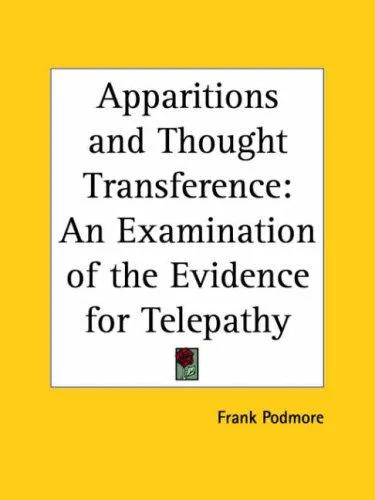
Apparitions and Thought-Transference
 75
75

Apparitions and Thought-Transference
Frank Podmore’s "Apparitions and Thought-Transference" remains a crucial, if dry, compilation for anyone tracing the historical roots of parapsychology. Rather than offering sensational tales, Podmore acts as a sober cataloger, meticulously presenting case after case of alleged telepathy and clairvoyance. His strength lies in this encyclopedic approach, providing a dense reference for the raw data that fueled early psychical research. A notable limitation, however, is the sheer volume of detail, which can make sustained reading an arduous task. The passage detailing various experimental setups for thought-transference trials, while informative, exemplifies this exhaustive methodology. It presents a solid, if unexciting, foundation for understanding the evidence considered by early investigators.
Podmore’s work is a foundational text for the empirical study of the paranormal.
📝 Description
75
Frank Podmore's 1905 book, Apparitions and Thought-Transference, examines psychic phenomena with a critical eye.
Published in 1905, Frank Podmore's Apparitions and Thought-Transference is a detailed study of psychic phenomena reported in the late 19th and early 20th centuries. Podmore, associated with the Society for Psychical Research, did not present this as a speculative work. Instead, he meticulously gathered and analyzed anecdotal evidence of telepathy, clairvoyance, and similar experiences. His aim was to assess the credibility of these accounts and search for explanations beyond simple delusion or fraud. The book is best suited for readers interested in the historical approach to psychical research and the intellectual debates surrounding consciousness and belief during the Victorian and Edwardian eras. It offers a look into early attempts to apply scientific scrutiny to paranormal claims, distinct from later interpretations.
This work emerged during a time of significant scientific and philosophical discussion about the mind and reality. The late 1800s saw the formation of groups like the Society for Psychical Research, which sought to investigate unusual experiences using empirical methods. Podmore's study engages with the prevailing materialist perspectives of the time, addressing how reported mental occurrences seemed to challenge established physical and psychological theories. It provides a valuable historical perspective for understanding the study of the paranormal.
Apparitions and Thought-Transference belongs to the tradition of psychical research that flourished in the late 19th and early 20th centuries. This period saw attempts to apply scientific methodology to phenomena traditionally relegated to folklore or religious belief. Figures like Podmore, associated with the Society for Psychical Research, aimed to investigate claims of telepathy, clairvoyance, and spiritualism through careful collection and analysis of evidence. The work represents a specific effort within a broader movement to understand consciousness and the potential for mental abilities beyond conventional sensory perception, often in dialogue with or in opposition to the materialist worldview.
💡 Why Read This Book?
• Learn about the foundational methodology used by early psychical researchers to collect and evaluate evidence for telepathy and clairvoyance, as exemplified in Podmore's detailed case studies from the late 19th century. • Understand the specific challenges and intellectual climate faced by investigators in the era of the Society for Psychical Research, recognizing how Podmore grappled with phenomena that contradicted prevailing scientific thought. • Gain insight into early experimental designs for testing thought-transference, appreciating the practical difficulties and ethical considerations Podmore navigated when attempting to verify subjective experiences.
⭐ Reader Reviews
Honest opinions from readers who have explored this book.
❓ Frequently Asked Questions
What is thought-transference according to Frank Podmore's research?
Podmore defines thought-transference as the purported direct communication of thoughts or mental states between individuals, without recourse to the ordinary sensory channels. His work meticulously documents reported instances and attempts to analyze their credibility.
When was Frank Podmore's "Apparitions and Thought-Transference" first published?
While the provided information states a first publication year of 2018, the work itself is a historical text that emerged from research conducted in the late 19th and early 20th centuries, reflecting the scientific and philosophical debates of that period.
What is the primary focus of "Apparitions and Thought-Transference"?
The book's primary focus is the empirical investigation and cataloging of reported phenomena such as telepathy, clairvoyance, and apparitions. Podmore sought to analyze anecdotal evidence critically and explore potential explanations.
Who were Frank Podmore's contemporaries in psychical research?
Frank Podmore was associated with prominent figures in early psychical research, including members of the Society for Psychical Research such as Henry Sidgwick and Frederic W. H. Myers, who were active during the late Victorian and Edwardian eras.
Does Podmore offer explanations for apparitions in the book?
Yes, Podmore examines various reported apparitions, considering explanations ranging from psychological misinterpretation and hallucination to the possibility of telepathic or discarnate agency, within the context of the evidence presented.
What historical period does "Apparitions and Thought-Transference" primarily cover?
The book draws heavily on accounts and research from the late 19th century and early 20th century, reflecting the intense interest and scientific inquiry into spiritualism and psychic phenomena during that era.
🔮 Key Themes & Symbolism
Empirical Investigation of Psychic Phenomena
This work champions a systematic, evidence-based approach to phenomena like telepathy and clairvoyance. Podmore moves beyond mere anecdote to dissect reported experiences, scrutinizing witness testimonies and experimental conditions. He aims to establish a factual basis for discussions on the paranormal, reflecting the late Victorian era's scientific aspirations to quantify and categorize even the most elusive aspects of human experience. The book serves as a historical document of this early empirical turn in psychical research.
The Nature of Consciousness and Perception
Podmore's exploration of thought-transference and apparitions inherently probes the boundaries of consciousness. He questions whether mental states are confined solely within the physical brain or if they possess an independent, transferable quality. By analyzing cases of perceived shared experiences or visual manifestations, the book engages with philosophical debates on mind-body dualism and the potential for non-local consciousness, challenging purely materialistic explanations prevalent in his time.
Sociology of Belief and Superstition
Beyond the phenomena themselves, "Apparitions and Thought-Transference" offers a lens into the social dynamics surrounding belief in the supernatural. Podmore documents the widespread nature of such reports across different social strata and geographical locations. His work implicitly examines why certain beliefs persist and how collective experiences, even if subjective, shape cultural understanding and personal conviction, contributing to the study of how extraordinary claims gain traction.
Historical Methodology of Psychical Research
The book is a prime example of the rigorous, albeit sometimes debated, methodology employed by early members of the Society for Psychical Research. Podmore's detailed cataloging, his attempts to verify accounts, and his critical analysis of potential biases or errors in perception represent foundational efforts in parapsychological inquiry. Readers encounter firsthand the challenges and standards set by pioneers seeking to legitimize the study of psychic phenomena.
💬 Memorable Quotes
Direct passages from the work, attributed to the author.
“The evidence for telepathy is largely anecdotal, requiring careful scrutiny.”
— This statement highlights Podmore's cautious approach, emphasizing that claims of direct mind-to-mind communication, while numerous, are primarily based on personal testimonies that need rigorous examination for reliability and potential alternative explanations.
“Apparitions may be explained by psychological suggestion or hallucination.”
— Here, Podmore suggests that visual or auditory manifestations of figures, often attributed to ghosts, could stem from internal mental processes rather than external, supernatural causes, reflecting a scientific attempt to clarify such experiences.
“Experimental conditions for thought-transference must eliminate sensory cues.”
— This emphasizes the critical requirement for controlled observation in psychical research: to prove telepathy, any experiment must demonstrably prevent the use of normal senses, isolating the alleged mental transmission.
“The persistence of belief in spiritual phenomena warrants investigation.”
— Podmore acknowledges the widespread and enduring nature of beliefs in ghosts, spirits, and psychic abilities, suggesting that their very prevalence makes them a subject worthy of serious, empirical study, rather than outright dismissal.
“Discrimination is necessary when evaluating reports of psychic events.”
— This principle underscores the need for critical judgment when assessing accounts of unusual experiences. Podmore urges readers and researchers alike to differentiate between credible testimony and unreliable narration or misinterpretation.
🌙 Esoteric Significance
Tradition
While not strictly adhering to a single esoteric lineage like Kabbalah or Hermeticism, Podmore's work is deeply embedded within the Western Esoteric Tradition's late 19th-century manifestation, particularly its engagement with psychical research and theosophy. It represents a significant effort to bridge empirical investigation with esoteric concepts of mind, consciousness, and potential non-physical realms, seeking rational explanations for phenomena often accepted on faith within older mystical traditions.
Symbolism
The book primarily deals with abstract concepts rather than overt symbolism. However, the 'apparition' itself functions as a potent symbol of the boundary between the physical and non-physical, life and death, the known and the unknown. The concept of 'thought-transference' symbolizes the interconnectedness of minds, hinting at a universal consciousness or psychic ether that ancient traditions often posited but which Podmore sought to empirically verify.
Modern Relevance
Podmore's meticulous documentation and analytical approach laid groundwork for modern parapsychology and the scientific study of consciousness. Contemporary researchers exploring remote viewing, precognition, and the nature of subjective experience, as well as scholars of the history of science and religion, continue to reference his foundational work. His critical methodology remains relevant for evaluating anecdotal evidence in fields ranging from ufology to near-death experiences.
👥 Who Should Read This Book
• Students of the history of psychical research seeking foundational texts on early empirical investigations into telepathy and apparitions. • Scholars of Victorian and Edwardian intellectual history interested in the intersection of science, spirituality, and the occult during a period of rapid societal change. • Skeptics and proponents of paranormal phenomena looking for a detailed, evidence-based compilation of historical reports and analytical approaches to subjective experiences.
📜 Historical Context
Frank Podmore's "Apparitions and Thought-Transference" emerged from the fertile intellectual ground of late Victorian and Edwardian England, a period marked by both burgeoning scientific positivism and a widespread fascination with the spiritual and the unknown. As a key figure in the Society for Psychical Research (SPR), co-founded in 1882 by figures like Henry Sidgwick and Edmund Gurney, Podmore was at the forefront of attempts to apply empirical methods to phenomena traditionally relegated to folklore and religion. This era witnessed intense debate between materialistic science, which sought explanations within known physical laws, and spiritualist or idealist philosophies that allowed for non-physical realities. Podmore's work directly engaged with the prevailing scientific skepticism, meticulously cataloging reported psychic experiences – telepathy, clairvoyance, and apparitions – to test the limits of conventional understanding. He operated within an intellectual milieu that also included thinkers like F.W.H. Myers, whose concept of the 'subliminal self' influenced discussions on consciousness, and figures like Sir Arthur Conan Doyle, who actively championed spiritualism. The SPR itself provided a platform for such investigations, though it was often criticized by both staunch materialists and fervent spiritualists.
📔 Journal Prompts
Apparition accounts and their potential psychological triggers.
The concept of thought-transference and its implications for consciousness.
Evaluating the credibility of anecdotal evidence presented in the text.
The historical context of the Society for Psychical Research's investigations.
Distinguishing between hallucination and potential telepathic perception.
🗂️ Glossary
Thought-Transference
The purported direct transmission of thoughts, feelings, or mental impressions from one person to another without the use of the recognized sensory organs.
Clairvoyance
The supposed ability to perceive objects, events, or information that is not accessible to the normal senses, often over distance or time.
Apparition
A visible manifestation of a person or thing, especially one that is believed to be a ghost or a spirit of a deceased person.
Psychical Research
The empirical investigation of alleged psychic phenomena, such as telepathy, clairvoyance, precognition, and psychokinesis, often employing scientific methods.
Anecdotal Evidence
Information based on personal accounts rather than on fact or research; often used in the context of psychic phenomena reports.
Suggestion (Psychological)
The process by which an idea or impression is introduced into the mind, potentially influencing thoughts, feelings, or behavior without conscious awareness.
Hallucination
A sensory experience that appears real but is created by the mind, occurring in the absence of an external stimulus.
🔮 Readers Also Liked
Browse all →








More by Frank Podmore
All books →




More Free Occult Philosophy Books
View all →