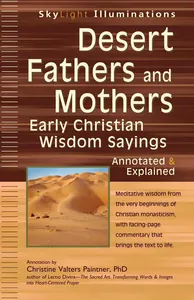
Apoftegmele părinţilor deşertului
 74
74

Apoftegmele părinţilor deşertului
The compilation known as *Apoftegmele Părinţilor deşertului* offers a stark, unadorned look at the rigorous spiritual discipline practiced by early ascetics. Its strength lies in its directness; the aphorisms cut to the heart of spiritual struggle without embellishment. One particularly striking passage discusses the monk who, after years of striving, realizes his true progress began only when he stopped judging others. The limitation, however, is the sheer volume and often repetitive nature of the sayings, which can obscure the deeper currents for the casual reader. Without a guiding commentary, some of the cultural and theological nuances of 4th-century Egyptian monasticism remain opaque. This work serves as a potent, if unvarnished, manual for the dedicated spiritual seeker.
📝 Description
74
The Apophthegmata Patrum contains sayings from 4th and 5th century Egyptian desert monks.
Apoftegmele Părinţilor deşertului, or the Sayings of the Desert Fathers, is a compilation of anecdotes and pronouncements attributed to early Christian ascetics in Egypt. These monks, active around the 4th and 5th centuries CE, developed a distinct spiritual path focused on inner stillness and overcoming personal struggles. The collection preserves their practical wisdom on managing desires, attaining mental clarity, and understanding the inner life.
The text details the lives and teachings of figures like Saint Anthony the Great and Macarius of Egypt, who shaped early Christian monasticism. Their approach emphasized spiritual combat, the constant watchfulness of the mind, and the pursuit of a tranquil inner state. While rooted in orthodox Christianity, these teachings share certain resonances with later contemplative traditions and philosophical ideas concerning the soul and its development.
This collection belongs to a stream of Christian mysticism that values direct spiritual experience and the cultivation of inner discipline over purely intellectual or ritualistic approaches. The Desert Fathers sought a direct relationship with the divine through ascetic practice and contemplation, aiming for a state of inner peace and spiritual freedom. Their methods, focused on the purification of the heart and mind, influenced subsequent contemplative movements within and beyond Christianity, offering a model for achieving spiritual depth through lived experience.
💡 Why Read This Book?
• Learn about the ascetic practice of *nepsis* (vigilance) as described in the sayings, gaining techniques for mental clarity unavailable in modern self-help. • Understand the concept of *apatheia* through the direct anecdotes of the Desert Fathers, offering a historical perspective on emotional regulation beyond contemporary psychology. • Discover the historical context of early Christian monasticism through specific mentions of figures like Saint Anthony the Great, enriching your understanding of Western contemplative traditions.
⭐ Reader Reviews
Honest opinions from readers who have explored this book.
❓ Frequently Asked Questions
What is the historical period from which the sayings of the Desert Fathers originate?
The sayings are primarily attributed to monks living in the Egyptian desert during the 4th and 5th centuries CE, a foundational period for Christian monasticism.
Who are some key figures associated with the Desert Fathers' teachings?
Prominent figures include Saint Anthony the Great, often hailed as the father of monasticism, and Macarius of Egypt, whose wisdom is frequently recorded in these collections.
What does 'apatheia' mean in the context of the Desert Fathers?
'Apatheia' refers to a state of spiritual tranquility and inner peace, characterized by freedom from disturbing passions and mental agitation, a central goal of their ascetic practice.
Are these sayings exclusively religious or do they have broader philosophical implications?
While rooted in Christian theology, the sayings explore universal themes of self-mastery, the nature of thought, and the pursuit of inner peace, offering insights applicable beyond a strictly religious framework.
How were these sayings originally transmitted?
Initially, these aphorisms and stories were transmitted orally within the monastic communities of the Egyptian desert before being compiled into written collections.
What role did 'discernment' play for the Desert Fathers?
Discernment (*diakrisis*) was crucial for distinguishing between beneficial and harmful thoughts, recognizing divine inspiration versus demonic deception, and making wise spiritual choices.
🔮 Key Themes & Symbolism
The Battle for the Mind
The collection vividly illustrates the constant spiritual warfare waged within the mind. Sayings detail the nature of intrusive thoughts, the tactics of 'demons' (often interpreted as negative thought patterns or egoic desires), and the necessity of *nepsis* (vigilance) to maintain spiritual focus. The emphasis is on recognizing these mental incursions and redirecting the mind towards prayer and contemplation, showing that the true arena of spiritual development is internal.
Asceticism as Inner Transformation
Far from mere physical deprivation, the ascetic practices described by the Desert Fathers are presented as tools for profound inner transformation. Fasting, solitude, and manual labor are means to achieve *apatheia* – a state of undisturbed inner peace – and to purify the heart. The goal is not self-punishment but the dismantling of egoic attachments and the cultivation of virtues like humility and charity, leading to a more direct experience of the divine.
The Wisdom of Simplicity
The aphoristic style of the *Apophthegmata Patrum* itself reflects a core teaching: the power of distilled truth. Complex spiritual realities are conveyed through brief, memorable sayings and parables. This emphasizes the importance of direct experience and intuitive understanding over elaborate theological systems. The wisdom offered is practical, applicable to the daily struggles of anyone seeking a more conscious spiritual life.
Humility as the Foundation
Humility is consistently presented as the bedrock upon which all spiritual progress is built. The sayings warn against pride, self-reliance, and spiritual arrogance, often illustrating how these vices lead to downfall. True humility is shown not as self-deprecation, but as an accurate assessment of one's dependence on divine grace and a recognition of one's limitations, fostering an attitude of receptivity and obedience.
💬 Memorable Quotes
Direct passages from the work, attributed to the author.
“A monk asked an elder: 'What is obedience?' The elder replied: 'Obedience is the renunciation of one's own will.'”
— This concise exchange highlights a central tenet of asceticism: the voluntary surrender of personal desires and inclinations as a path to spiritual freedom and alignment with a higher purpose.
“The elder said: 'If you are silent, you will be delivered from much evil. If you are always talking, you will be overcome by evil.'”
— This emphasizes the virtue of silence (*hesychia*) and the dangers of uncontrolled speech, suggesting that mindful restraint in communication is essential for preserving spiritual purity and avoiding entanglement in worldly affairs.
“An elder saw a monk who was always praying, but his mind was wandering. The elder told him, 'Your prayer is like a well without water.'”
— This parable underscores the importance of *nepsis* (mindfulness or vigilance) in prayer. It suggests that rote repetition without inner focus is insufficient; true prayer requires the active engagement and presence of the mind.
“Regarding the demon of fornication, the elder said: 'It is not overcome by many prostrations, but by humility and service to others.'”
— This points to the inadequacy of mere external ritual for overcoming deep-seated spiritual challenges, advocating instead for internal virtues like humility and practical charity as more potent spiritual weapons.
“A brother came to an elder and said, 'I have fallen.' The elder replied, 'Rise again.' The brother said, 'I have fallen again.' The elder said, 'Rise again.'”
— This dialogue illustrates the persistent nature of spiritual struggle and the importance of unyielding perseverance. It conveys a message of hope and continuous effort, emphasizing that repeated falls do not preclude eventual spiritual victory.
🌙 Esoteric Significance
Tradition
The *Apophthegmata Patrum* represents a foundational text within the Christian contemplative tradition, which itself has significant esoteric dimensions. It belongs to the lineage of early Christian asceticism and mysticism, emphasizing direct experience of the divine through rigorous self-discipline and inner work. While explicitly Christian, its focus on cultivating inner states, overcoming psychological obstacles, and achieving spiritual clarity aligns with broader esoteric goals found in Hermeticism and Gnosticism, albeit through a distinct theological framework.
Symbolism
Key symbols include the *desert* itself, representing a place of stripping away worldly distractions to encounter the divine, and a space for spiritual testing. The *demons* are not merely external entities but potent symbols of inner passions, negative thought forms, and egoic attachments that must be recognized and overcome. The *cell* or *cave* symbolizes the inner sanctuary of the soul, where focused prayer and self-examination take place, a microcosm of the spiritual universe.
Modern Relevance
Contemporary contemplative practitioners, psychologists interested in the roots of mindfulness and cognitive therapy, and scholars of comparative spirituality draw heavily on the *Apophthegmata Patrum*. Figures like Thomas Keating (Centering Prayer) and various modern monastic movements continue to engage with these teachings. The emphasis on *apatheia* and *nepsis* finds echoes in modern secular mindfulness practices, albeit stripped of their original theological context, demonstrating the enduring appeal of these ancient techniques for mental and emotional regulation.
👥 Who Should Read This Book
• Students of early Christian history and monasticism seeking primary source material on the lives and teachings of the Desert Fathers. • Individuals interested in contemplative prayer and ascetic practices looking for foundational wisdom on self-discipline and spiritual warfare. • Practitioners of meditation and mindfulness seeking historical perspectives on techniques for mental clarity and overcoming inner obstacles.
📜 Historical Context
The *Apophthegmata Patrum* emerged from the crucible of 4th and 5th century CE Egyptian monasticism, a period of intense spiritual experimentation following the Edict of Milan (313 CE) which legalized Christianity. Figures like Saint Anthony the Great, Macarius of Egypt, and Evagrius Ponticus shaped this movement, emphasizing eremitical life, ascetic discipline, and interior prayer. This focus on the *nous* (mind or intellect) and its purification resonated with, and sometimes diverged from, contemporary Neoplatonic philosophical currents, particularly in the works of Evagrius. While the sayings are rooted in orthodox Christian theology, their exploration of inner states and spiritual combat shares conceptual space with Gnostic ideas about overcoming ignorance. The reception was initially within monastic circles, but the collections quickly gained wider circulation, influencing Byzantine and later Western monastic traditions, despite occasional controversies surrounding figures like Evagrius Ponticus and his teachings on the 'eight evil thoughts'.
📔 Journal Prompts
The monk's struggle against the demon of pride: How does the concept of humility, as presented in the sayings, counter such internal adversaries?
The practice of *nepsis*: Reflect on moments when your mind wandered during prayer or focused activity, and how vigilance could have altered the experience.
The elder's advice on silence: Consider the times when speaking excessively led you into trouble or distraction, contrasting it with the benefits of restraint.
The desert as a spiritual crucible: How does embracing solitude and simplicity, as exemplified by the Desert Fathers, challenge your current life circumstances?
The goal of *apatheia*: Explore the difference between emotional suppression and the state of inner tranquility sought by the Desert Fathers.
🗂️ Glossary
Desert Fathers
Early Christian monks and hermits, primarily from Egypt, who lived in the desert during the 4th and 5th centuries CE, seeking spiritual perfection through asceticism and contemplation.
Apophthegmata Patrum
A collection of sayings, anecdotes, and teachings attributed to the Desert Fathers, often organized thematically or by individual elder.
Apatheia
A state of spiritual tranquility and inner peace, characterized by freedom from disturbing passions and mental agitation; often translated as 'impassibility' or 'non-passion'.
Nepsis
A state of vigilant mindfulness or watchfulness, particularly concerning the thoughts and activities of the mind, crucial for discerning spiritual influences.
Discernment (Diakrisis)
The spiritual ability to distinguish between different kinds of thoughts, motivations, and spiritual influences, crucial for working through the inner life.
Asceticism
A practice of rigorous self-discipline, typically involving abstinence from indulgence, as a means of spiritual purification and advancement.
Humility
A virtue characterized by a modest view of one's own importance; in the context of the Desert Fathers, it implies recognizing one's dependence on God and the need for spiritual guidance.