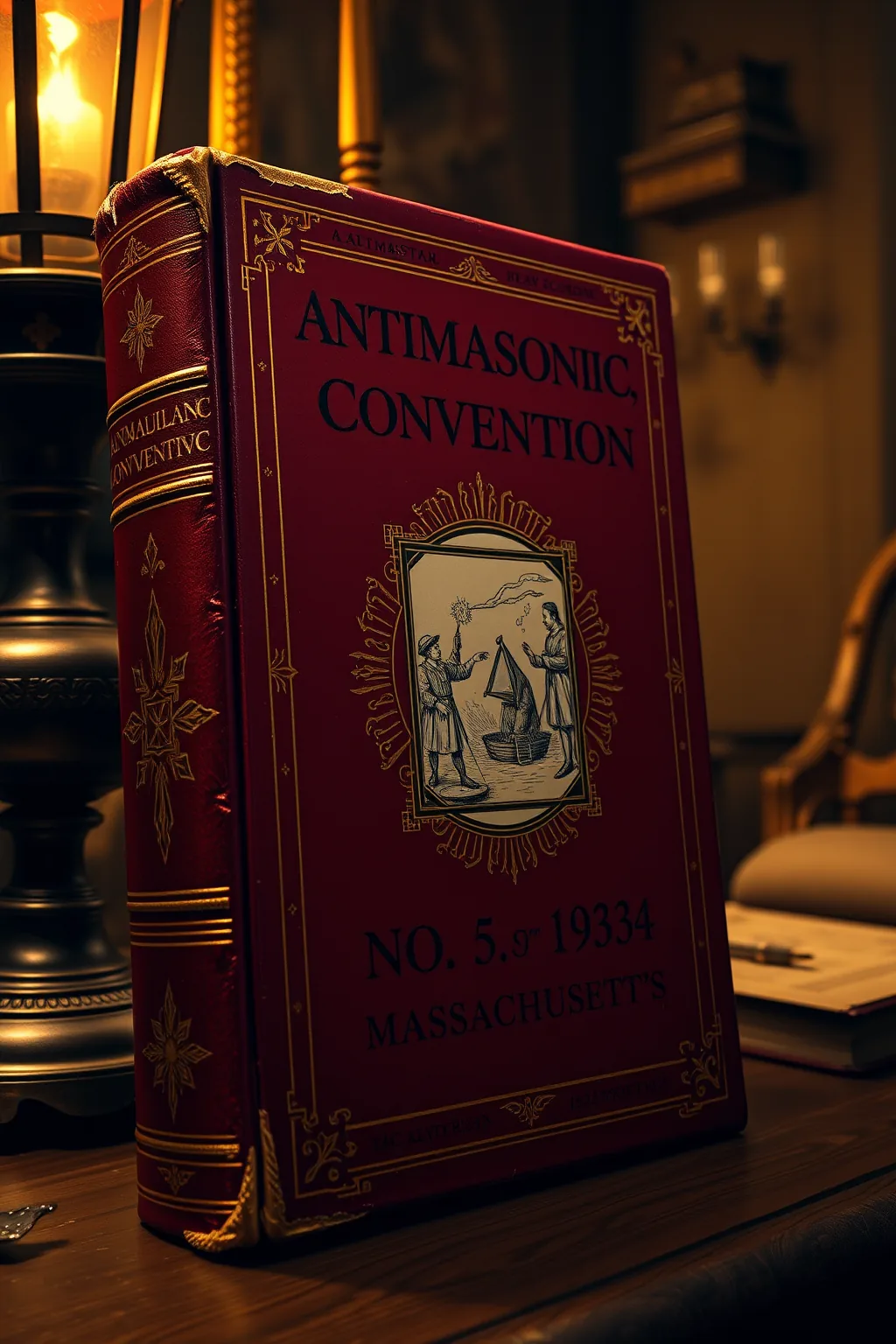
Antimasonic Republican Convention For Massachusetts No. 5 1934
 78
78

Antimasonic Republican Convention For Massachusetts No. 5 1934


Ophelia Vance, Mystical Literature Reviewer — This compelling tract from the 1934 Antimasonic Republican Convention For Massachusetts No. 5 offers profound insights into the perennial human fascination with hidden orders and their influence. It transcends mere historical artifact, revealing a potent undercurrent of spiritual and philosophical resistance. The document’s strength lies in its evocative language, hinting at esoteric principles without overt declaration, and its ability to resonate with contemporary concerns about transparency and power structures. Ideal for scholars of secret societies, seekers of alternative political philosophies, and anyone intrigued by the historical interplay of public opinion and clandestine influence.
📝 Description
78
The 1934 Antimasonic Republican Convention For Massachusetts No. 5 produced a document that spoke against a secretive fraternity.
This 1934 convention document from Massachusetts addresses anxieties surrounding a secretive fraternity and its influence. It moves beyond simple political statements to touch on a widespread unease about transparency and the suspicion of hidden structures controlling power and information. The text uses symbolism to reference historical patterns of influence and how groups might shape public opinion through covert means.
It encourages readers to recognize forces that shape events from behind the scenes. The document calls for questioning accepted stories and uncovering truths that are not openly discussed. It appeals to individuals interested in uncovering concealed histories and those who feel the presence of hidden influences affecting everyday life. The work invites a consideration of the interplay between what is seen and unseen, what is stated and what is kept secret, within the broader context of human events.
While seemingly a political tract, the document reflects a strain of thought common in esoteric traditions that scrutinize perceived hidden hierarchies and their control over knowledge. Its language of 'veiled pronouncements' and 'unseen currents' aligns with an interest in decoding symbols and questioning surface realities. Such texts often emerge from periods of social upheaval, seeking to expose what are believed to be manipulative forces operating outside public view, echoing themes found in certain strands of Western esotericism concerned with societal control and liberation through gnosis.
💡 Why Read This Book?
Uncover the historical roots of societal suspicion towards hidden power structures. This text offers a unique lens through which to examine the psychological and philosophical motivations behind movements advocating for transparency. It is essential reading for those interested in the esoteric dimensions of political discourse and the enduring human quest for unveiled truth.
⭐ Reader Reviews
Honest opinions from readers who have explored this book.
❓ Frequently Asked Questions
What is the primary focus of this document?
The primary focus is the antimasonic sentiment expressed by the Republican Convention in Massachusetts in 1934, highlighting concerns about the influence and secrecy of Freemasonry on societal and political matters.
Is this a historical political manifesto or a mystical text?
While rooted in a historical political movement, the language and underlying anxieties often carry an esoteric resonance, touching upon themes of hidden knowledge, societal control, and the search for deeper truths.
Who was the intended audience for this publication?
The intended audience was likely the general public in Massachusetts, particularly those already harboring reservations about Freemasonry, as well as fellow political activists and thinkers interested in societal reform.
Does this document reveal specific Masonic secrets?
No, the document does not reveal specific Masonic secrets. Instead, it expresses opposition and suspicion towards the perceived secrecy and influence of the organization.
What makes this document relevant today?
Its relevance lies in the enduring themes of transparency, the potential for hidden influence in society, and the human tendency to question powerful, often opaque, organizations.
🔮 Key Themes & Symbolism
The Shadow of Secrecy
This theme explores the pervasive human apprehension surrounding clandestine organizations and the perceived opacity of their operations. The document probes the anxieties that arise when power structures operate behind veiled doors, suggesting that secrecy, regardless of intent, breeds suspicion and can be perceived as a tool for control. It explores the psychological impact of not knowing, and the societal desire for transparency as a bedrock of trust and equitable governance. The allure of uncovering what is hidden, and the inherent distrust of the unseen, forms a potent undercurrent.
The Unseen Hand of Influence
Here, we examine the concept of 'the unseen hand' – not in the economic sense, but as a metaphor for hidden forces shaping societal narratives and political outcomes. The text implicitly questions the authenticity of public discourse when it might be subtly guided by the agendas of powerful, non-public entities. It speaks to a primal fear of manipulation, where individual agency is undermined by forces operating beyond the reach of democratic scrutiny. This theme encourages contemplation on the true locus of power and the subtle mechanisms through which it is wielded.
The Quest for Societal Purity
This theme addresses the impulse towards 'purity' within a societal context, particularly when confronted with perceived corruption or undue influence. The antimasonic movement, as represented here, often stems from a desire to purify the body politic of what is seen as a corrupting, exclusionary element. It reflects a yearning for a society governed by openly declared principles rather than by the perceived machinations of exclusive brotherhoods. This quest for purity can be seen as a spiritual or philosophical imperative for authenticity and ethical governance.
💬 Memorable Quotes
Direct passages from the work, attributed to the author.
“Where shadows lengthen, light is suspect.”
— This aphorism suggests that in areas of obscurity or secrecy, genuine truth and good intentions are often met with distrust and suspicion.
“The veil is thin, but the gaze must be keen.”
— This implies that while the hidden truths are not entirely inaccessible, discerning them requires sharp perception and a dedicated effort to look beyond the superficial.
“Brotherhoods forged in darkness do not illuminate the dawn.”
— This suggests that organizations built on secrecy and exclusivity are inherently incapable of fostering genuine progress or enlightenment for the broader society.
“The unexamined oath is a silent chain.”
— This highlights the danger of blind adherence to commitments or allegiances, particularly those made in private, which can lead to a loss of personal freedom and critical judgment.
“To know the architect is to understand the edifice.”
— This philosophical statement underscores the importance of understanding the origins and guiding principles behind any structure, whether literal or societal, to truly comprehend its nature and function.
🌙 Esoteric Significance
Tradition
While not overtly a text of a specific esoteric tradition, its significance lies in its engagement with the *perennial* themes of secrecy, hidden knowledge, and the perceived influence of clandestine organizations. It taps into a long-standing human fascination with the 'occult' – not necessarily magical, but the hidden and the veiled – that has informed many mystical and philosophical lineages throughout history. It speaks to the archetypal struggle between illumination and shadow.
Symbolism
The document is rich with implicit symbolism. 'Shadows' represent secrecy and the unknown, while 'light' symbolizes truth and transparency. The 'veil' is a potent symbol for the hidden nature of Masonic operations, implying that what is concealed is often more significant than what is revealed. References to 'edifices' and 'architects' evoke the idea of societal structures built by unseen hands. The 'oath' itself can be seen as a symbolic binding, potentially restrictive.
Modern Relevance
In an era saturated with information yet often plagued by misinformation and concerns about powerful lobbies, the anxieties voiced in this 1934 document resonate profoundly. The questions about transparency, hidden influence, and the ethics of secret societies remain pertinent. Understanding historical critiques of such organizations provides a valuable framework for critically examining contemporary power dynamics and the ongoing quest for accountability in both public and private spheres.
👥 Who Should Read This Book
This text is essential for scholars of American history, political science, and the sociology of secret societies. Seekers of esoteric knowledge will find it a fascinating case study in how suspicion of hidden power manifests in public discourse. Practitioners of critical thinking will benefit from its examination of argumentation and its appeal to latent anxieties. While not a direct how-to guide, it offers clear insights for anyone interested in the historical dynamics of societal control and the enduring human fascination with the unseen.
📜 Historical Context
The year 1934 marked a period of significant social and political upheaval in the United States, still grappling with the aftermath of the Great Depression and navigating complex international relations. Antimasonry, though a movement with roots stretching back to the early 19th century, continued to find fertile ground in times of uncertainty, often resonating with populist sentiments that viewed established institutions, including Freemasonry, with suspicion. The perceived exclusivity and elaborate rituals of Masonic lodges, coupled with their historical influence in various sectors of society, made them a convenient focal point for anxieties about hidden power and undemocratic influence. This convention's pronouncements, therefore, should be understood not just as a political statement, but as a reflection of broader societal currents questioning authority, seeking transparency, and grappling with the enduring tension between the visible structures of governance and the potential for unseen forces to shape public life.
📔 Journal Prompts
Reflect on a time you felt a lack of transparency in a situation, and how it affected your perception.
What does the concept of 'hidden knowledge' mean to you in the digital age?
Consider the potential benefits and drawbacks of organizations operating with a degree of secrecy.
How might historical fears of secret societies inform contemporary societal concerns?
Write about a personal experience where you felt compelled to question established narratives.
🗂️ Glossary
Antimasonry
A movement or sentiment opposing Freemasonry, often based on beliefs about its secrecy, alleged political influence, or perceived anti-religious nature.
Fraternity
An organization of men, typically with a common interest, profession, or social standing, often characterized by rituals and a bond of brotherhood.
Clandestine
Kept secret or done secretively, especially because illicit or not approved of. Pertaining to secrecy and hidden operations.
Esoteric
Intended for or likely to be understood by only a small number of people with a specialized knowledge or interest. Relating to hidden or secret knowledge.
Philanthropy
The desire to promote the welfare of others, expressed especially by the generous donation of money to good causes. In this context, potentially viewed with suspicion if perceived as a means of influence.
This book appears in 2 collections
🔮 Readers Also Liked
Browse all →





From the “Secret Societies” Collection
View all →





More Free Freemasonry & Secret Societies Books
View all →