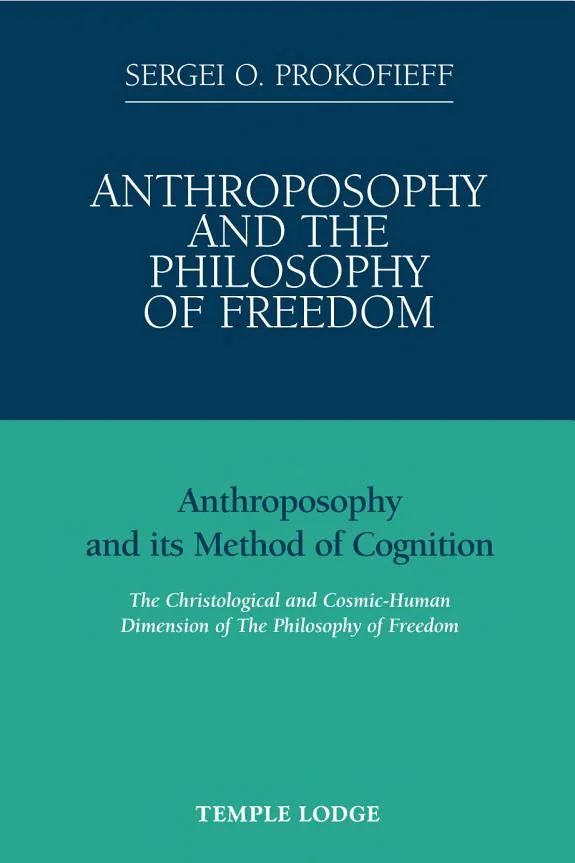
Anthroposophy and the Philosophy of Freedom
 73
73

Anthroposophy and the Philosophy of Freedom
Sergei O. Prokofieff’s "Anthroposophy and the Philosophy of Freedom" is a tightly focused monograph, acting less as an introduction and more as an exegesis of Rudolf Steiner’s "Intuitive Thinking as a Spiritual Path." Prokofieff begins with a striking quote attributed to Walter Johannes Stein, relaying Rudolf Steiner’s own emphasis on the 1894 work as containing the entirety of Anthroposophy. This sets a clear agenda: to demonstrate how the philosophical principles articulated in "The Philosophy of Freedom" are not just preparatory but constitutive of Steiner's later spiritual science. Prokofieff’s strength lies in his unwavering commitment to this thesis, meticulously drawing connections between the early philosophical text and the later, more overtly spiritual-scientific writings. However, the book’s singular focus can be its limitation; readers unfamiliar with "The Philosophy of Freedom" or Steiner's broader Anthroposophy might find the dense argumentation challenging without prior context. A particularly illuminating section discusses how the concept of moral imagination, derived from the free act of thinking, underpins the ethical dimension of Anthroposophy. Ultimately, Prokofieff delivers a scholarly, if somewhat specialized, argument for the primacy of "The Philosophy of Freedom" within the Anthroposophical corpus.
📝 Description
73
Sergei O. Prokofieff's 2009 book argues Rudolf Steiner's 1894 "The Philosophy of Freedom" is Anthroposophy's bedrock.
In "Anthroposophy and the Philosophy of Freedom," Sergei O. Prokofieff examines Rudolf Steiner's 1894 work, "Intuitive Thinking as a Spiritual Path: A Philosophy of Freedom." Prokofieff asserts that Steiner's treatise forms the essential philosophical basis for all subsequent Anthroposophical study and practice. He contends that grasping the nature of free thinking, as detailed by Steiner, is the direct path to understanding Anthroposophy in its entirety. This book is directed toward those already familiar with Anthroposophy who wish to deepen their comprehension by studying its philosophical roots. Students of Steiner's wider teachings will find value in tracing his ideas back to this early text. The work also addresses readers interested in the philosophical foundations of esoteric thought and the concepts of consciousness and freedom.
Steiner published "The Philosophy of Freedom" in 1894, a time of increasing scientific materialism and a perceived spiritual void in European thought. His book presented a method for attaining spiritual knowledge through conscious, free thinking, setting itself apart from both religious dogma and unchecked mysticism. Prokofieff's analysis places Steiner's foundational text within the context of the later Anthroposophical movement, highlighting its continuing significance for understanding Steiner's later work.
This book situates Rudolf Steiner's "The Philosophy of Freedom" as a central text within the broader movement of Anthroposophy. Prokofieff connects Steiner's early philosophical work, which emphasized the power of conscious, self-directed thinking, to the spiritual scientific path that Anthroposophy represents. It suggests that the capacity for free, intuitive thought is not merely an intellectual faculty but the very means by which individuals can access spiritual realities and develop their own inner capacities, a core tenet of esoteric traditions seeking direct experience of the spiritual world.
💡 Why Read This Book?
• Gain a precise understanding of how Rudolf Steiner’s 1894 work, "The Philosophy of Freedom," functions as the core philosophical basis for all of Anthroposophy, as argued by Prokofieff. • Explore the specific "act of freedom" described by Steiner, learning how conscious thinking is presented as the method for accessing spiritual knowledge. • Grasp the relationship between individual consciousness and the development of spiritual perception, as detailed in Prokofieff's analysis of Steiner's foundational text.
⭐ Reader Reviews
Honest opinions from readers who have explored this book.
❓ Frequently Asked Questions
What is the primary focus of Sergei O. Prokofieff's "Anthroposophy and the Philosophy of Freedom"?
The book centers on Rudolf Steiner's "Intuitive Thinking as a Spiritual Path: A Philosophy of Freedom" (1894), arguing it forms the essential philosophical foundation for the entirety of Anthroposophy.
When was "Anthroposophy and the Philosophy of Freedom" first published?
Sergei O. Prokofieff's work was first published in 2009.
What does Rudolf Steiner's "Philosophy of Freedom" emphasize as central?
It emphasizes the "act of freedom" in thinking – a conscious, self-aware engagement with one's own cognitive processes – as the key to both philosophical understanding and spiritual insight.
Is this book suitable for beginners in Anthroposophy?
While it discusses foundational concepts, it is more of an in-depth analysis for those already familiar with Rudolf Steiner's work, rather than a general introduction.
What is the connection between "The Philosophy of Freedom" and the broader Anthroposophical movement?
Prokofieff posits that understanding the principles of free thinking from the 1894 work is the direct path to comprehending the entirety of Anthroposophy's subsequent developments.
Who was Walter Johannes Stein and why is he quoted?
Walter Johannes Stein was an associate of Rudolf Steiner. His quoted recollection highlights Steiner's own view of "The Philosophy of Freedom" as containing the essence of his entire life's work.
🔮 Key Themes & Symbolism
The Primacy of Free Thinking
Prokofieff highlights Rudolf Steiner's 1894 work, "Intuitive Thinking as a Spiritual Path: A Philosophy of Freedom," as the indispensable philosophical bedrock for Anthroposophy. The text argues that grasping the 'act of freedom'—the conscious, self-directed nature of thinking—is not merely an introductory step but the essential key. This self-aware cognitive process, distinct from passive reception of ideas, is presented as the primary tool for developing spiritual perception and understanding the entirety of Steiner's later teachings.
Consciousness and Spiritual Development
The book examines how the development of a free and conscious will, as outlined in Steiner's early philosophy, directly correlates with the capacity for spiritual apprehension. Prokofieff elaborates on the Anthroposophical view that spiritual realities are not external revelations but are accessed through the disciplined and self-aware activity of the human spirit. This internal cultivation, rooted in the practice of free thinking, is crucial for working through the spiritual path.
Anthroposophy as a Science of Freedom
Central to Prokofieff's thesis is the idea that Anthroposophy, fundamentally, is a path of developing human freedom. "The Philosophy of Freedom" is presented as the philosophical articulation of this freedom, demonstrating how conscious thought can liberate the individual from deterministic forces, both material and psychic. The work suggests that embracing this freedom is the prerequisite for engaging with the higher realities Anthroposophy seeks to explore.
Steiner's Early Philosophy's Enduring Impact
The analysis underscores the enduring relevance of Rudolf Steiner's 1894 work, "The Philosophy of Freedom," even as his spiritual-scientific research evolved. Prokofieff contends that the foundational principles of conscious thinking and individual responsibility laid out in this early text remain the essential framework for understanding all subsequent Anthroposophical concepts, from karma to reincarnation to the nature of spiritual beings.
💬 Memorable Quotes
Direct passages from the work, attributed to the author.
“If one realizes the act of freedom described there, one can discover the whole content of Anthroposophy.”
— This statement, attributed to Rudolf Steiner via Walter Johannes Stein, expresses the book's core argument. It suggests that the philosophical principles of conscious, self-determined thinking are not just a prerequisite but are intrinsically linked to the entirety of Anthroposophical knowledge.
“True spiritual insight arises from the internal cultivation of free thought.”
— This interpretation emphasizes the Anthroposophical perspective that spiritual knowledge is not passively received but actively generated through conscious, self-directed thinking, as detailed in Steiner's Philosophy of Freedom.
“The act of freedom involves a conscious, self-aware engagement with one's own thinking process.”
— This defines the central concept of 'the act of freedom' as presented in Steiner's work, focusing on the self-reflective and intentional nature of thinking required for spiritual development.
“Everything else [in Anthroposophy] is contained in it [The Philosophy of Freedom].”
— This reinforces the idea that Steiner's 1894 philosophical work is not merely introductory but is a compendium of principles from which the entire Anthroposophical worldview can be derived and understood.
💡 Key Ideas
Editorial paraphrase of the work's core concepts — not direct quotes.
The path to Anthroposophy leads directly to Rudolf Steiner's early work Intuitive Thinking as a Spiritual Path: A Philosophy of Freedom.
This paraphrase highlights how Prokofieff positions Steiner's 1894 text as the essential starting point for anyone seeking a genuine understanding of Anthroposophy, emphasizing its role as the philosophical basis.
🌙 Esoteric Significance
Tradition
This work is firmly rooted in the Western Esoteric Tradition, specifically as a foundational text for Anthroposophy, which emerged from Theosophy. It represents a unique synthesis of Kantian philosophy with a spiritual-scientific methodology. While Theosophy often drew heavily on Eastern traditions, Steiner's "Philosophy of Freedom" is distinctly European in its philosophical lineage, emphasizing individual spiritual development through conscious thought as a path to knowing higher worlds.
Symbolism
The primary 'symbol' explored is the act of thinking itself, particularly the conscious, self-aware 'I' that can direct its own cognitive processes. This 'I' or ego-consciousness is the central symbol of human spiritual potential. Another implicit motif is the concept of freedom as an active, dynamic force, not a passive state, symbolizing the potential for humanity to evolve spiritually through self-initiation and conscious will.
Modern Relevance
Contemporary thinkers and practitioners in fields influenced by Anthroposophy, such as Waldorf education, biodynamic agriculture, and anthroposophical medicine, continue to draw on the principles of "The Philosophy of Freedom." Modern discussions on consciousness studies, free will, and the nature of subjective experience also find resonance with Steiner's ideas, making Prokofieff's analysis relevant to those exploring the philosophical underpinnings of consciousness and agency.
👥 Who Should Read This Book
• Students of Rudolf Steiner seeking to understand the philosophical roots of Anthroposophy, gaining clarity on how "The Philosophy of Freedom" underpins his later spiritual science. • Researchers in comparative philosophy and esoteric traditions interested in the development of consciousness and the concept of free will within Western spiritual thought. • Individuals grappling with the relationship between mind, spirit, and the material world, looking for a structured approach to spiritual inquiry based on conscious thinking.
📜 Historical Context
Rudolf Steiner's "Intuitive Thinking as a Spiritual Path: A Philosophy of Freedom" was published in 1894, a period of intense philosophical debate in Europe. The late 19th century saw the rise of scientific materialism, challenging traditional religious and spiritual beliefs. Steiner's work emerged as a significant counter-current, proposing a method for spiritual cognition grounded in the disciplined exercise of human consciousness, rather than reliance on dogma or unverified mystical experiences. It offered an alternative to prevailing positivist and neo-Kantian philosophies. Prokofieff's "Anthroposophy and the Philosophy of Freedom" analyzes this foundational text within the broader context of the Anthroposophical movement Steiner would later establish. While Steiner's work was not subject to widespread censorship, its esoteric nature placed it outside mainstream academic discourse, making reception largely confined to spiritual and philosophical circles interested in alternatives to materialism.
📔 Journal Prompts
The act of freedom in thinking: how does self-awareness shape your cognitive process?
Rudolf Steiner's emphasis on "The Philosophy of Freedom" as containing all of Anthroposophy: what implications does this have for your study?
Reflecting on the 'I' as a symbol of spiritual potential, how can you consciously cultivate this in your daily life?
The relationship between free thinking and spiritual development: identify one area where this connection can be applied.
Consider the historical context of 1894: how did "The Philosophy of Freedom" offer an alternative to dominant philosophical currents?
🗂️ Glossary
Anthroposophy
A spiritual philosophy founded by Rudolf Steiner, seeking to understand the spiritual nature of the human being and the universe through a developed capacity for spiritual perception.
The Philosophy of Freedom
Rudolf Steiner's 1894 work, "Intuitive Thinking as a Spiritual Path," which lays out the philosophical basis for understanding consciousness, freedom, and the potential for spiritual knowledge.
Act of Freedom
A core concept from Steiner's work, referring to the conscious, self-aware, and self-directed activity of the human mind in thinking and willing.
Spiritual Science
The term Rudolf Steiner used for his body of work, emphasizing a rigorous, verifiable approach to understanding spiritual realities, analogous to natural science.
Intuitive Thinking
A mode of thinking described by Steiner that is not merely logical but arises from a direct, conscious apprehension of spiritual realities.
Ego-Consciousness
The sense of 'I' or selfhood, which in Anthroposophy is seen as the developing center of human consciousness and the potential vehicle for spiritual evolution.
Moral Imagination
The capacity, developed through free thinking, to discern and enact ethical impulses directly from one's own conscious will, rather than from external rules.
This book appears in 1 collection
🔮 Readers Also Liked
Browse all →







From the “Anthroposophy” Collection
View all →






More Free Theosophy & Anthroposophy Books
View all →