Annie Besant
 79
79

Annie Besant
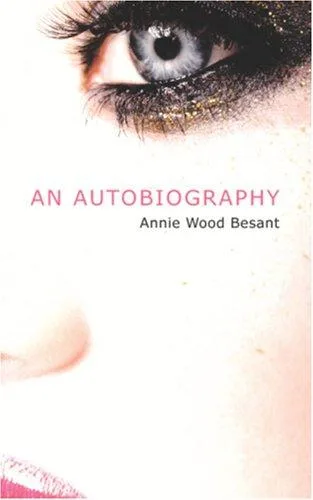
Annie Besant's self-titled volume from 1920 is a direct, unvarnished look at her own spiritual trajectory, a rare commodity when biographies are often filtered through the perspectives of others. The strength of this work lies in its candor; Besant does not shy away from detailing her dramatic shifts in belief, from her early atheism to her embrace of Theosophy. Her account of her involvement with Helena Blavatsky and her later role in leading the Theosophical Society is particularly illuminating, offering a firsthand perspective on internal dynamics and philosophical developments. However, the book's primary limitation is its inherent subjectivity. While invaluable for understanding Besant's personal convictions, it presents Theosophical doctrines as objective truth without substantial external critique. A passage detailing her conviction about the spiritual significance of Jiddu Krishnamurti, whom she and Charles Leadbeater identified as a coming World Teacher, exemplifies this unwavering faith in her esoteric insights. This is an indispensable primary source for serious students of Theosophy, though it requires critical engagement with its foundational premises.
📝 Description
79
Annie Besant's 1920 autobiography offers a direct account of her spiritual and intellectual evolution.
Published in 1920, Annie Besant's self-titled work is not a biography but a personal distillation of her life experiences and philosophical views. The book charts her intellectual development, from her early engagement with socialism and atheism to her profound commitment to Theosophy. It details her encounters with various spiritual movements and her dedication to social and political reform, all framed by her evolving spiritual understanding.
This text serves as a primary source for understanding Besant's unique path and her significant contributions to the Theosophical Society and wider occult discussions. It is particularly useful for students of Theosophy, comparative religion, and the history of Western esotericism. Readers interested in influential women who shaped intellectual and spiritual movements in the late 19th and early 20th centuries will find it illuminating. It also speaks to those researching the intersection of spirituality, social activism, and philosophical inquiry.
This work emerged in 1920, a time of significant spiritual exploration alongside societal change. Theosophy, a movement co-founded by Helena Blavatsky, presented an alternative to prevailing materialist and orthodox religious views. Besant, having moved from secularism to become a leading Theosophist after Blavatsky's death, was central to this tradition. Her writings from this period reflect her engagement with these ideas during a time when figures like Aleister Crowley pursued their own magical paths and Rudolf Steiner began developing Anthroposophy.
💡 Why Read This Book?
• Learn about the Theosophical understanding of karma and reincarnation directly from one of its leading proponents, gaining insight into concepts central to Besant's worldview as articulated in the early 20th century. • Understand Besant's critical role in the Theosophical Society, particularly her relationship with Helena Blavatsky and her later efforts to guide the movement after Blavatsky's death in 1897. • Explore Besant's personal journey from secular activism to profound spiritual conviction, offering a case study in radical personal transformation within the context of early esoteric movements.
⭐ Reader Reviews
Honest opinions from readers who have explored this book.
❓ Frequently Asked Questions
When was Annie Besant's self-titled book first published?
Annie Besant's self-titled work was first published in 1920, reflecting her mature philosophical and spiritual views developed over decades of public life and esoteric study.
What is the primary focus of Annie Besant's book?
The book primarily focuses on Annie Besant's personal spiritual journey, her intellectual development, and her philosophical contributions, particularly within the framework of Theosophy.
What is Theosophy as described by Annie Besant?
Within Besant's work, Theosophy is presented as a synthesis of ancient wisdom, emphasizing universal brotherhood, the study of comparative religion and philosophy, and the investigation of unexplained laws of nature and the powers latent in humanity.
Who was Helena Blavatsky in relation to Annie Besant?
Helena Blavatsky was the co-founder of the Theosophical Society. Besant became a devoted follower and successor, playing a crucial role in the Society's leadership after Blavatsky's death in 1897.
Does Annie Besant discuss Jiddu Krishnamurti in this book?
Yes, Besant discusses her role in identifying and promoting Jiddu Krishnamurti, whom she and Charles Leadbeater believed to be the 'World Teacher' destined to appear.
What social or political views are expressed by Annie Besant in her book?
Besant connects her spiritual philosophy to social reform, advocating for universal brotherhood and ethical living, reflecting her lifelong commitment to social justice alongside her esoteric pursuits.
🔮 Key Themes & Symbolism
Spiritual Evolution and the Man-Idea
Besant articulates a vision of humanity's spiritual evolution, often referencing the concept of the 'Man-Idea' – a divine archetype or blueprint for human potential. This theme explores the unfolding consciousness of individuals and the collective, guided by spiritual laws and hierarchical principles inherent in the Theosophical cosmology. It posits a journey from material existence towards higher spiritual planes, emphasizing inherent divinity within each being and the gradual realization of this potential through successive lives and spiritual disciplines.
Theosophical Principles and Practice
The work serves as a primer for understanding core Theosophical tenets as interpreted by Besant. Key principles such as karma, reincarnation, and the interconnectedness of all life are presented not merely as doctrines but as fundamental laws governing the universe. Besant explains how these principles inform ethical conduct and spiritual progress, advocating for a life dedicated to service and the pursuit of wisdom as outlined by Helena Blavatsky and the Masters of Wisdom.
Leadership and Succession in Theosophy
Besant candidly discusses her transition into leadership within the Theosophical Society, particularly following Helena Blavatsky's passing in 1897. The book touches upon the challenges of maintaining the Society's integrity and mission, her collaborations with figures like Charles Leadbeater, and her controversial decision to identify Jiddu Krishnamurti as the prophesied World Teacher. This theme highlights her dedication to the Theosophical cause and her attempts to guide its future direction.
The Synthesis of Science and Spirituality
A recurring thread in Besant's writings is the attempt to reconcile scientific understanding with esoteric and spiritual truths. She posits that science and spirituality are not in opposition but represent different facets of a unified reality. The book suggests that the 'unexplained laws of nature' and the 'powers latent in humanity' are subjects that future science will validate, bridging the perceived gap between the material and the spiritual realms.
💬 Memorable Quotes
Direct passages from the work, attributed to the author.
“Theosophy is not a religion, but a religion to build upon.”
— This statement underscores Besant's view of Theosophy as a foundational philosophical and ethical framework rather than a dogma-bound faith. It suggests that its principles can underpin diverse spiritual paths and personal beliefs, serving as a universal guide.
“The path of spiritual evolution is one of unfoldment, not of creation.”
— This highlights the Theosophical concept that spiritual growth is an inherent process of revealing what already exists within the individual, rather than an external imposition of new qualities. It emphasizes the latent divinity and potential within all beings.
“Service is the greatest of all the disciplines.”
— Besant consistently linked spiritual progress with altruistic action. This maxim emphasizes that selfless service to humanity is not merely a good deed but a fundamental spiritual practice, essential for the development of compassion and wisdom.
“The universe is governed by Law, and the highest wisdom is to understand and work in harmony with it.”
— This reflects the deterministic yet ordered view of the cosmos within Theosophy. Understanding universal laws like karma is presented as crucial for navigating life effectively and aligning oneself with the natural progression of spiritual development.
💡 Key Ideas
Editorial paraphrase of the work's core concepts — not direct quotes.
I have learned that the greatest of all powers is the power of love.
This quote points to the central role of unconditional love and brotherhood in Besant's spiritual philosophy. It suggests that this force is not only a virtue but a potent, transformative energy driving spiritual growth and universal connection.
🌙 Esoteric Significance
Tradition
This work is firmly rooted in the Theosophical tradition, which itself draws eclectically from Hermeticism, Neoplatonism, Kabbalah, Buddhism, and Hinduism. Annie Besant, as a principal successor to Helena Blavatsky, articulates the core tenets of this syncretic spiritual philosophy. Her writings are crucial for understanding the evolution and dissemination of Theosophical ideas in the early 20th century, particularly concerning concepts of divine evolution, karma, and the hidden spiritual hierarchy guiding humanity.
Symbolism
Within Besant's framework, the 'Man-Idea' serves as a potent symbol for the divine archetype or blueprint of humanity, representing the ultimate spiritual potential each individual embodies. The concept of the 'Masters of Wisdom' functions symbolically as the guiding intelligence or perfected beings within the spiritual hierarchy, whose teachings Besant represented. The serpent, often depicted in esoteric traditions, can be interpreted within her work as symbolizing spiritual wisdom, cyclic evolution, and the awakening of Kundalini energy.
Modern Relevance
Contemporary esoteric practitioners and scholars of comparative religion continue to engage with Besant's interpretations of Theosophy. New Age movements and various forms of Western esotericism echo her emphasis on spiritual evolution, karma, and the interconnectedness of all beings. Thinkers exploring conscious evolution, the potential of human consciousness, and the integration of spiritual principles with social reform often find foundational ideas within her extensive writings.
👥 Who Should Read This Book
• Students of Theosophy and the works of Helena Blavatsky, seeking a direct account of Annie Besant's personal philosophical development and leadership within the movement. • Researchers of early 20th-century spiritual and intellectual history, interested in figures who bridged social activism with esoteric thought and shaped alternative religious movements. • Individuals exploring the concepts of karma, reincarnation, and spiritual evolution, wanting to understand these ideas from a prominent historical proponent of Theosophy.
📜 Historical Context
Annie Besant's self-titled work, published in 1920, emerged from a fertile ground of late Victorian and Edwardian spiritual ferment. Theosophy, spearheaded by Helena Blavatsky and later led by Besant herself, offered a compelling alternative to the perceived spiritual vacuum of industrializing societies and the rigid doctrines of established religions. This period saw significant intellectual currents, including the rise of psychology, new scientific discoveries challenging old paradigms, and a burgeoning interest in Eastern philosophies. Besant, a formidable orator and writer, had previously been a prominent figure in secular socialism and freethought before her profound conversion to Theosophy around 1889. Her writings from this era engaged with figures and movements like Spiritualism, Anthroposophy (Rudolf Steiner had by then broken from the Theosophical Society), and various occult revivalist circles. The reception of her work and Theosophy was often polarized, praised by adherents for its spiritual depth and criticized by materialists and religious conservatives alike.
📔 Journal Prompts
The Man-Idea as a spiritual blueprint for human potential.
Reflecting on the concept of 'Service is the greatest of all the disciplines'.
Annie Besant's transition from secularism to Theosophy.
The role of karma and reincarnation in spiritual evolution.
Understanding the Theosophical Society's historical context and Besant's leadership.
🗂️ Glossary
Theosophy
A spiritual philosophy founded by Helena Blavatsky, aiming to synthesize Eastern and Western esoteric traditions. It emphasizes universal brotherhood, the study of comparative religion and philosophy, and the investigation of unexplained laws of nature and latent human powers.
Karma
In Theosophical thought, the universal law of cause and effect. Actions in one life have consequences in future lives, influencing an individual's circumstances and spiritual development.
Reincarnation
The Theosophical belief that the soul or consciousness is reborn into a new physical body after death, undergoing a cycle of lives to learn and evolve spiritually.
Man-Idea
A Theosophical concept referring to the divine archetype or spiritual blueprint of humanity, representing the ultimate potential towards which all human beings are evolving.
Masters of Wisdom
In Theosophy, highly evolved spiritual beings or adepts believed to guide humanity's evolution and transmit spiritual knowledge, of whom Helena Blavatsky claimed to be a messenger.
World Teacher
A prophesied spiritual leader, often identified within Theosophy as a figure like Maitreya or the Christ, destined to appear to guide humanity into a new era of spiritual understanding.
Esotericism
Teachings or practices concerned with hidden, inner, or spiritual knowledge, often distinct from exoteric or outward, public teachings. It typically involves mystical, occult, or Gnostic traditions.
🔮 Readers Also Liked
Browse all →






More by Annie Wood Besant
All books →




More Free Theosophy & Anthroposophy Books
View all →