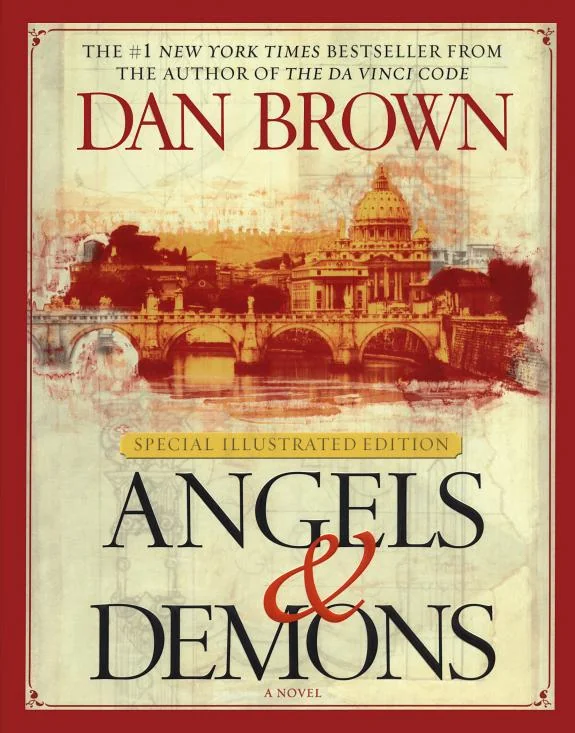
Angels & Demons Special Illustrated Edition
 82
82

Angels & Demons Special Illustrated Edition
Brown’s *Angels & Demons* remains a masterclass in propulsive plotting, even if its thematic depth is more shallow than a baptismal font. This special illustrated edition adds a visual layer to the breakneck pursuit through Rome, illuminating the architectural and symbolic clues that Robert Langdon must decipher. The strength lies in its relentless pacing and the clever integration of historical sites with a fictional conspiracy. However, the characterizations, particularly of the antagonists, often feel more like archetypes than fully realized individuals, serving the plot rather than driving it organically. The passage detailing the 'Path of Illumination' across Rome, with its specific landmarks and associated symbols, is particularly effective in showcasing Brown's research and narrative construction. While not a work of profound philosophical inquiry, it succeeds brilliantly as a high-octane intellectual puzzle.
📝 Description
82
Dan Brown's 2006 thriller, Angels & Demons, returns with a special illustrated edition.
This edition of Dan Brown's 2006 novel follows religion professor Robert Langdon and Dr. Vittoria Vetra. Their investigation begins after a CERN physicist's murder and the discovery of an antimatter vial. The narrative centers on Langdon's race against time to stop the Illuminati, an ancient secret society, from enacting a catastrophic event in Vatican City. The plot weaves through historical sites, religious symbols, and scientific ideas, all enhanced by new illustrations.
Readers who enjoy Brown's blend of mystery, history, and conspiracy will find this edition appealing. It is particularly suited for those interested in the Vatican, Catholic Church history, or the intersection of science and faith. The visually driven format and embedded puzzles will also attract readers who appreciate deciphering symbols. The book offers an accessible fictional entry point into topics such as antimatter, secret societies, and art history.
Angels & Demons taps into a popular fascination with secret societies and their alleged influence on history, a theme explored in various occult and conspiracy literature. The novel draws on the lore surrounding the Illuminati, a historical group that has become a touchstone in esoteric traditions for discussions of hidden power structures and manipulation. It frames these elements within a modern thriller, using religious and scientific imagery to create a sense of mystery and danger, aligning with fictional works that blend historical secrets with contemporary narratives.
💡 Why Read This Book?
• Learn about the historical Illuminati and their alleged anti-religious agenda, understanding how Brown fictionalizes their revival in the context of the 2000 publication. • Experience the symbolic significance of Roman landmarks like the Pantheon and St. Peter's Square, as Langdon uses them as crucial waypoints in his investigation. • Grasp the basic scientific concept of antimatter and its fictional role as a doomsday device, a key plot element driving the urgency of the narrative.
⭐ Reader Reviews
Honest opinions from readers who have explored this book.
❓ Frequently Asked Questions
Is Angels & Demons based on a true story about the Illuminati?
While the Illuminati were a real historical secret society founded in Bavaria in 1776, Dan Brown's novel *Angels & Demons* is a work of fiction. It reimagines the Illuminati as a powerful, ancient organization actively working against the Catholic Church, a narrative not supported by historical evidence.
What is the significance of the antimatter in Angels & Demons?
In *Angels & Demons*, antimatter is a powerful, unstable substance created at CERN. The Illuminati steal a vial of it, intending to detonate it in Vatican City as a symbolic act of revenge and to disrupt the papal conclave, serving as the story's central ticking clock.
Which real places are featured in Angels & Demons?
The novel prominently features iconic Roman locations, including St. Peter's Square, Castel Sant'Angelo, the Pantheon, Piazza Navona, and the Vatican City itself. These sites form the 'Path of Illumination' that Robert Langdon follows.
How does the illustrated edition enhance the reading experience?
The special illustrated edition provides visual aids, such as images of the artwork, architecture, and symbols discussed in the book. This helps readers better visualize the settings and understand the complex iconography that is integral to solving the mystery.
Who is Robert Langdon?
Robert Langdon is a fictional professor of religious iconology and symbology at Harvard University, created by Dan Brown. He is the protagonist in several of Brown's novels, including *Angels & Demons*, known for his ability to decipher ancient symbols and solve historical mysteries.
What is the connection between Angels & Demons and The Da Vinci Code?
Both novels feature protagonist Robert Langdon and explore themes of secret societies, religious conspiracy, and hidden historical truths. *Angels & Demons* was published before *The Da Vinci Code* and introduces Langdon, but the latter became significantly more famous and controversial.
🔮 Key Themes & Symbolism
Science vs. Religion
The novel frequently pits scientific advancements and rational inquiry against religious dogma and ancient faith. CERN's creation of antimatter serves as a potent symbol of science's power, while the Catholic Church represents millennia of tradition and belief. Langdon, a symbologist, often bridges these seemingly opposing worlds, suggesting that understanding symbols can illuminate both scientific and spiritual truths. The Illuminati, as an anti-religious force, seek to exploit scientific power to dismantle religious authority, highlighting the historical tension between secularism and established faith.
Secret Societies and Conspiracy
Central to the plot is the resurgence of the Illuminati, a historical secret society purportedly dedicated to undermining religious power. Brown uses the lore surrounding the Illuminati, along with references to the Freemasons and the Catholic Church's own internal structures, to build a narrative steeped in conspiracy. The idea that powerful, hidden forces manipulate world events is a recurring motif, driving the suspense and Langdon's race against time to expose the truth before a catastrophic event unfolds in Vatican City.
Symbolism and Iconography
As a symbologist, Robert Langdon deciphers a trail of clues left behind by the Illuminati, each linked to a specific symbol and a significant historical site in Rome. The novel explores the meanings of various symbols, including the ambigrammatic 'Illuminati' logo, the elemental symbols (earth, air, fire, water), and religious iconography found within the Vatican. The interpretation of these symbols is crucial to understanding the Illuminati's plan and preventing disaster, emphasizing the power of visual language to convey hidden messages.
Art, Architecture, and History
The narrative is intricately woven with real-world art, architecture, and historical sites, primarily in Rome. Langdon's expertise allows him to navigate and interpret these elements, from Bernini's sculptures in St. Peter's Square to the ancient structure of the Pantheon. The book uses these settings not just as backdrops but as integral components of the mystery, turning famous landmarks into a 'Path of Illumination' that guides the protagonists and the reader through the unfolding conspiracy. This integration grounds the fantastical plot in tangible history and culture.
💬 Memorable Quotes
Direct passages from the work, attributed to the author.
“The Illuminati feared the Church. They believed the Church had hoarded the secrets of God, and they were determined to reclaim them.”
— This statement captures the core motivation of the fictional Illuminati in the novel. It frames their actions not merely as terrorism, but as a perceived righteous quest to liberate suppressed knowledge, setting up the central conflict between ancient secret societies and established religious power.
“The ultimate source of all knowledge is the divine.”
— While not a direct quote from the book's characters in this exact phrasing, this represents a sentiment often explored within the novel's religious and philosophical discussions. It contrasts with the scientific pursuit of knowledge, suggesting that true understanding originates from a spiritual rather than empirical source.
“Evil will always triumph because good is simply dumb.”
— This cynical observation, often attributed to the character of the Illuminati's assassin, reflects a bleak worldview. It suggests that naive goodness is ill-equipped to combat calculated malice, providing a justification for the ruthless efficiency of the antagonists within the story's plot.
“The Vatican is a city within a city, a kingdom within a kingdom, a sovereign state.”
— This description emphasizes the unique political and spiritual status of the Vatican City. It highlights its independence and the concentrated power it holds, making it a logical target for a conspiracy aiming to disrupt the Catholic Church's leadership during a papal conclave.
💡 Key Ideas
Editorial paraphrase of the work's core concepts — not direct quotes.
Science sees fanaticism. Fanaticism sees science.
This quote highlights the perceived irreconcilable conflict between scientific rationalism and religious fundamentalism. It suggests a mutual blindness, where each perspective fails to acknowledge the validity or potential insights of the other, driving the narrative's exploration of science versus faith.
🌙 Esoteric Significance
Tradition
While not strictly adhering to a single esoteric lineage, *Angels & Demons* draws heavily from the lore surrounding Western esoteric traditions, particularly those focused on secret societies and their perceived opposition to established religious power structures. It echoes Gnostic themes of hidden knowledge and liberation from dogma, and touches upon Hermetic principles of hidden correspondences. The narrative positions the Illuminati as keepers of forbidden truths, a common trope in occult literature that seeks to uncover esoteric wisdom allegedly suppressed by mainstream institutions like the Catholic Church.
Symbolism
The novel is rich with symbolism, most notably the ambigrammatic 'Illuminati' logo, which visually represents duality and hidden meaning – appearing the same forwards and backward, signifying the secret society's clandestine nature. The 'Path of Illumination' itself, marked by four cardinal directions and associated elemental symbols (earth, air, fire, water), functions as a symbolic map, guiding the protagonists through Rome and echoing ancient ceremonial practices. These symbols are not mere decoration; they are crucial keys to unlocking the conspiracy and understanding the Illuminati's perceived agenda.
Modern Relevance
In contemporary discourse, *Angels & Demons* continues to fuel popular interest in conspiracy theories, secret societies like the Freemasons and the Illuminati, and the intersection of religion and science. Thinkers and practitioners exploring alternative spiritualities or questioning institutional power structures often find resonance in Brown's narrative. While critics point to its historical liberties, the novel's enduring appeal lies in its accessible exploration of hidden histories and its suggestion that profound secrets lie concealed within familiar religious and scientific frameworks, a theme relevant to many contemporary seekers.
👥 Who Should Read This Book
• Armchair detectives and fans of historical thrillers who enjoy solving puzzles alongside protagonists, particularly those intrigued by the Vatican and Roman landmarks. • Readers interested in the popular (though often fictionalized) history of secret societies like the Illuminati and their supposed conflicts with religious institutions. • Those seeking an accessible, fast-paced introduction to concepts of symbology, art history, and the perceived tension between science and faith, presented within an entertaining narrative.
📜 Historical Context
Published in its original form in 2000, Dan Brown's *Angels & Demons* emerged during a period of heightened public fascination with historical conspiracies and secret societies, a trend notably amplified by the success of Umberto Eco's more complex novel *Foucault's Pendulum* (1988). Brown’s work, however, simplified these themes into a fast-paced thriller, making them accessible to a mass audience. The novel's depiction of the Catholic Church and the Illuminati sparked considerable debate, drawing criticism from some historians and religious scholars for its perceived inaccuracies and sensationalism. Despite controversy, its publication preceded the massive global phenomenon of *The Da Vinci Code* (2003), which further cemented Brown's reputation for blending historical elements with fictional intrigue. The book's reception highlighted a public appetite for narratives that questioned established institutions and explored hidden histories, often overshadowing more nuanced academic discussions on the same topics.
📔 Journal Prompts
The Illuminati's 'Path of Illumination' through Rome: how might sacred geography influence belief systems?
Robert Langdon's interpretation of symbols: consider a personal symbol and its hidden meanings.
The conflict between science (antimatter) and religion (papacy): where do these forces intersect in your life?
Vittoria Vetra's perspective on uncovering truth: reflect on the ethics of forbidden knowledge.
The power of the ambigrammatic 'Illuminati' symbol: how can dual meanings shape perception?
🗂️ Glossary
Ambigram
A graphical design or art form that can be read in more than one way, typically appearing the same when viewed from different directions or orientations. The Illuminati logo in the book is a prime example.
Antimatter
A theoretical type of matter composed of antiparticles, which are the opposites of ordinary matter particles. When matter and antimatter meet, they annihilate each other, releasing enormous amounts of energy.
CERN
The European Organization for Nuclear Research, a multinational organization based near Geneva, Switzerland. It operates the largest particle physics laboratory in the world, where the antimatter in the novel is created.
Illuminati
Historically, a Bavarian secret society founded in 1776 that sought to oppose superstition, obscurantism, religious influence over public life, and abuses of state power. In Dan Brown's novel, they are reimagined as an ancient, powerful organization plotting against the Catholic Church.
Papal Conclave
The assembly of Roman Catholic cardinals convened to elect a new pope when the office becomes vacant upon the death or abdication of the incumbent.
Path of Illumination
A fictional trail through Rome devised by the Illuminati, marked by four specific churches, each associated with a cardinal direction and an elemental symbol, leading to a final, hidden location.
Religion of Science
A concept explored in the novel suggesting that science, particularly the pursuit of knowledge and discovery, can function as a quasi-religious belief system for some individuals, offering purpose and order.
This book appears in 1 collection
🔮 Readers Also Liked
Browse all →









From the “Secret Societies” Collection
View all →



More Free Occult Philosophy Books
View all →