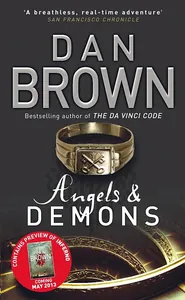
Angels & Demons
 75
75

Angels & Demons
Dan Brown's *Angels & Demons* functions as a frantic scavenger hunt through the hallowed halls of the Vatican and the streets of Rome. The central conceit—a race to disarm a bomb using a trail of ambigrams and obscure religious history—is undeniably propulsive. Robert Langdon, the academic protagonist, serves as our guide, dispensing historical tidbits and deciphering symbols with remarkable speed. The book’s primary strength lies in its relentless pacing and the clever integration of real-world landmarks and lore into its fictional conspiracy. However, the character development feels secondary to the plot mechanics, often serving merely as vehicles for exposition. The dialogue can feel stilted, particularly when characters are forced to explain complex concepts to one another. A passage detailing the process of ‘preferiti’ selection within the Vatican, for instance, is informative but delivered with a certain artificiality. Ultimately, *Angels & Demons* delivers a thrilling, if somewhat superficial, intellectual chase.
📝 Description
75
Angels & Demons, published in 2000, propels Robert Langdon into a race against time through Rome.
This thriller follows symbologist Robert Langdon as he uncovers a plot involving the Illuminati and a dangerous anti-matter device. The story unfolds with clues hidden within Rome's historical sites and famous art. Langdon must decipher these puzzles quickly to prevent disaster, pulling the reader into the urgent quest.
The novel is suited for those who enjoy fast-paced mysteries and puzzles rooted in history and secret societies. Readers interested in how art, history, religion, and conspiracy theories intersect will find it engaging. Fans of Dan Brown's style, which blends detailed plots with fictionalized research, will recognize his familiar approach.
The setting of Vatican City and Rome draws on extensive religious history and art. It references historical events and figures connected to the Catholic Church and Enlightenment secret groups. The plot uses the idea of old conflicts resurfacing to create tension about hidden forces shaping world events.
The book taps into enduring fascination with secret societies and their supposed influence on major historical events. It uses the Illuminati, a historical group, as a focal point for a narrative about hidden powers challenging established institutions. The story plays on anxieties about ancient conflicts between science and faith reemerging, using religious and artistic symbols as keys to unlocking a contemporary threat.
💡 Why Read This Book?
• Gain an understanding of the historical Illuminati, a secret society formed in Bavaria in 1776, and how Dan Brown reimagines their motives and methods within a modern conspiracy. • Experience the thrill of deciphering symbolic puzzles embedded within iconic Roman Catholic landmarks, fostering a new appreciation for art and architecture as narrative devices. • Explore the fictionalized tension between scientific discovery, particularly particle physics, and religious dogma, prompting reflection on the perceived conflict between faith and reason.
⭐ Reader Reviews
Honest opinions from readers who have explored this book.
❓ Frequently Asked Questions
Is *Angels & Demons* based on real Illuminati history?
While Dan Brown uses the historical Illuminati, founded in Bavaria in 1776, as inspiration, the book's depiction of their modern-day activities and goals is fictional. The author blends historical fact with speculative fiction to create his plot.
What is the significance of the symbols in *Angels & Demons*?
The symbols, such as ambigrams and the four elements (earth, air, fire, water), are crucial plot devices. They are used by the Illuminati to leave cryptic clues, guiding Robert Langdon through Rome and revealing hidden meanings tied to religious and scientific concepts.
Where does the story of *Angels & Demons* take place?
The primary settings are Rome, Italy, and Vatican City. Key locations include St. Peter's Square, the Pantheon, and various churches and historical sites, all integral to the unfolding mystery and the protagonist's quest.
Does *Angels & Demons* connect to *The Da Vinci Code*?
Yes, *Angels & Demons* was published before *The Da Vinci Code* and introduces the character Robert Langdon. While they share the same protagonist and a similar thematic blend of symbology and conspiracy, they are distinct stories.
What is the 'Illuminati' in the context of the book?
In *Angels & Demons*, the Illuminati are portrayed as an ancient, powerful secret society dedicated to opposing the Catholic Church. They are depicted as seeking revenge and employing elaborate, symbolic rituals to achieve their aims.
What is the role of science in *Angels & Demons*?
Science, particularly particle physics and the concept of antimatter, plays a pivotal role. The stolen antimatter is the central threat, and the scientific elements are juxtaposed against religious themes to explore conflicts between faith and reason.
🔮 Key Themes & Symbolism
Science vs. Religion
The narrative hinges on the perceived conflict between scientific advancement and religious dogma. The stolen antimatter represents a powerful scientific force directly confronting the ancient authority of the Catholic Church. Protagonist Robert Langdon, a symbologist, often finds himself bridging these two worlds, deciphering clues that blend scientific principles with religious iconography. This theme questions whether faith and reason are inherently opposed or if they can coexist and inform one another, a question central to the Illuminati's historical animosity towards the Church.
Secret Societies and Power
Central to the plot is the resurgence of the Illuminati, a historical secret society founded in Bavaria in 1776. The book portrays them as a clandestine organization wielding immense influence and operating from the shadows to challenge established powers. Their methods involve intricate puzzles, symbolic rituals, and strategic manipulation, reflecting a long-standing fascination with hidden groups that shape world events. The novel explores the allure and danger of such organizations and their potential impact on societal structures and religious institutions.
Symbolism and Interpretation
Symbols are not mere decoration but critical plot drivers in *Angels & Demons*. From ambigrams that read the same upside down to the four classical elements (earth, air, fire, water) and the 'path of illumination,' every symbol carries a specific meaning intended to guide or mislead. Robert Langdon's expertise lies in his ability to interpret these complex layers of meaning, often drawing connections between historical art, architecture, and esoteric traditions. The book emphasizes how symbols can conceal and reveal truth, making interpretation a central act of discovery.
The Vatican and its Secrets
The Vatican City serves as a primary stage for the unfolding conspiracy, its sacred spaces and historical traditions becoming integral to the mystery. The book examines the inner workings of the Catholic Church, including the conclave for electing a new Pope and the roles of cardinals. This exploration, while fictionalized, taps into public curiosity about the Church's history, rituals, and perceived hidden agendas. The narrative positions the Vatican as a seat of immense power and a target for those seeking to expose or dismantle its authority.
💬 Memorable Quotes
Direct passages from the work, attributed to the author.
“Science cannot tell us what is right or wrong. It can tell us how to build a bomb, but it cannot tell us why we should not.”
— This highlights the theme of science versus morality. While science provides knowledge and capability, the interpretation and application of that knowledge—the ethical dimension—is presented as a separate, perhaps more complex, domain.
“Illumination is a light that helps you to see.”
— A seemingly simple statement, this serves as a thematic anchor. In the context of the Illuminati, 'illumination' refers to enlightenment and the uncovering of hidden truths, often through dangerous or forbidden knowledge, contrasting with the perceived darkness of established religious power.
“Every choice has consequences.”
— A fundamental principle underpinning the thriller genre, this statement emphasizes the gravity of the characters' actions. In *Angels & Demons*, the choices made by protagonists and antagonists alike have far-reaching implications for global events and personal fates.
💡 Key Ideas
Editorial paraphrase of the work's core concepts — not direct quotes.
The church says the Earth orbits the Sun. That tells us what the church wants us to believe, not what is true.
This line expresses the book's exploration of conflict between established doctrine (religious) and empirical observation (scientific). It suggests that powerful institutions may shape narratives for their own ends, prompting a critical examination of accepted truths.
The most powerful weapon is truth.
This quote suggests that despite the presence of physical threats like antimatter, the ultimate power lies in uncovering and revealing hidden realities. It aligns with the protagonist's role as a decipherer of secrets and a seeker of truth.
🌙 Esoteric Significance
Tradition
While not strictly an esoteric text, *Angels & Demons* draws heavily from the symbolic language and historical narratives often explored within Western esoteric traditions, particularly those concerning secret societies and Gnostic ideas of hidden knowledge. It positions the Illuminati, a historical group with esoteric leanings, as protagonists in a modern conflict against the Catholic Church, a powerful established institution often viewed with suspicion by esoteric thinkers. The work reflects a popular fascination with these undercurrents of power and knowledge.
Symbolism
The novel employs a rich array of symbols, many with historical esoteric resonance. The four classical elements (earth, air, fire, water) represent distinct paths or stages within the Illuminati's 'path of illumination,' connecting to ancient philosophical and alchemical concepts. Ambigrams, words or designs that can be read in multiple orientations, serve as visual puzzles, symbolizing duality and hidden meanings. The Eye of Providence, often associated with Freemasonry and Enlightenment thought, also appears, representing divine oversight and hidden knowledge.
Modern Relevance
The work's enduring popularity speaks to a modern appetite for narratives that explore the intersection of history, religion, and conspiracy. Contemporary thinkers and practitioners interested in comparative religion, secret societies, and the symbolic language of power find fertile ground in Brown's blend of fact and fiction. It continues to spark discussions about the perceived conflict between science and faith, and the role of hidden organizations in shaping societal narratives, echoing themes found in modern occult and philosophical discourse.
👥 Who Should Read This Book
• Conspiracy theory enthusiasts and amateur historians interested in exploring fictionalized accounts of secret societies like the Illuminati and their historical roots. • Readers who appreciate fast-paced thrillers that integrate real-world locations, art history, and religious symbolism into a complex puzzle. • Individuals curious about the perceived historical tensions between science and religion, seeking a narrative that dramatizes this conflict through adventure and discovery.
📜 Historical Context
Published in 2000, Dan Brown's *Angels & Demons* arrived at a moment of heightened public interest in conspiracy theories and secret societies, amplified by the dawn of the internet. The novel tapped into enduring anxieties surrounding the Catholic Church and the Enlightenment-era Illuminati, a historical group founded in Bavaria in 1776. While Brown fictionalizes the Illuminati's modern resurgence, he grounds his narrative in real locations within Rome and Vatican City, blending historical fact with speculative fiction. The book’s reception was largely positive among popular audiences, though it drew criticism from some historians and religious figures for its factual liberties and portrayal of Catholic institutions. It gained significant traction alongside other works exploring religious conspiracies, appearing in the cultural landscape alongside a broader resurgence of interest in topics like Gnosticism and Templar lore, often discussed in popular history circles.
📔 Journal Prompts
The Illuminati's 'path of illumination' and its symbolic markers.
Robert Langdon's interpretation of the ambigram symbols.
The perceived conflict between science and faith presented in the narrative.
Vatican City as a setting for conspiracy and power struggles.
The concept of 'preferiti' and papal succession.
🗂️ Glossary
Ambigram
A graphical design or typographic art that can be read in multiple directions or orientations. In the book, ambigrams are used as cryptic clues by the Illuminati.
Illuminati
A historical secret society founded in Bavaria in 1776. In Dan Brown's novel, they are depicted as an ancient organization seeking revenge against the Catholic Church.
Preferiti
In the context of the book, this refers to the four cardinals chosen as frontrunners to become the next Pope during a papal conclave.
Antimatter
A theoretical substance composed of antiparticles, which annihilates upon contact with ordinary matter, releasing enormous energy. It is central to the plot as a weapon.
Path of Illumination
A series of locations and symbolic clues devised by the Illuminati in the novel, designed to lead Robert Langdon towards hidden secrets and a confrontation.
Symbologist
An expert in the study of symbols and their meanings. Robert Langdon's profession allows him to decipher the clues central to the book's plot.
Conclave
A private meeting or assembly, specifically referring to the gathering of cardinals to elect a new Pope in the Catholic Church.
🔮 Readers Also Liked
Browse all →








More by Dan Brown
All books →




More Free Occult Philosophy Books
View all →