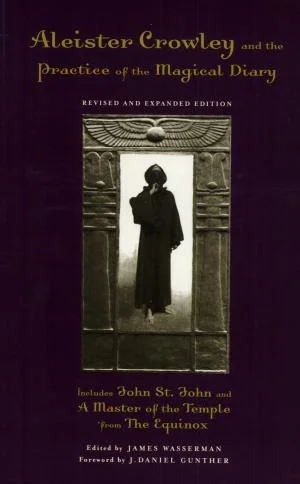
Aleister Crowley and the Practice of the Magical Diary
 71
71

Aleister Crowley and the Practice of the Magical Diary
James Wasserman’s presentation of Crowley's writings on the magical diary offers a starkly practical counterpoint to the often-abstract nature of occult theory. The inclusion of "John St. John," a minute-by-minute account of a 13-day working, is particularly illuminating. It demonstrates Crowley’s obsessive attention to detail, revealing the diary not as a passive chronicle but as an active tool for self-examination and magical efficacy. While the texts themselves are invaluable, the editorial framing could benefit from deeper contextualization beyond The Equinox's publication history. One limitation is the lack of extensive commentary on the later evolution of diary-keeping practices within Crowley's own order, the A∴A∴, after these initial publications. Nevertheless, the directness of Crowley’s prose and the raw, unfiltered nature of his self-documentation make this collection a significant resource for serious students of practical magic.
📝 Description
71
James Wasserman compiled Aleister Crowley's writings on the magical diary in 2006.
This volume collects two specific texts by Aleister Crowley, "John St. John" and "A Master of the Temple." These pieces, originally published in Crowley's periodical The Equinox, detail the creation and use of a magical diary. Wasserman's work makes these primary source materials available, showing Crowley's personal system for recording and analyzing his magical experiences. It is a direct look into his methods for documenting spiritual and ritualistic pursuits.
For practitioners of Western esotericism, especially those interested in Thelema and ceremonial magic, this book offers practical guidance. Scholars of occult history will find it useful for understanding the real-world application of magical ideas. Anyone interested in how personal journaling, self-improvement, and ritual connect will benefit from Crowley's emphasis on careful record-keeping as a means of spiritual growth.
This book engages with early 20th-century Western esotericism, a period marked by significant occult revival. Aleister Crowley was a central figure, shaping numerous magical groups and philosophies. The texts included, "John St. John" and "A Master of the Temple," first appeared in The Equinox, Crowley's 1909 periodical designed to spread his teachings. These writings are notable for their focus on the practical aspects of magical documentation, a less common subject than theoretical occultism at the time.
💡 Why Read This Book?
• Understand the function of a magical diary as an active instrument of the Great Work, as exemplified by Crowley's "John St. John" text. • Learn Crowley's specific methods for documenting magical operations and analyzing their results, drawing directly from the principles outlined in "A Master of the Temple." • Gain insight into the early 20th-century occult landscape through the original publication context of The Equinox, appreciating the practical focus Crowley brought to his teachings.
⭐ Reader Reviews
Honest opinions from readers who have explored this book.
❓ Frequently Asked Questions
When were Aleister Crowley's "John St. John" and "A Master of the Temple" first published?
These two key instructional writings on the magical diary were first published during Aleister Crowley's lifetime within his ambitious periodical, The Equinox, which began publication in 1909.
What is the primary purpose of a magical diary according to Aleister Crowley?
Crowley viewed the magical diary as an essential tool for self-observation, the meticulous recording of magical operations, and the critical analysis of results to guide the magician's progress.
Who is the author of the compilation and commentary on Crowley's diary writings?
The compilation and related commentary for 'Aleister Crowley and the Practice of the Magical Diary' are provided by James Wasserman.
What specific 13-day working is detailed in the book?
The text 'John St. John' chronicles Aleister Crowley's moment-by-moment progress during a specific 13-day magical working, offering a detailed case study.
What publication hosted the original appearance of these Crowley texts?
Both "John St. John" and "A Master of the Temple" were originally published in Aleister Crowley's significant collection of magical instruction known as The Equinox.
Is this book suitable for beginners in occult studies?
While it presents foundational material, the book is most valuable for those with some existing familiarity with Aleister Crowley's work or ceremonial magic, offering direct primary source insights.
🔮 Key Themes & Symbolism
The Diary as a Tool
The central theme is the magical diary's function beyond simple record-keeping. Crowley, as presented by Wasserman, treats it as a dynamic instrument for self-discovery and magical advancement. Texts like "John St. John" illustrate its use in tracking minute-by-minute progress during intense ritual work, emphasizing observation and analysis as crucial components of the Great Work. It's a personal laboratory for testing magical hypotheses and understanding the magician's relationship with the universe.
Self-Observation and Analysis
A core tenet is the rigorous self-observation facilitated by the diary. Crowley’s approach demands a dispassionate recording of thoughts, feelings, external events, and magical effects. This detailed log allows for patterns to emerge, revealing the magician's strengths, weaknesses, and the subtle interplay between inner work and outer manifestation. "A Master of the Temple" elaborates on the principles guiding this analytical process, making the diary a mirror to the soul and a map of consciousness.
Practical Application of Thelema
This work provides a tangible look at how the principles of Thelema were put into practice by its founder. The meticulous nature of diary-keeping reflects the Thelemic emphasis on will and the execution of one's True Will. By documenting every aspect of a magical working, the practitioner refines their understanding and application of their unique path, ensuring that magical efforts are focused and effective, aligning with Crowley's concept of the Great Work.
The Equinox as a Dissemination Platform
The historical context of The Equinox is itself a theme, highlighting Crowley's intent to create a comprehensive and authoritative source for his teachings. The inclusion of these diary texts within the periodical underscores their importance in his system of magical instruction. It showcases a period when occult knowledge was being systematically codified and distributed through dedicated publications, aiming to standardize and advance magical practice.
💬 Memorable Quotes
Direct passages from the work, attributed to the author.
“Crowley referred to "John St. John" as 'a perfect method of magical instruction'.”
— This highlights Crowley's high regard for the detailed, moment-by-moment account of his magical working. It suggests the diary's potential as a pedagogical tool, offering a direct model for aspiring practitioners.
“Both works were the only two regarding the magical diary published in Crowley's lifetime.”
— This statement underscores the unique and primary status of these texts within Crowley's published corpus on diary practice. It signals their foundational importance for understanding his specific approach to magical documentation.
“The diary chronicles progress during a 13-day magical working.”
— This concise description points to the practical, operational focus of the diary as exemplified in 'John St. John,' illustrating its role in documenting specific, time-bound magical operations.
“These writings were first published in Crowley's collection of magical instruction, The Equinox.”
— This contextualizes the origin of the texts, placing them within Crowley's larger project of disseminating his magical system through a dedicated, multi-volume periodical starting in 1909.
💡 Key Ideas
Editorial paraphrase of the work's core concepts — not direct quotes.
The magical diary is not a mere record, but a tool for the Great Work.
This paraphrased concept emphasizes Crowley's view of the diary as an active, functional element in magical progress, rather than a passive collection of notes. It's designed to be used and analyzed for tangible results.
🌙 Esoteric Significance
Tradition
This work is firmly rooted in the Western Esoteric Tradition, specifically within the framework of Thelema founded by Aleister Crowley. It extends Hermetic principles by focusing on the practical application of magical theory through meticulous personal documentation. While drawing from Kabbalistic and ceremonial magic lineages, Crowley’s emphasis on the individual’s unique Great Work and the diary as a tool for self-realization departs from more rigidly structured, group-oriented magical systems.
Symbolism
While the texts themselves are less symbolic and more procedural, the overarching concept of the diary functions symbolically. It represents the 'Mirror of Nature' or the 'Book of the Soul,' a reflective surface onto which the magician projects their will and observes the ensuing patterns. The act of detailed recording symbolizes the disciplined application of consciousness necessary for reading through the hidden realms and enacting magical change, mirroring the precision required in alchemical processes.
Modern Relevance
Contemporary practitioners of ceremonial magic, particularly those following the Thelemic path, continue to draw heavily on Crowley's methods for diary-keeping. Modern occult authors and teachers often reference these texts when instructing students on practical magical techniques. Furthermore, the broader interest in journaling for personal development and mindfulness carries the principles of self-observation and analysis inherent in Crowley's approach, making his methods relevant beyond strictly occult circles.
👥 Who Should Read This Book
• Aspiring practitioners of ceremonial magic and Thelema: Gain direct insight into Aleister Crowley's personal methods for documenting and analyzing magical operations, crucial for developing your own practice. • Students of occult history: Understand the practical application of magical theory in the early 20th century and Aleister Crowley's contribution through his periodical, The Equinox. • Journaling enthusiasts interested in esoteric disciplines: Explore how detailed self-observation and record-keeping can be applied as a tool for spiritual growth and self-understanding within a magical framework.
📜 Historical Context
Aleister Crowley and the Practice of the Magical Diary emerges from the fertile ground of early 20th-century occultism, a period marked by a surge in interest in esoteric traditions and a desire to systematize magical knowledge. Crowley (1875-1947) was a dominant, if controversial, figure, actively challenging established spiritual hierarchies and founding new orders. The texts presented here, "John St. John" and "A Master of the Temple," were first published in The Equinox, Crowley’s ambitious periodical launched in 1909. The Equinox aimed to be a comprehensive manual of his magical system, thelema, often presented in stark contrast to the more esoteric or academic approaches found in contemporary publications by groups like the Hermetic Order of the Golden Dawn (from which Crowley had departed). These diary writings were significant because they offered a rare, practical glimpse into the daily mechanics of magical practice, a focus less common than the theoretical or philosophical discussions prevalent at the time. Their publication within The Equinox signaled Crowley's intent to provide actionable instruction, distinguishing his approach from contemporaries like Dion Fortune, whose writings often explored psychological interpretations of magic.
📔 Journal Prompts
Reflect on the purpose of "John St. John" as a method of magical instruction.
Analyze the role of the magical diary in observing and understanding personal will.
Consider how detailed record-keeping, as shown in Crowley's work, aids in the analysis of magical results.
Document a recent small-scale operation or intention, noting thoughts and external circumstances.
Evaluate the effectiveness of the diary as a mirror to one's own consciousness.
🗂️ Glossary
Magical Diary
A journal kept by a magician to record spells, rituals, visions, thoughts, and daily events, used for analysis and self-development.
The Great Work
The central aim in many esoteric traditions, often referring to the process of spiritual transformation, self-realization, or the attainment of gnosis.
The Equinox
A periodical published by Aleister Crowley starting in 1909, intended as a comprehensive collection of magical and philosophical instruction.
Ceremonial Magic
A type of ritual magic that uses specific procedures, often involving elaborate tools, costumes, and invocations, to achieve magical effects.
Thelema
A religious and philosophical system established by Aleister Crowley, based on the Book of the Law, with the central tenet 'Do what thou wilt shall be the whole of the Law'.
Gnosis
Spiritual knowledge or insight, particularly a mystical understanding of the divine, often seen as the goal of esoteric practices.
True Will
In Thelema, one's unique purpose or destiny in life, the fulfillment of which is the primary goal of the practitioner.
This book appears in 1 collection
🔮 Readers Also Liked
Browse all →









From the “Occultism” Collection
View all →





More Free Occult Philosophy Books
View all →