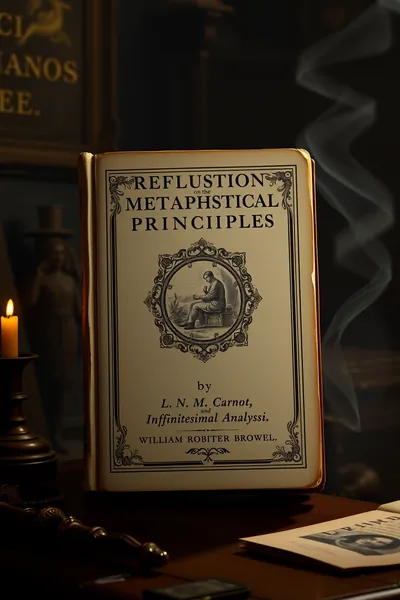
Akumu no chōtokkyū

 81
81

Akumu no chōtokkyū
Kashida's Akumu no chōtokkyū offers a compelling, if demanding, examination of the subjective and objective interplay of consciousness and the material world. The author’s strength lies in his meticulous construction of theoretical models, particularly the "shadow-archive," which provides a novel lens through which to view collective psychic phenomena. However, the text occasionally falters in its accessibility; the intricate prose, while precise, can obscure the very insights it aims to illuminate. A particularly striking passage describes the "liminal echo" in relation to historical sites, suggesting a palpable psychic residue. While dense, the work represents a significant contribution to contemporary esoteric thought for those willing to engage its complexities.
📝 Description
81
Hideki Kashida's Akumu no chōtokkyū, published in 2014, offers a method for understanding phenomena outside rational discourse.
Akumu no chōtokkyū, by Hideki Kashida, presents a framework for examining phenomena often dismissed by conventional thought. The book does not provide simple answers but instead offers a way to engage with the hidden forces and symbolic systems that influence human existence. It examines the ambiguous spaces between consciousness and the external world, guiding readers through complex theoretical ideas. The work is written for those with a serious interest in esoteric studies who have progressed past introductory concepts and desire a deeper understanding of theoretical foundations. It will appeal to students of comparative religion, Western esotericism, and practitioners looking to place their work within a larger intellectual history. Readers should anticipate in depth theoretical discussions and a non-linear approach that demands careful attention.
Published in 2014, the book emerged when digital media had increased both the spread and fragmentation of occult knowledge. The early 21st century saw a renewed interest in occult traditions, often spread online and met with growing academic curiosity. Kashida's text responds to this environment, aiming to establish a solid structure amid a vast amount of scattered information. Its publication year aligns with a period where philosophical ideas, like those of Jacques Derrida, continued to shape critical analysis of religious and mystical texts, reflecting a shared concern for the instability of meaning.
Akumu no chōtokkyū engages with occult philosophy, a field concerned with hidden knowledge and practices beyond mainstream understanding. Emerging in the 21st century, it navigates a complex information environment shaped by digital dissemination. The book situates itself within a tradition that questions empirical limits, drawing parallels with philosophical approaches that examine the fluidity of meaning and interpretation. It seeks to offer a structured approach to subjects often fragmented or misrepresented in popular discourse.
💡 Why Read This Book?
• Gain a structured understanding of how subjective states might influence objective reality, as explored through the concept of "dream-state resonance" presented in the text. • Learn to identify and analyze the "liminal echo" in specific environments, offering a new perspective on historical locations and their energetic imprints. • Explore the theoretical framework of the "shadow-archive" to better comprehend the repository of collective unconscious material and its potential impact on individual and group consciousness.
⭐ Reader Reviews
Honest opinions from readers who have explored this book.
❓ Frequently Asked Questions
What is the primary focus of Akumu no chōtokkyū?
Akumu no chōtokkyū primarily focuses on the intricate relationship between consciousness and the external world, exploring how subjective experiences and symbolic frameworks can manifest in tangible ways.
When was Akumu no chōtokkyū first published?
The book was first published in 2014, positioning it within the contemporary discourse on esoteric subjects.
What esoteric traditions does Akumu no chōtokkyū engage with?
While not strictly adhering to a single tradition, the work draws from and synthesizes elements found in Jungian psychology, Gnosticism, and various forms of Western esotericism.
Who is the author of Akumu no chōtokkyū?
The author is Hideki Kashida, whose 2014 publication entered the esoteric literature landscape with its unique theoretical approach.
Is Akumu no chōtokkyū suitable for beginners in esotericism?
The book is more suited for advanced students or those with a background in philosophical and psychological theory, due to its complex conceptual framework.
What is the "dream-state resonance" concept?
Dream-state resonance, as presented in the work, suggests a phenomenon where symbolic content experienced during dreams can have a tangible correspondence or influence on waking reality.
🔮 Key Themes & Symbolism
Dream-State Resonance
This theme centers on the premise that the symbolic architecture of dreams is not merely a passive reflection of the psyche but possesses an active capacity to influence or mirror external circumstances. Kashida posits that specific patterns and archetypes encountered in the dream state can establish a form of sympathetic vibration with the waking world, creating observable correlations. The work explores how concentrated psychic energy directed through the dream medium can, under specific conditions, manifest subtle or even direct effects in the physical realm, challenging the conventional separation of inner and outer realities.
The Shadow-Archive
Kashida introduces the "shadow-archive" as a conceptual space where repressed, unacknowledged, or collectively rejected psychic material resides. This is not a literal place but a dynamic repository of the unconscious, influenced by societal taboos and individual suppression. The text examines how this archive can exert a pervasive influence on collective consciousness, manifesting as societal anxieties, cultural blind spots, or recurring historical patterns. Understanding this concept allows for a deeper analysis of hidden motivations and the unseen forces shaping group dynamics and historical trajectories.
Liminal Echoes
The concept of the "liminal echo" refers to the residual psychic or energetic imprint left behind in places where significant emotional events, intense rituals, or concentrated human intention have occurred. Kashida suggests that these locations, situated at thresholds or "liminal" spaces, retain a distinct energetic signature that can be perceived or interacted with. The work explores how these echoes can influence the atmosphere of a place, affect sensitive individuals, and serve as a form of historical or emotional residue, connecting the past to the present through subtle energetic fields.
Symbolic Causality
This theme investigates the idea that symbols possess an inherent causal power, capable of initiating or influencing events in the real world. Rather than symbols merely representing concepts, Kashida proposes a more active role, where the precise arrangement and invocation of symbolic forms can create specific effects. This concept bridges the gap between psychological symbolism and practical manifestation, suggesting that a sophisticated understanding and application of symbolic language can become a tool for interacting with the deeper currents of existence. It challenges purely materialistic explanations for phenomena.
💬 Memorable Quotes
Direct passages from the work, attributed to the author.
“The architecture of dreams is not a passive mirror, but an active blueprint.”
— This statement expresses the core idea of dream-state resonance, suggesting that dreams possess a generative power that can shape or correspond to external reality, rather than just reflecting it.
“Where intention coalesces, the liminal echo imprints.”
— This highlights the concept of the liminal echo, proposing that concentrated human focus or significant events leave a lasting energetic signature on specific locations or thresholds.
“The shadow-archive feeds on the unacknowledged.”
— This interpretive quote speaks to the nature of the shadow-archive, suggesting that its influence grows and its power is sustained by collective denial and the suppression of difficult truths or aspects of the psyche.
“Consciousness is the solvent for the material world's perceived solidity.”
— This interpretation suggests a fundamental role for consciousness in altering or perceiving the nature of material reality, implying that the solidity we perceive is not absolute but malleable.
💡 Key Ideas
Editorial paraphrase of the work's core concepts — not direct quotes.
Symbolic language is the grammar of unseen causality.
This quote points to the central tenet of symbolic causality, positing that symbols are not merely representations but fundamental tools that operate within the underlying mechanics of reality.
🌙 Esoteric Significance
Tradition
Akumu no chōtokkyū draws from a broad spectrum of esoteric thought, notably synthesizing concepts that echo Gnostic ideas of hidden knowledge and the power of symbols, alongside Jungian archetypes and the collective unconscious. It departs from more dogmatic traditions by offering a flexible, analytical framework rather than a prescriptive doctrine. The work can be seen as contributing to a modern, more intellectualized branch of Western esotericism that seeks to bridge psychological depth with metaphysical speculation.
Symbolism
Key symbols include the 'dream-state resonance,' representing the interconnectedness of inner psychic states and outer manifest reality, suggesting dreams are not mere phantoms but active blueprints. The 'shadow-archive' symbolizes the collective repository of suppressed psychic material, akin to a hidden, potent layer of shared unconsciousness. The 'liminal echo' signifies the energetic imprint left by intense events or focused intention in specific thresholds or transitional spaces, acting as a persistent resonance of past potent energies.
Modern Relevance
Contemporary thinkers and practitioners in fields like depth psychology, consciousness studies, and emergent forms of ritual practice find value in Kashida's frameworks. His concepts provide tools for analyzing the psychological underpinnings of collective phenomena and for understanding the subtle energetic dynamics of spaces. Schools exploring liminality and the power of the unconscious, particularly those influenced by Jungian and post-Jungian thought, often engage with the ideas presented in Akumu no chōtokkyū.
👥 Who Should Read This Book
• Advanced students of Western Esotericism seeking to understand the theoretical underpinnings of consciousness and manifestation, particularly those interested in the intersection of psychology and metaphysics. • Scholars of comparative religion and mythology who wish to explore novel frameworks for analyzing symbolic systems and their potential impact beyond mere representation. • Practitioners of contemplative or ritualistic arts looking for conceptual models to deepen their understanding of subjective experience and its connection to the perceived external world.
📜 Historical Context
Published in 2014, Akumu no chōtokkyū emerged during a period of intensified interest in esoteric subjects, amplified by the internet's capacity for information sharing and community building. The early 21st century saw a notable resurgence of scholarly attention towards occultism and mysticism, moving it from the margins of academia into more critical discourse. Kashida's work can be situated within this milieu, offering a rigorous theoretical framework that seeks to articulate complex ideas often found in disparate traditions. This era was also marked by the continued influence of post-structuralist thought, which encouraged critical deconstruction of established narratives, providing an intellectual backdrop for analyzing symbolic systems. While not directly engaged in a public debate, Kashida's approach implicitly counters purely materialistic philosophies that dominated much of the 20th century, aligning with a broader, albeit fragmented, counter-current seeking meaning beyond empirical reductionism.
📔 Journal Prompts
The shadow-archive's influence on contemporary events.
Dream-state resonance: personal experiences of mirroring.
Identifying liminal echoes in familiar or historical spaces.
The practical application of symbolic causality.
Mapping personal symbols to collective archetypes.
🗂️ Glossary
Akumu no chōtokkyū
A Japanese phrase that can be translated to 'Nightmare's Super-Express' or 'Dream's Super-Express,' suggesting a rapid or powerful transit through states of consciousness or subconscious realms.
Dream-State Resonance
A theoretical concept positing that the symbolic content and energetic patterns experienced within dreams can establish a sympathetic connection or influence upon waking reality.
Shadow-Archive
A conceptual space where repressed, unacknowledged, or collectively rejected psychological and psychic material is stored, influencing both individual and collective consciousness.
Liminal Echo
The residual psychic or energetic imprint left in specific locations or thresholds (liminal spaces) by significant events, intense emotions, or concentrated human intention.
Symbolic Causality
The principle that symbols possess an intrinsic power to influence or directly cause events, operating as fundamental agents within the fabric of reality.
Esoteric
Pertaining to or accessible only by a relatively small number of people with a specialized knowledge or interest, often concerning mystical, occult, or spiritual subjects.
Archetype
In Jungian psychology, a universal, inherited pattern of thought or imagery derived from the experience of the human race, present in the collective unconscious.
🔮 Readers Also Liked
Browse all →







More Free Occult Philosophy Books
View all →