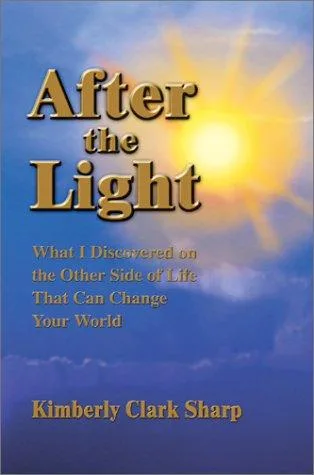
After the Light
 71
71

After the Light
Sharp's "After the Light" presents a deeply personal narrative that, while touching on familiar themes within NDE literature, offers a unique introspective quality. The strength lies in its raw honesty and the palpable sense of wonder and transformation it conveys. The author doesn't shy away from the profound existential questions that such experiences provoke. However, a limitation is the inherent subjectivity; the narrative's power relies heavily on the reader's openness to its premise, and it offers little in the way of empirical verification, which is to be expected but worth noting. The description of the "veil" between physical and non-physical realms serves as a particularly poignant example of the book's evocative, albeit personal, depiction of transition. It’s a sincere testament to one individual's encounter with the unknown.
📝 Description
71
Kimberly Clark Sharp's "After the Light" was published in 2003, detailing personal experiences of consciousness beyond the body.
Published in 2003, Kimberly Clark Sharp's "After the Light" presents a personal account of consciousness and the afterlife, blending introspection with philosophical inquiry. The book challenges conventional views on life and death, inviting readers to consider perspectives beyond the material world. It is not a rigid doctrine but an invitation to contemplate existence and what may lie beyond.
This work is suited for those interested in near-death experiences (NDEs), consciousness studies, and the philosophical questions surrounding altered states of awareness. Readers who appreciate personal narratives combined with intellectual exploration will find it particularly valuable. It appeals to individuals seeking to broaden their understanding of fundamental questions about life and what follows, offering a blend of personal testimony and thoughtful consideration.
Emerging in the early 2000s, a period of renewed interest in NDE research, "After the Light" joins a lineage of works that explore consciousness beyond corporeal limits. It follows in the tradition of researchers like Raymond Moody Jr. and Elisabeth Kübler-Ross, who brought concepts of the afterlife into wider discussion. Sharp's contribution is a personal narrative that adds subjective depth to the growing field, complementing more clinical or theoretical explorations of spiritual and metaphysical experiences.
💡 Why Read This Book?
• Gain a personal perspective on near-death experiences, moving beyond clinical descriptions to an intimate narrative of transition, as detailed in Kimberly Clark Sharp's account of her own profound encounter. • Explore the concept of consciousness potentially existing independently of the physical body, challenging conventional materialist viewpoints with Sharp's reflections on post-physical awareness. • Contemplate the interconnectedness of existence and the nature of unconditional love, as presented through the author's transformative experience and subsequent philosophical considerations.
⭐ Reader Reviews
Honest opinions from readers who have explored this book.
❓ Frequently Asked Questions
What is the primary focus of Kimberly Clark Sharp's "After the Light"?
The book primarily focuses on the author's personal experience of a near-death event and the subsequent insights gained about consciousness, the afterlife, and the nature of existence beyond the physical body.
When was "After the Light" first published?
Kimberly Clark Sharp's "After the Light" was first published in 2003, a period when interest in near-death experiences was gaining broader traction.
Does the book offer scientific proof of an afterlife?
No, "After the Light" is presented as a personal narrative and philosophical exploration, not as scientific proof. It offers a subjective account and interpretation of an extraordinary experience.
Who would benefit most from reading this book?
Individuals interested in near-death experiences, consciousness studies, spirituality, and those seeking personal reflections on life, death, and what may lie beyond would find this book valuable.
How does "After the Light" relate to other near-death experience literature?
It contributes a personal, introspective voice to the field, complementing more clinical or theoretical works by offering a deeply felt, subjective account of a transformative experience.
What is the tone of "After the Light"?
The tone is deeply personal, reflective, and often awe-inspired. It balances a sense of wonder with earnest inquiry into the metaphysical implications of the author's experience.
🔮 Key Themes & Symbolism
Consciousness Beyond the Body
The central theme revolves around the idea that consciousness is not solely confined to the physical brain. Sharp's narrative explores states of being where awareness seems to transcend bodily limitations. This concept challenges materialistic views and aligns with philosophical traditions that posit a non-physical aspect of the self. The book presents this not as abstract theory, but as a lived experience, prompting readers to consider the potential for awareness to persist or exist independently of physical form, drawing parallels with Gnostic ideas of the soul's journey.
The Nature of Transition
Sharp details the perceived transition from physical life to another state of existence, often referred to as the 'light' or the 'other side.' This process is depicted with a sense of profound peace and understanding, contrasting with common fears associated with death. The work explores the dissolution of ego and the merging with a greater awareness, suggesting a process less of ending and more of transformation. This aligns with certain mystical interpretations of death as a gateway rather than a finality.
Unconditional Love and Interconnectedness
A recurring element in the narrative is the overwhelming experience of unconditional love and the realization of deep interconnectedness with all beings and the universe. This theme suggests a fundamental spiritual reality where separation is an illusion. The book implies that such experiences, often reported in NDEs, offer a glimpse into a universal consciousness where love is the underlying principle. This appeals to concepts found in various spiritual traditions, including Sufism and certain interpretations of Buddhist philosophy.
Purpose and Meaning
The journey described in "After the Light" leads to a re-evaluation of life's purpose. The author conveys a sense of understanding regarding the lessons and growth intended by existence. This perspective suggests that earthly life is a crucial phase for spiritual development, and that challenges are opportunities for learning. The book encourages readers to consider their own lives within a larger context of spiritual evolution, moving beyond mundane concerns to embrace a more profound sense of meaning.
💬 Memorable Quotes
Direct passages from the work, attributed to the author.
“Separation was an illusion I no longer perceived.”
— This statement points to a core realization within the narrative: the dissolution of the ego's sense of individuality and the perception of a unified reality, aligning with monistic and panentheistic philosophical viewpoints.
“Life’s meaning unfolded not in achievement, but in connection.”
— This interpretation emphasizes a shift in perspective regarding life's value. It suggests that true significance is found in relationships and universal interconnectedness, rather than personal accomplishments or material success.
“Fear dissolved in the face of absolute acceptance.”
— This captures the transformative emotional impact of the experience, suggesting that the profound love and understanding encountered eliminated fear, replacing it with a sense of complete peace and validation.
💡 Key Ideas
Editorial paraphrase of the work's core concepts — not direct quotes.
The light was not just seen, it was felt. It was understanding.
This paraphrased concept highlights the multi-sensory and cognitive nature of the 'light' experience described. It suggests that the encounter was not merely visual but an immersive state of being that imparted knowledge and profound comprehension.
The veil between worlds felt thin, permeable.
This paraphrased concept describes the subjective experience of a diminished barrier between the physical and non-physical realities, implying an awareness of other dimensions or states of existence.
🌙 Esoteric Significance
Tradition
While not strictly aligned with a single esoteric lineage, "After the Light" echoes themes found in Gnosticism, particularly concerning the soul's journey beyond the material world and the realization of a higher, transcendent consciousness. It also shares affinities with Neoplatonic concepts of emanation and the ultimate return to the One. The emphasis on unconditional love and interconnectedness aligns with mystical branches of various world religions and esoteric traditions like Theosophy, which posit underlying spiritual unity.
Symbolism
The central symbol is the 'light,' representing divine consciousness, ultimate truth, and unconditional love. It serves as a gateway and a source of profound knowledge, transcending ordinary perception. Another motif is the 'veil,' symbolizing the perceived separation between the physical and non-physical realms, which the author experiences as thinning or becoming permeable. This symbolizes the potential for expanded awareness and the illusory nature of material boundaries.
Modern Relevance
Contemporary thinkers and practitioners exploring consciousness, transpersonal psychology, and the spiritual dimensions of near-death experiences often cite personal accounts like Sharp's. The book's themes of interconnectedness and love are relevant to mindfulness practices, integral spirituality movements, and discussions on the limitations of purely materialistic worldviews. Its narrative approach continues to inform contemporary explorations into the nature of reality and subjective experience beyond the physical.
👥 Who Should Read This Book
• Individuals fascinated by near-death experiences (NDEs) and personal accounts of consciousness beyond the physical body, seeking a deeply introspective narrative. • Students of comparative spirituality and philosophy of mind, interested in subjective testimonies that challenge materialistic paradigms and explore metaphysical concepts. • Those undergoing personal crises or questioning the meaning of life and death, who may find solace and expanded perspective in Sharp's journey of transformation and realization.
📜 Historical Context
Published in 2003, "After the Light" emerged during a continued wave of interest in near-death experiences (NDEs) and consciousness studies, building on the foundational work of figures like Dr. Raymond Moody Jr. in the 1970s. While Moody's work often focused on common elements reported by multiple individuals, Sharp's book offers a deeply personal, introspective account. The early 2000s saw a broader cultural engagement with spirituality outside traditional religious frameworks, with NDE narratives contributing to discussions on the nature of reality and the possibility of life after death. This period also saw the rise of comparative spirituality and the blending of scientific inquiry with subjective experience. Unlike more academic explorations or philosophical treatises, Sharp’s work provided a narrative anchor for the often-ineffable aspects of such profound encounters, resonating with a public increasingly open to alternative perspectives on existence.
📔 Journal Prompts
Reflect on the concept of the 'veil' and its perceived permeability in your own life.
Consider the nature of unconditional love as described in the book's interpretation.
Analyze the shift in perceived life purpose presented in 'After the Light'.
Explore the implications of consciousness existing independently of the physical body.
How might the experience of the 'light' redefine one's understanding of fear?
🗂️ Glossary
Near-Death Experience (NDE)
A profound personal experience associated with events involving actual or imminent physical death, often characterized by altered states of consciousness and perceptions.
Consciousness
The state of being aware of and responsive to one's surroundings; the totality of one's thoughts, feelings, and experiences; often explored in esoteric contexts as potentially independent of the physical body.
The Light
In the context of NDEs, often refers to a perceived brilliant, benevolent light that imparts feelings of peace, love, and understanding, and may serve as a gateway or source of wisdom.
Veil
A metaphorical or perceived barrier separating the physical world from spiritual or non-physical dimensions, which may become thin or transparent during profound altered states.
Interconnectedness
The state of being connected or related; in spiritual and esoteric contexts, it refers to the fundamental unity of all beings and phenomena, often perceived as a core aspect of reality.
Ego Dissolution
A state where the sense of self, the individual identity, temporarily diminishes or disappears, often experienced during mystical or profound altered states of consciousness.
Spiritual Evolution
The concept that individuals and consciousness progress through stages of development, learning lessons and gaining wisdom, often seen as the overarching purpose of existence.
🔮 Readers Also Liked
Browse all →








More by Kimberly Clark Sharp
All books →
More Free Occult Philosophy Books
View all →