A Very Brief History of Spirit Communication
 77
77

A Very Brief History of Spirit Communication
Dr. Juan Carlos Rey's "A Very Brief History of Spirit Communication" offers a welcome, sober examination of a topic often relegated to sensationalism. Rey’s strength lies in his academic rigor, treating spirit communication as a genuine cultural and religious phenomenon worthy of serious study, not mere dismissal. He adeptly traces its lineage from antiquity, highlighting its recurring presence in diverse societies. A particular strength is the chapter detailing the rise of Spiritualism in the 19th century, placing it within its socio-historical context. However, the book's brevity, while its stated aim, sometimes feels like a constraint; complex philosophical underpinnings or regional variations could benefit from more extensive discussion. The exploration of the séance, for instance, touches upon its mechanics but could perhaps engage more deeply with the psychological dynamics at play beyond a general cultural framework. Nevertheless, Rey provides a valuable, concise overview for those seeking an informed perspective on this enduring aspect of human experience.
📝 Description
77
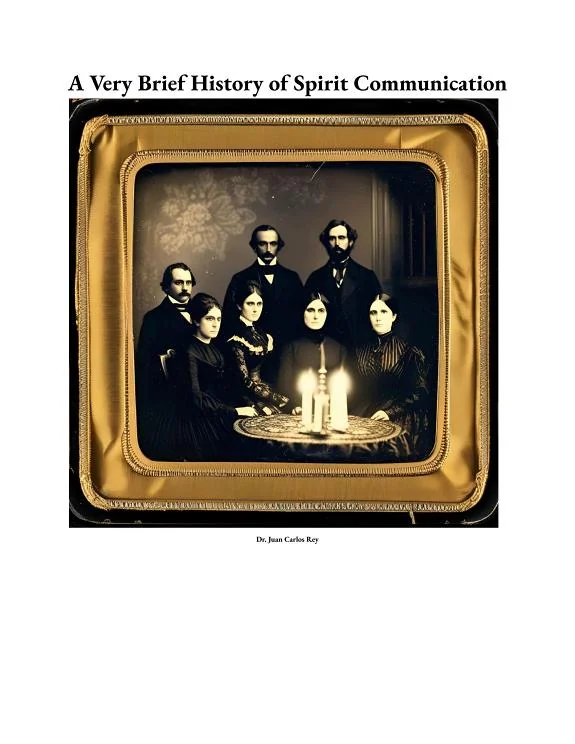
Dr. Juan Carlos Rey's 2023 book traces humanity's long history of contacting the dead.
This book surveys humanity's persistent fascination with contacting deceased or non-corporeal entities. Dr. Juan Carlos Rey, a scholar in comparative religious studies, examines this phenomenon not as folklore, but as a significant religious, cultural, and psychological pursuit across diverse societies and epochs. The work charts the historical trajectory of these interactions, from their earliest documented forms to more recent manifestations.
Rey's study situates spirit communication within broader historical currents. It covers its role in religious rites, philosophical debates, and social movements, spanning ancient traditions, medieval practices, and the spiritualist activity of the 19th century. The book acknowledges the phenomenon's presence in various cultures, framing it as a consistent thread in human intellectual and spiritual endeavor.
Core concepts addressed include the nature of consciousness, the persistence of identity after death, and the methodologies employed in attempted spirit communion. It differentiates between shamanic journeying, ecstatic states, and formalized séance practices. Rey examines the cultural and psychological frameworks that gave meaning to these experiences, treating them as integral to understanding human belief and ritual.
This book fits within the study of Spiritualism and the afterlife, traditions that have long explored the possibility of communication with spirits. It examines historical movements like 19th-century Spiritualism, which brought these ideas into public discourse, and connects them to older practices such as shamanism and necromancy found in various cultures. The work treats these pursuits as serious subjects for academic inquiry, looking at the belief systems and social structures that supported them.
💡 Why Read This Book?
• Gain a factual understanding of spirit communication's historical roots, tracing its presence from ancient shamanism to the organized Spiritualism movement of the 19th century, a scope often overlooked in popular accounts. • Understand the academic perspective on phenomena like séances and mediumship, presented as serious religious and psychological pursuits rather than mere superstition, as detailed in Dr. Rey's scholarly analysis. • Learn about the diverse cultural frameworks that have interpreted communion with the unseen, providing context for how societies have historically understood and integrated these experiences.
⭐ Reader Reviews
Honest opinions from readers who have explored this book.
❓ Frequently Asked Questions
What is the earliest historical evidence of spirit communication discussed in the book?
Dr. Rey's work explores ancient traditions and documented practices, suggesting that the human pursuit of spirit communication is deeply rooted, extending back to early shamanic practices and ritualistic interactions with the unseen.
How does Dr. Rey differentiate spirit communication from other religious practices?
Rey frames spirit communication as a distinct phenomenon involving direct or mediated contact with non-corporeal entities, examining its specific methodologies and cultural interpretations across various religious and philosophical traditions.
What role did the 19th century play in the history of spirit communication, according to the book?
The book highlights the 19th century as a pivotal era, marked by the significant rise of organized Spiritualism, which brought mediumship and séances into wider public consciousness and academic discussion.
Is Dr. Juan Carlos Rey a recognized scholar in this field?
Yes, Dr. Juan Carlos Rey is presented as a noted scholar of comparative religious studies and esoteric traditions, lending academic authority to his examination of spirit communication.
Does the book focus only on Western traditions of spirit communication?
No, the book examines spirit communication across multiple civilizations and cultures, indicating a global perspective rather than a narrow focus on Western esoteric or religious history.
What kind of scholarly approach does 'A Very Brief History of Spirit Communication' take?
The book adopts a richly scholarly yet concise approach, treating spirit communication as a serious religious, cultural, and psychological phenomenon worthy of academic exploration.
🔮 Key Themes & Symbolism
Ancient Communion Rituals
The work explores early forms of spirit communication, detailing how ancient cultures integrated interactions with the unseen into their religious and social fabric. This includes shamanic practices and temple rituals where communion with spiritual entities was a central tenet, predating later formalized movements and offering a foundational understanding of humanity's enduring dialogue with the beyond.
The Spiritualist Movement
A significant focus is placed on the 19th-century Spiritualist movement, examining its emergence, key figures, and the societal impact of widespread belief in mediumship and séances. Dr. Rey situates this period as a critical juncture where spirit communication transitioned from localized traditions to a more public, organized phenomenon debated across cultural and scientific spheres.
Cultural and Psychological Frameworks
Rey analyzes the diverse belief systems and psychological needs that have shaped the perception and practice of spirit communication. The book investigates how different societies have conceptualized the afterlife, the nature of the soul, and the possibility of inter-realm dialogue, providing context for the consistent human drive to connect with the spiritual domain.
Methodologies of Contact
The volume details various historical methods employed for communicating with spirits, ranging from ecstatic trance states and divination techniques to the more structured séances of the modern era. It differentiates these approaches, examining the cultural significance and perceived efficacy attributed to each form of communion.
💬 Memorable Quotes
Direct passages from the work, attributed to the author.
“Communion with the unseen remains one of humanity’s most persistent pursuits.”
— This statement captures the book's central thesis: that the desire to connect with spirits is a fundamental and enduring aspect of human history and culture, not a fleeting trend.
“From ancient temples to modern séances, spirit communication has manifested as a serious religious, cultural, and psychological phenomenon.”
— This highlights the book's broad scope, emphasizing that spirit communication should be understood through academic lenses of religion, culture, and psychology, rather than being dismissed as mere superstition.
“The work examines spirit communication across multiple civilizations.”
— This indicates the book's comparative approach, promising a global perspective on the phenomenon rather than a singular, culture-bound analysis.
“Dr. Rey notes the scholarly exploration of esoteric traditions.”
— This points to the author's academic background and the book's intention to provide a well-researched, informed perspective on subjects often treated superficially.
“The pursuit of contacting the unseen spans millennia.”
— This emphasizes the deep historical roots of spirit communication, framing it as an integral part of the human experience across vast stretches of time.
🌙 Esoteric Significance
Tradition
This work aligns with traditions that study comparative religion and the history of consciousness, particularly those interested in altered states and inter-dimensional interaction. While not strictly within a single lineage like Hermeticism or Gnosticism, it provides historical context for practices that often intersect with these traditions, such as divination and mediumship, viewed as expressions of humanity's ongoing quest for knowledge beyond the mundane.
Symbolism
The book implicitly engages with symbols of transition and the veil between worlds. Concepts like the séance table, the medium's trance state, or ancient burial rites can be seen as symbolic representations of the threshold between the living and the departed. These motifs signify humanity's attempt to bridge the perceived gap between the material and spiritual realms, seeking connection and understanding.
Modern Relevance
Contemporary thinkers and practitioners in fields ranging from parapsychology to Jungian psychology, particularly those exploring archetypes of the collective unconscious and the nature of consciousness, find value in Rey's historical grounding. Researchers investigating modern mediumship, near-death experiences, and cross-cultural spiritual practices can draw upon this work to understand the historical precedents and enduring human drive for spirit communion.
👥 Who Should Read This Book
["• Academic researchers in comparative religion and cultural history seeking a concise overview of spirit communication's global trajectory.", '• Students of esoteric traditions interested in the historical development of practices related to mediumship and afterlife beliefs.', "• Skeptics and believers alike who desire a scholarly, non-sensationalized account of humanity's enduring fascination with contacting the unseen."]
📜 Historical Context
Published in 2026, Dr. Juan Carlos Rey's "A Very Brief History of Spirit Communication" arrives in an era where interest in the esoteric and paranormal continues to gain academic traction, albeit often contested. The book engages with a long intellectual tradition, tracing threads from ancient necromancy and oracle practices through the fervent Spiritualist movement of the 19th century, which captivated figures like Arthur Conan Doyle. Rey's work implicitly dialogues with contemporary comparative religious studies and anthropological approaches that seek to understand belief systems without necessarily validating the phenomena themselves. While not directly engaging with specific contemporary critics, the scholarly tone implicitly counters the sensationalism prevalent in popular media. The book’s concise format addresses a need for accessible yet rigorous scholarship on a topic frequently misunderstood or relegated to fringe studies, offering a grounded historical overview that acknowledges the seriousness with which these pursuits have been undertaken across cultures.
📔 Journal Prompts
The persistence of spirit communication across cultures and eras.
Analysis of the 19th-century Spiritualist movement's societal impact.
Comparison of ancient communion rituals with modern séance practices.
The psychological drivers behind the pursuit of contacting the unseen.
The role of belief systems in interpreting spirit communication phenomena.
🗂️ Glossary
Spirit Communication
The practice or belief in interacting with non-corporeal entities, including deceased individuals or other spiritual beings, through various methods.
Mediumship
The practice by which a person (a medium) supposedly acts as an intermediary between the spirit world and the physical world.
Séance
A meeting where individuals attempt to make contact with spirits, often involving a medium and specific rituals or protocols.
Comparative Religious Studies
An academic discipline that analyzes and compares the beliefs, practices, and histories of different religions and spiritual traditions.
Esoteric Traditions
Systems of thought and practice concerned with hidden knowledge or spiritual attainment, often involving mystical or occult elements.
Shamanism
A range of traditional beliefs and practices concerning communication with the spirit world, typically involving a shaman.
Necromancy
A form of divination involving communication with the dead, often through magical means.
This book appears in 1 collection
🔮 Readers Also Liked
Browse all →







From the “Spirit Communication” Collection
View all →





More Free Occult Philosophy Books
View all →