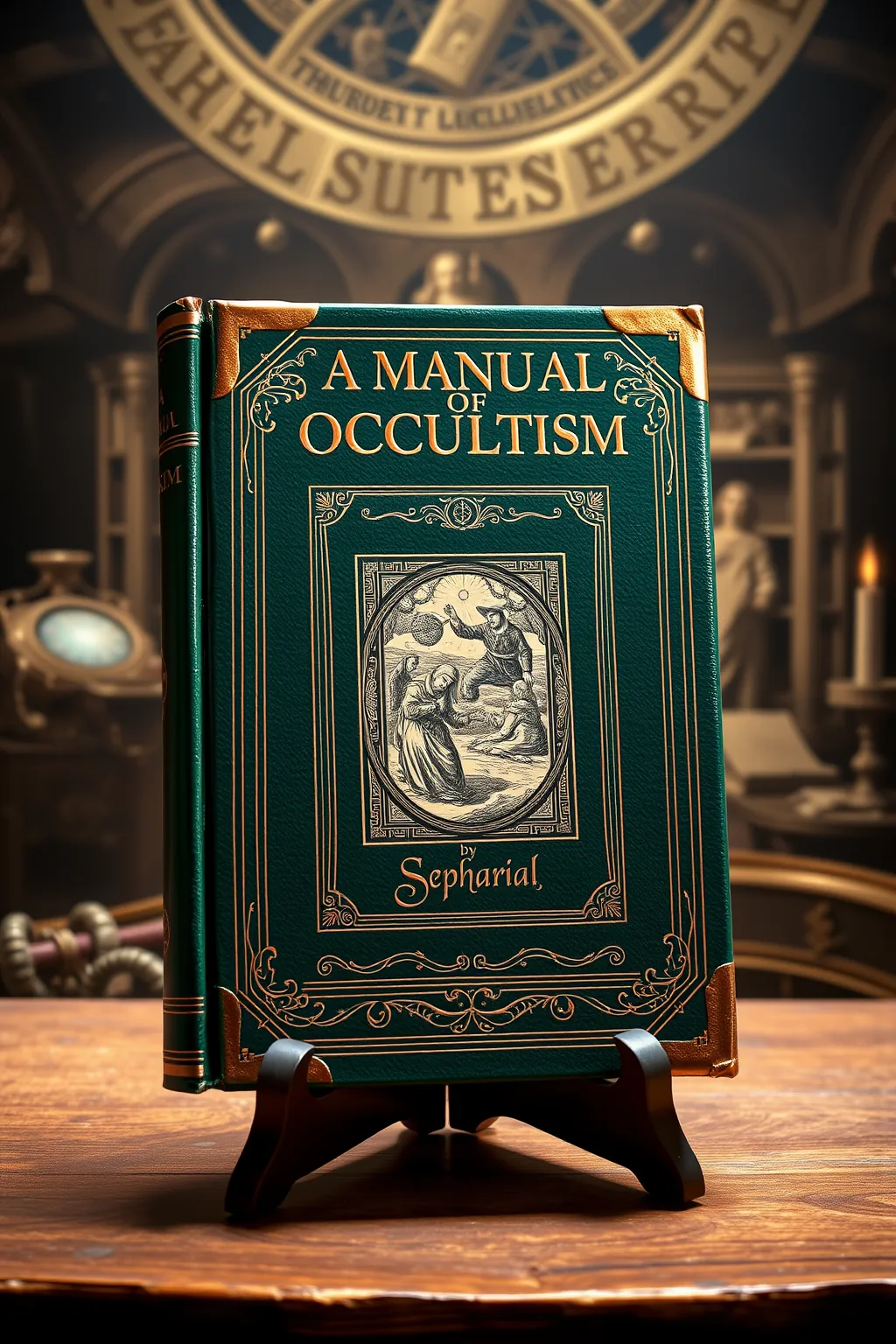
A Manual of Occultism
 71
71

A Manual of Occultism
Sepharial's A Manual of Occultism presents a dense, information-rich compendium that avoids the pitfalls of overly romanticized occult writing. Its strength lies in its systematic approach to subjects like astrology and palmistry, treating them with a seriousness that was characteristic of early 20th-century occult scholarship. The section on thaumaturgy, while perhaps less accessible today, offers a fascinating glimpse into historical conceptions of ritual magic. However, the treatment of hypnotism and mesmerism, while informative, feels dated by contemporary psychological understanding. The book’s original text, unadorned by modern commentary, provides a direct conduit to the author's intent. A key passage detailing the astrological significance of planetary aspects demonstrates the work’s analytical depth. Despite some dated perspectives, the manual remains a valuable resource for understanding the foundational texts of modern occultism.
📝 Description
71
Sepharial's A Manual of Occultism, published circa 1900, details practical occult arts.
Sepharial's A Manual of Occultism, originally appearing in the early 20th century, compiles discussions on several esoteric disciplines. The book covers astrology, palmistry, thaumaturgy, hypnotism, and mesmerism, aiming to give readers a broad understanding of these practices. It is intended for students of Western esotericism interested in how these subjects were understood by practitioners of that era.
This work emerged from a period of occult revival in Britain. It reflects an effort to organize and explain esoteric knowledge, often referencing older Hermetic ideas alongside contemporary scientific and psychological thought. The manual sought to reinterpret ancient wisdom for a modern audience. It systematically addresses core occult disciplines, viewing astrology as a cosmic science, detailing palmistry's characterological correlations, and examining thaumaturgy as the practical use of occult forces. Hypnotism and mesmerism are discussed for their energetic and psychological aspects. The book suggests underlying principles connect these diverse practices into a unified occult philosophy.
Sepharial's manual appeared during a British occult revival, a time when figures like Crowley and Blavatsky were active. The book represents a move to systematize esoteric knowledge, drawing on Hermeticism while incorporating contemporary scientific and psychological ideas. It aimed to present ancient wisdom in a way that resonated with early 20th-century thought, seeking to show the connections between various occult arts.
💡 Why Read This Book?
• Gain a foundational understanding of early 20th-century occult studies, particularly Sepharial's systematic approach to astrology and palmistry, which contrasts with more fragmented contemporary resources. • Explore the historical context of thaumaturgy and its perceived connection to psychological phenomena like hypnotism, as presented in the book's specific chapters on these arts. • Appreciate the original textual integrity of classic occult works, understanding how concepts like the 'occult arts' were defined and discussed by practitioners around the 1900s.
⭐ Reader Reviews
Honest opinions from readers who have explored this book.
❓ Frequently Asked Questions
When was A Manual of Occultism first published?
A Manual of Occultism by Sepharial was first published in the early 20th century, with this edition reflecting the original text from that period.
What specific occult subjects are covered in this book?
The book provides a comprehensive study of Astrology, Palmistry, Thaumaturgic Art, Hypnotism & Mesmerism, and the broader category of Occult Arts, offering detailed insights into each.
Is the information in A Manual of Occultism still relevant today?
While some specific practices and understandings have evolved, much of the foundational knowledge and historical perspective on occult disciplines presented in the book remains useful for students of esotericism.
Why are reprints of books like A Manual of Occultism important?
Many early occult texts are scarce and expensive. Republishing them in affordable, high-quality editions makes these historically significant works accessible to a new generation of researchers and practitioners.
Who was Sepharial, the author of A Manual of Occultism?
Sepharial was a prominent astrologer and occultist of the late 19th and early 20th centuries, known for his contributions to astrological literature and esoteric studies.
What is Thaumaturgy as discussed in the manual?
Thaumaturgy, within the context of A Manual of Occultism, refers to the practice of performing wondrous or miraculous feats, often understood as the practical application of occult forces or magical arts.
🔮 Key Themes & Symbolism
Astrological Science
The work presents astrology as a systematic science rather than mere fortune-telling. It details the interpretation of planetary positions, houses, and aspects, emphasizing the intricate calculations and symbolic language required for accurate readings. Sepharial positions astrological knowledge as a key to understanding cosmic influences and their terrestrial manifestations, a central tenet in early 20th-century occult thought.
Palmistry and Characterology
A Manual of Occultism provides a detailed guide to palmistry, correlating the lines and mounts of the hand with personality traits and life potentials. It moves beyond superficial readings to suggest a deeper connection between the physical form and the individual's psychic and spiritual constitution, reflecting the era's interest in physiognomy and esoteric psychology.
Thaumaturgic Art
This section explores the practical application of occult forces, often termed the 'Thaumaturgic Art.' It examines the principles believed to govern magical operations, the invocation of energies, and the execution of rituals aimed at producing specific effects. The manual treats these practices with a formal, almost scientific, rigor, aiming to clarify the mechanics of occult power.
Hypnotism and Mesmerism
Sepharial examines hypnotism and mesmerism from an occult perspective, exploring the nature of the human aura, psychic suggestion, and the manipulation of vital energies. The work connects these phenomena to broader occult principles, suggesting they are manifestations of forces and consciousness that can be understood and directed through specific techniques.
💬 Memorable Quotes
Direct passages from the work, attributed to the author.
“The Thaumaturgic Art is the practical application of occult forces.”
— This concise statement defines the core of practical magic within the book's framework, emphasizing the active manipulation of unseen energies rather than passive reception of mystical phenomena.
“Astrology reveals the cosmic influences upon earthly life.”
— This highlights the author's view of astrology as a science of cosmic correspondences, linking celestial events to terrestrial occurrences and human destiny.
“Hypnotism and Mesmerism are concerned with the manipulation of vital forces.”
— This interpretation reflects the manual's understanding of these practices, framing them within the context of esoteric energy work and psychic influence.
💡 Key Ideas
Editorial paraphrase of the work's core concepts — not direct quotes.
Palmistry offers insights into character through the hand's configuration.
This paraphrase captures the essence of the book's approach to chiromancy, focusing on the hand as a map of an individual's inherent nature and potential.
Occult Arts encompass diverse disciplines united by underlying principles.
This summarizes the book's overarching theme: that seemingly disparate practices like astrology and magic share common, discoverable laws within the occult framework.
🌙 Esoteric Significance
Tradition
This work fits squarely within the Western Esoteric Tradition, particularly the Hermetic and astrological lineages. It reflects a post-Theosophical impulse to consolidate and present occult knowledge in a more accessible, didactic format. While drawing from older Hermetic principles of correspondence and microcosm/macrocosm, Sepharial's manual is characteristic of early 20th-century efforts to create a coherent, practical system of occultism for initiates.
Symbolism
The manual frequently employs astrological symbolism, where planets, signs, and houses represent specific energies, archetypes, and potentials. The hand in palmistry serves as a symbolic map, with lines and mounts representing life currents and characterological features. Thaumaturgy itself is symbolic of humanity's capacity to interact with and influence the subtle energies of the cosmos.
Modern Relevance
Contemporary practitioners of traditional astrology and those interested in the history of palmistry find Sepharial's work a valuable source text. Its structured approach to occult disciplines also informs modern eclectic occultists seeking to understand the historical development and interrelation of various esoteric practices from the early 20th century.
👥 Who Should Read This Book
• Students of Western Esotericism: Those seeking to understand the foundational texts and systematic approaches to occultism prevalent in the early 20th century will find this manual informative. • Aspiring Astrologers and Palmist: Individuals beginning their study of astrology or palmistry can benefit from Sepharial's detailed explanations and historical perspectives on these arts. • Researchers of Occult History: Scholars interested in the intellectual currents of the occult revival and the development of esoteric thought will appreciate the manual's comprehensive scope.
📜 Historical Context
Sepharial's A Manual of Occultism emerged during Britain's late Victorian and Edwardian occult revival, a period marked by intense interest in spiritualism, Theosophy, and ceremonial magic. Published around the turn of the 20th century, it stands alongside works by contemporaries like Aleister Crowley and Arthur Edward Waite. The manual reflects a desire to systematize esoteric knowledge, often presenting astrological and thaumaturgic principles with a seriousness that sought to legitimize them against a backdrop of increasing scientific materialism. Unlike the more Theosophically-influenced writings of figures like Blavatsky, Sepharial's approach leans towards a more direct, practical application of astrological and magical doctrines. The work engaged with popular scientific ideas of the time, attempting to bridge the gap between ancient mystical traditions and nascent psychological theories.
📔 Journal Prompts
The astrological significance of planetary aspects, as detailed in the manual, and its personal resonance.
Reflections on the connection between hand formations and character traits discussed in the palmistry section.
The principles of thaumaturgy and their potential application in modern contexts.
Sepharial's view on hypnotism and mesmerism versus contemporary psychological understanding.
The underlying unity of the occult arts as presented by Sepharial.
🗂️ Glossary
Astrology
The study of the movements and relative positions of celestial bodies interpreted as having an influence on human affairs and the natural world.
Palmistry (Chiromancy)
The practice of fortune-telling or divination by the interpretation of the palm of the hand; also, the study of the character of a person by the lines and configurations of the hand.
Thaumaturgy
The practice of magic or sorcery, especially the performance of miracles or wondrous feats.
Hypnotism
The induction of a state of consciousness in which a person appears to be in a daze and to be unusually responsive to suggestions.
Mesmerism
A system of treatment based on hypnotism, originally developed by Franz Mesmer, involving the manipulation of a supposed universal fluid or 'animal magnetism'.
Occult Arts
A general term for disciplines and practices concerned with hidden or secret knowledge, often relating to magic, mysticism, and supernatural phenomena.
Aura
In esoteric traditions, a supposed field of subtle energy surrounding a living being, believed to reflect their physical, emotional, and spiritual state.