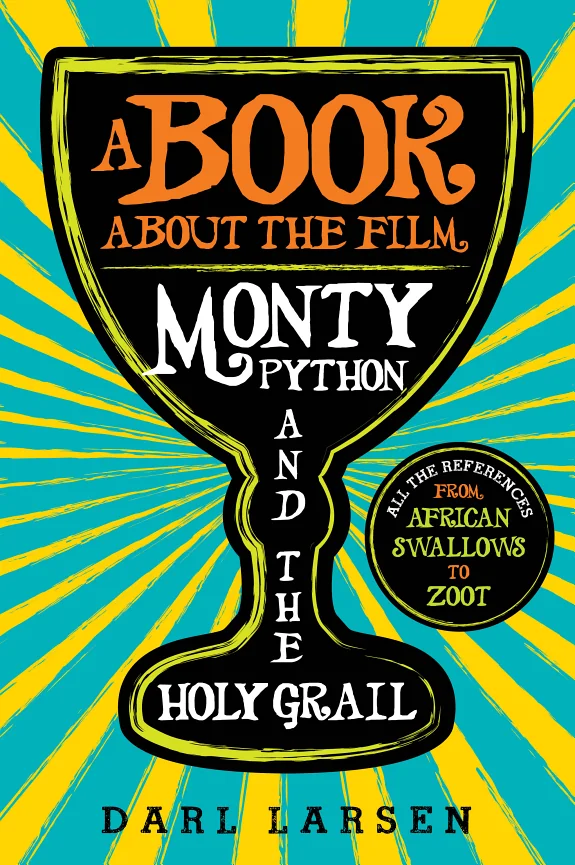
A book about the film Monty Python and the Holy Grail
 76
76

A book about the film Monty Python and the Holy Grail
Darl Larsen’s exploration of *Monty Python and the Holy Grail* offers a welcome departure from typical film fan analysis. Instead of rehashing jokes, Larsen investigates the film’s surprisingly robust engagement with Arthurian myth and the very nature of quests. The analysis of the 'Black Beast of Aaaaarrrrrrggghhh' scene, for instance, highlights the film's meta-commentary on narrative perils and the arbitrary nature of danger in storytelling. While the book provides a solid framework for understanding the film's thematic layers, its focus can sometimes feel overly academic, occasionally losing the very spirit of playful deconstruction that the Pythons themselves championed. It is a valuable read for those who appreciate a serious look at comedic art, though it may not satisfy those seeking purely lighthearted commentary.
📝 Description
76
Darl Larsen's 2015 book analyzes *Monty Python and the Holy Grail*'s engagement with archetypal narratives.
Published in 2015, Darl Larsen's study examines the 1975 film *Monty Python and the Holy Grail*. The book moves beyond the film's overt comedy to investigate its deeper connections to Arthurian legend and quest narratives. Larsen argues the film functions as a modern reinterpretation of chivalry and the search for meaning, using absurdity as its primary tool.
This work is for viewers and analysts interested in film's creative underpinnings and its use of satire. It will appeal to fans of Monty Python seeking a closer look at their methods, as well as scholars of medievalism, cultural studies, and comedy. Anyone interested in how current media uses historical and mythical themes will find this book valuable.
Larsen places the film within the context of 1970s British satire and comedy, noting its release in 1975 coincided with a period of cultural questioning. The film's deconstruction of heroism and myth resonated with a zeitgeist skeptical of authority and grand stories.
While categorized under Occult Philosophy, Larsen's work engages with esoteric themes through the lens of archetypal narratives and mythology. It connects the film's quest for the Grail to broader human desires for meaning and purpose, often found in occult traditions. The analysis of symbolic journeys and the deconstruction of heroic figures aligns with how esoteric thought often reinterprets classical myths and legends. The book uses the film as a modern text to discuss enduring patterns of human experience and the search for transcendent goals, even when framed by satire.
💡 Why Read This Book?
• Understand the film's deconstruction of the Arthurian myth cycle, learning how Larsen analyzes the subversion of chivalric tropes through specific examples like the "Knights Who Say 'Ni!'". • Grasp the historical context of the film's 1975 release, identifying how Larsen connects its absurdist humor to mid-1970s cultural skepticism towards established narratives. • Explore the concept of the 'parody quest' as presented by Larsen, recognizing how the film uses King Arthur's search for the Holy Grail to comment on the futility of grand, often arbitrary, human endeavors.
⭐ Reader Reviews
Honest opinions from readers who have explored this book.
❓ Frequently Asked Questions
What is the primary academic lens used in Darl Larsen's analysis of Monty Python and the Holy Grail?
The book primarily employs a lens of comparative mythology and cultural studies, examining how the 1975 film engages with and parodies Arthurian legends and the concept of the heroic quest.
Does Darl Larsen's book discuss the individual performances of the Monty Python cast members?
While the book focuses more on thematic and narrative analysis, it implicitly acknowledges the cast's contributions by discussing how their portrayals embody the film's satirical intent and deconstruction of archetypes.
When was the film Monty Python and the Holy Grail released?
The film *Monty Python and the Holy Grail* was released in 1975, a fact that Darl Larsen uses to contextualize its satirical impact within the mid-1970s cultural landscape.
What specific Arthurian legend elements are analyzed in Larsen's work?
Larsen's work specifically analyzes elements such as King Arthur's quest for the Holy Grail, the concept of chivalry, and the archetypal knightly figures, contrasting them with the film's comedic and absurd interpretations.
Is Darl Larsen's book considered a definitive academic study of the film?
While not the sole academic study, Darl Larsen's 2015 book is recognized for its detailed thematic and mythological analysis, offering a significant contribution to understanding the film's deeper layers beyond its comedic surface.
How does the book explain the film's use of anachronisms?
The book interprets the film's deliberate anachronisms, such as the use of coconuts as horses, as a comedic device to highlight the absurdity of historical reenactment and the arbitrary nature of narrative conventions.
🔮 Key Themes & Symbolism
The Parodied Quest
Larsen's work investigates how *Monty Python and the Holy Grail* satirizes the archetypal heroic quest, a concept central to Arthurian legend and many mythic narratives. The book dissects the film's deliberate subversion of the noble pursuit of the Grail, presenting it instead as a series of absurd encounters and arbitrary obstacles. This theme explores the inherent folly in grand, often ill-defined, objectives, drawing parallels to how many esoteric traditions analyze the arduous path of spiritual attainment and the ego's tendency to create phantom goals.
Chivalric Ideals Under Scrutiny
The book examines the film's deconstruction of chivalry, a core tenet of Arthurian lore. Larsen highlights how the knights' actions, from the 'Knights Who Say Ni!' to the infamous Black Knight, mock the very notion of valor and courtly conduct. This critique of idealized heroism appeals to esoteric thought that often emphasizes self-knowledge and inner transformation over external displays of power or virtue. The film, through Larsen's analysis, reveals the performative aspect of traditional virtues and the humor found in their misapplication.
Absurdity as Revelation
A significant theme explored is the use of profound absurdity as a tool for revealing deeper truths, a concept that has echoes in certain mystical traditions. Larsen suggests that the film's relentless silliness and non-sequiturs are not merely comedic devices but function to dismantle conventional perceptions and expectations. This aligns with esoteric practices that seek to break down egoic structures and habitual thinking through paradoxical teachings or experiences that defy rational comprehension, forcing a re-evaluation of reality.
The Quest for Meaning in a Chaotic World
Larsen's analysis positions the film's narrative, particularly Arthur's titular quest, as a reflection of humanity's ongoing search for meaning and order in a fundamentally chaotic existence. The Holy Grail itself becomes a symbol of elusive ultimate truth. The book connects this to broader philosophical and spiritual inquiries, suggesting that the film's absurd journey mirrors the often-disjointed and perplexing paths individuals take in their own lives when seeking purpose or enlightenment. The film, via Larsen, questions the very nature of what constitutes a worthy pursuit.
💬 Memorable Quotes
Direct passages from the work, attributed to the author.
“The film’s treatment of the quest for the Holy Grail offers a modern lens on archetypal journeys.”
— This interpretation suggests that Larsen views the film not just as a comedy but as a meta-narrative that engages with the enduring human impulse to seek something greater, albeit through a distorted, humorous reflection.
“The film uses absurdity to challenge viewers' expectations of narrative and heroism.”
— This highlights the book's argument that *Monty Python and the Holy Grail*'s comedic style serves a deeper purpose: to deconstruct conventional storytelling and the concept of the heroic figure, prompting a re-evaluation of what constitutes meaning.
“King Arthur's journey exemplifies a quest fraught with arbitrary obstacles.”
— This interpretation focuses on Larsen's analysis of the film's central narrative, suggesting the book discusses how the pursuit of the Grail, as depicted, is less about spiritual attainment and more about navigating a series of nonsensical challenges.
💡 Key Ideas
Editorial paraphrase of the work's core concepts — not direct quotes.
Chivalric ideals are frequently undermined by the film's depiction of knightly conduct.
This paraphrase points to Larsen's critical examination of the film's satire of traditional heroism, indicating that the book analyzes how the movie pokes fun at the very notion of noble behavior and valor.
The film's humor stems from the subversion of medieval tropes.
This paraphrased concept implies that Larsen's work details how the comedic effect of *Monty Python and the Holy Grail* is derived from its playful and irreverent manipulation of familiar elements from Arthurian legend and medieval history.
🌙 Esoteric Significance
Tradition
While not directly aligned with a specific esoteric lineage like Hermeticism or Gnosticism, Larsen's work highlights how *Monty Python and the Holy Grail* engages with archetypal narratives found universally in myth and spiritual seeking. The film's quest structure, when analyzed through Larsen's lens, mirrors the arduous paths described in various traditions for achieving enlightenment or self-knowledge, particularly the challenges of overcoming egoic illusions and the deceptive nature of the material world.
Symbolism
The Holy Grail itself, a central symbol, is examined not just as a religious relic but as an emblem of elusive ultimate truth or gnosis – a concept familiar in Gnostic traditions. The 'Black Beast of Aaaaarrrrrrggghhh' can be interpreted as a manifestation of primal fears or the shadow self that must be confronted on any spiritual journey. The 'Knights Who Say Ni!' represent the arbitrary and often nonsensical barriers erected by the ego or external forces against genuine inquiry.
Modern Relevance
Contemporary thinkers in media studies and comparative mythology continue to draw upon the film's deconstructive power, as analyzed by Larsen. Practices involving philosophical humor, the critique of heroism in modern narratives, and the exploration of existential absurdity find resonance with the film's enduring appeal. Those exploring the intersection of comedy and existentialism, or the reinterpretation of ancient myths in secular contexts, often reference *Monty Python and the Holy Grail* as a prime example.
👥 Who Should Read This Book
• Film scholars and students of medievalism seeking an analysis that moves beyond plot to explore thematic and mythological underpinnings. • Fans of Monty Python interested in a deeper academic understanding of the troupe's creative output and their engagement with classic narratives. • Readers of cultural criticism interested in how 1970s media reflected and satirized societal norms and traditional storytelling structures.
📜 Historical Context
Darl Larsen’s 2015 book arrives decades after *Monty Python and the Holy Grail*'s 1975 release, allowing for a retrospective analysis of its place within mid-1970s British comedy. The film emerged during a period characterized by a burgeoning counter-culture and a growing skepticism towards established institutions and grand narratives, a sentiment that permeated much of the era's satirical output. While Monty Python's television show had already established their unique brand of surreal humor, the film solidified their deconstructionist approach to classic myths. Contemporaries like the satirical magazine *Private Eye* were also engaging in similar critiques of authority, though often with a sharper political edge. Larsen's work contextualizes the film not just as a comedic artifact but as a cultural response to the prevailing social and intellectual currents of its time, examining how its blend of medievalism and absurdity resonated with an audience questioning traditional values.
📔 Journal Prompts
The film's parody of the quest for the Holy Grail.
King Arthur's knights and their subversion of chivalric ideals.
The role of absurdity in revealing deeper truths within the film's narrative.
The film's critique of heroism as presented by Darl Larsen.
The significance of arbitrary obstacles in the quest structure.
🗂️ Glossary
Arthurian Legend
A body of medieval literary works and traditional stories concerning the legendary British leader King Arthur, his knights of the Round Table, and their quests, particularly the quest for the Holy Grail.
Chivalry
The medieval knightly system of ideals and social behaviors, encompassing courage, honor, and courtesy, often associated with the code of conduct expected of knights in Arthurian romances.
Heroic Quest
A narrative archetype involving a protagonist who begins a perilous journey to achieve a significant goal, often involving trials, supernatural aid, and a transformative return.
Satire
The use of humor, irony, exaggeration, or ridicule to expose and criticize people's stupidity or vices, particularly in the context of contemporary politics and other topical issues.
Archetype
A very typical example of a certain person or thing; in literature and mythology, a recurring symbol or motif representing universal patterns of human nature or experience.
Gnosticism
A complex set of religious ideas and systems that emerged in the first century AD, characterized by the belief that salvation is attained through secret knowledge (gnosis) of a divine nature within oneself.
Anachronism
A thing belonging or appropriate to a period other than that in which it exists, especially a thing that is conspicuously old-fashioned. In film, often used for comedic or thematic effect.
🔮 Readers Also Liked
Browse all →









More by Darl Larsen
All books →
More Free Occult Philosophy Books
View all →






![Roald Dahl's Tales of the Unexpected [24 stories]](/img/thumb/roald-dahls-tales-of-the-unexpected-24-stories-roald-dahl-509219.webp)