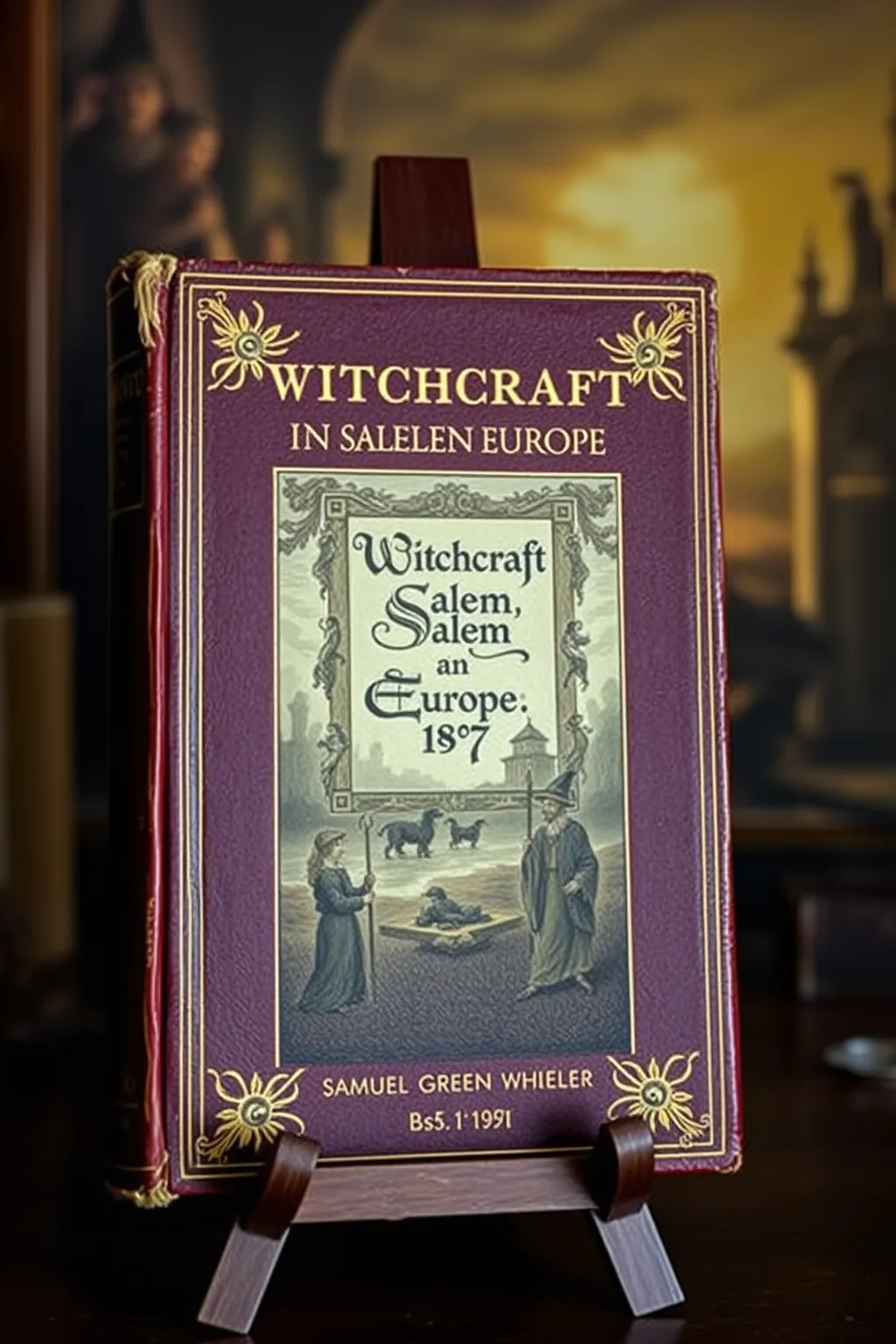
Witchcraft in Salem and in Europe. 1893: Iss 97
 77
77

Witchcraft in Salem and in Europe. 1893: Iss 97


Sophia Crane (Associate Editor) — This seminal work by Benjamin offers a vital comparative analysis of witchcraft phenomena across continents and eras. Its strength lies in Benjamin's nuanced approach, moving beyond sensationalism to explore the socio-historical and psychological dimensions of witch accusations in both Salem and Europe. He skillfully unearths the esoteric undercurrents, hinting at the deeper, often suppressed, spiritual or magical practices that may have been misinterpreted by society. For scholars of occult history, religious studies, and cultural anthropology, this issue is an indispensable resource, providing a foundational understanding of how fear and belief systems intersect, and offering glimpses into genuine esoteric traditions obscured by persecution. It is a compelling read for anyone seeking to understand the roots of modern paganism and the enduring legacy of perceived sorcery.
📝 Description
77
Published in 1893, Samuel Green Wheeler Benjamin's 'Witchcraft in Salem and in Europe' examines historical witch trials.
Samuel Green Wheeler Benjamin's 1893 work, 'Witchcraft in Salem and in Europe,' offers a comparative study of witch trials in America and Europe. Benjamin contrasts the Salem witch trials with the more extensive history of occult practices and accusations in Europe. He analyzes the social and psychological factors that contributed to mass hysteria and persecution during these periods.
The book discusses the perceived motivations behind witchcraft accusations and the ways societies grappled with beliefs in unseen forces. Benjamin also touches upon the energies that individuals supposedly sought to control through occult means. This study aims to illuminate the historical roots of fear and fascination surrounding witchcraft, suggesting connections to enduring human anxieties about the unknown.
This book fits within the late 19th-century surge of interest in occultism and historical anomalies. It examines beliefs and practices that were often labeled as 'witchcraft' through a lens informed by emerging psychological theories and a fascination with comparative religion and folklore. Benjamin's work engages with the historical record of accusations and perceived magical practices, placing it alongside contemporary esoteric inquiries into ancient traditions and hidden knowledge.
💡 Why Read This Book?
Uncover the historical roots of witchcraft beliefs, from the stark realities of the Salem trials to the complex tapestry of European occultism. Benjamin's work illuminates the societal fears and hidden knowledge that fueled accusations, offering profound insights into human psychology and the enduring power of the mystical. Ideal for history buffs, spiritual seekers, and practitioners interested in the historical context of their craft.
⭐ Reader Reviews
Honest opinions from readers who have explored this book.
❓ Frequently Asked Questions
What historical periods does this issue primarily cover?
This issue delves into the late 17th century for the Salem witch trials and provides a broader historical overview of European witchcraft beliefs and practices that predate and extend beyond that period, examining centuries of tradition.
Does Benjamin offer explanations for the alleged witchcraft?
Benjamin explores both the societal explanations of the time, such as religious fervor and mass hysteria, as well as hinting at potential underlying esoteric practices that may have been misunderstood or feared by the populace.
Is this book suitable for beginners in witchcraft studies?
Yes, while academically rigorous, Benjamin's accessible prose makes it suitable for beginners seeking a historical and cultural understanding of witchcraft, offering a solid foundation for further exploration.
What is the primary geographical focus?
The primary geographical focus is on the United States (specifically Salem, Massachusetts) and various regions across Europe, offering a comparative perspective on witchcraft phenomena.
How does this issue relate to other witchcraft literature from the era?
As part of a periodical, this issue likely engages with contemporary debates and scholarship on witchcraft, offering Benjamin's unique perspective and historical analysis within the broader discourse of late 19th-century occult studies.
🔮 Key Themes & Symbolism
The Crucible of Accusation: Salem's Shadow
This theme dissects the socio-historical and psychological dynamics that precipitated the infamous Salem witch trials. Benjamin explores the volatile atmosphere, the role of Puritanical doctrine, and the insidious spread of fear and suspicion that led to mass accusations. It examines how societal anxieties, personal vendettas, and religious fervor converged, creating a fertile ground for persecution. The narrative highlights the vulnerability of individuals caught in the maelstrom of hysteria, and the lasting impact of collective belief on judicial and social outcomes, offering a chilling portrait of a community consumed by its own demons.
European Arcana: The Broader Range of Witchcraft
Benjamin broadens the lens to encompass the diverse and often ancient traditions of witchcraft across Europe. This section explores the varied manifestations of folk magic, herbalism, divination, and alleged pacts with unseen forces that characterized European beliefs. It contrasts the more localized and often misunderstood practices in Europe with the specific events in Salem, revealing common threads of fear, superstition, and the human desire to control or appease the supernatural. The exploration touches upon the evolution of these beliefs, from pagan roots to their suppression and reinterpretation within Christian societies, painting a rich historical panorama.
The Esoteric Undercurrent: Symbolism and Hidden Knowledge
Beyond mere historical recounting, this theme probes the esoteric significance embedded within witchcraft narratives. Benjamin hints at the deeper symbolism associated with rituals, familiars, and alleged magical abilities. It examines how practitioners, both real and imagined, might have utilized symbolic language and practices to connect with hidden energies or achieve altered states of consciousness. This exploration invites readers to consider the archetypal forces at play, the potential for genuine spiritual or magical knowledge veiled by societal condemnation, and the enduring human quest for understanding the mysteries of existence through the lens of the occult.
💬 Memorable Quotes
Direct passages from the work, attributed to the author.
“Whispers in the dark bred phantoms in the light.”
— This succinctly captures how rumor and fear, amplified in secrecy, could manifest as terrifying delusions and accusations in the public eye.
“The line between genuine spiritual seeking and perceived malevolence was often blurred by societal prejudice.”
— This highlights the subjective nature of defining witchcraft, suggesting that acts of devotion or spiritual exploration could be misconstrued as evil due to prevailing biases.
“In the crucible of fear, reason often yielded to the spectral.”
— This emphasizes how overwhelming fear could override logical thought processes, leading individuals to embrace supernatural explanations for ordinary or misunderstood events.
“The elements of ancient rites still resonated, though often cloaked in condemnation.”
— This suggests that remnants of old magical or spiritual practices persisted, albeit misunderstood and demonized, within the collective consciousness and societal narratives.
💡 Key Ideas
Editorial paraphrase of the work's core concepts — not direct quotes.
The air itself seemed charged with unseen forces, a evidence of the lingering power of ancient fears.
This quote evokes the palpable atmosphere of dread and supernatural tension surrounding witchcraft accusations, suggesting that the environment itself bore witness to potent, unseen energies.
🌙 Esoteric Significance
Tradition
This work touches upon the historical manifestations of Western esoteric traditions, particularly folk magic, pre-Christian European paganism, and the early roots of ceremonial magic. While not exclusively focused on a single codified system, it explores the societal perception and persecution of practices that often involved communication with nature spirits, divination, herbalism, and an understanding of subtle energies – elements that form the bedrock of many occult lineages.
Symbolism
Benjamin's analysis implicitly engages with the symbolism inherent in witchcraft narratives, such as the archetypal figures of the witch, the devil, and familiars. These figures can be interpreted as symbolic representations of primal forces, shadow aspects of the psyche, or connections to the elemental realms. The rituals and accusations themselves carry symbolic weight, reflecting societal fears of transgression, the feminine divine, and the unknown, all potent symbols within esoteric philosophy.
Modern Relevance
The enduring fascination with witchcraft in contemporary culture, including the resurgence of Neo-Paganism and Wicca, makes Benjamin's historical analysis profoundly relevant. Understanding the historical context of persecution and societal fear provides a critical lens through which to view modern spiritual practices. It highlights the archetypal patterns of humanity's relationship with nature, the divine feminine, and the instinctual desire to connect with unseen forces, offering lessons on tolerance, critical thinking, and the evolution of spiritual belief.
👥 Who Should Read This Book
This edition is essential for historians of religion, cultural anthropologists, and scholars of the occult seeking a foundational understanding of witchcraft's historical trajectory. Esoteric practitioners, particularly those interested in the roots of Western magical traditions and the historical context of their craft, will find invaluable insights into the evolution of beliefs and practices. Spiritual seekers and readers fascinated by the intersection of history, psychology, and the mystical will appreciate Benjamin's nuanced exploration. Beginners to witchcraft studies will benefit from this accessible yet thorough introduction to a complex and often misunderstood aspect of human history.
📜 Historical Context
Published in 1893, 'Witchcraft in Salem and in Europe' emerges from a late Victorian era grappling with modernity while retaining a fascination for the occult and the 'primitive.' This period saw a burgeoning interest in spiritualism, folklore, and comparative religion, a stark contrast to the scientific rationalism gaining ground. Benjamin's work, as part of a periodical, would have contributed to this discourse, offering historical scholarship that sought to explain, rather than simply condemn, the phenomena of witchcraft. The late 19th century was a time when the romanticized image of the witch, as well as a more academic interest in folklore and mythology, began to take shape. Benjamin's analysis, therefore, sits at the intersection of historical inquiry and an emergent esoteric sensibility, reflecting a society both looking back to understand its past and forward to redefine its relationship with the unseen.
📔 Journal Prompts
Reflect on the societal anxieties prevalent in late 17th-century Salem and how they might compare to anxieties in contemporary society. What parallels can you draw?
Consider the archetypal symbolism of the 'witch' figure. What does this archetype represent in terms of societal fears or suppressed aspects of the human psyche?
Benjamin contrasts European and Salem witchcraft. How do different cultural contexts shape the expression and perception of magic and superstition?
If you were living in the time of the Salem witch trials, what beliefs or practices might have made you a target, and how would you navigate such a climate?
How has the perception of witchcraft evolved from the era Benjamin describes to the present day? What factors have contributed to this evolution?
🗂️ Glossary
Puritanism
A denomination of Protestantism that emerged in the 16th century, emphasizing religious reform and strict moral and social codes, which heavily influenced early American colonial society and its views on witchcraft.
Mass Hysteria
A phenomenon characterized by the spontaneous and simultaneous manifestation of similar physical or psychological symptoms in a group of people, often triggered by fear, stress, or suggestion, as seen in the Salem trials.
Folk Magic
A broad category of magical practices rooted in traditional customs, beliefs, and rituals passed down through generations within a specific community or culture, often distinct from formal ceremonial magic.
Esoteric
Intended for or likely to be understood by only a small number of people with a specialized knowledge or interest; relating to hidden or secret knowledge, often of a mystical or spiritual nature.
Arcane
Understood by few; mysterious or secret, referring to knowledge, practices, or phenomena that are hidden, obscure, or not commonly known.
This book appears in 2 collections
🔮 Readers Also Liked
Browse all →
![Aloysii Charitini [pseud.] Discurs von trüglichen Kennzeichen der Zauberey, worinnen viel abergläubische Meinungen vernunfftmässig untersucht und verworffen; wie auch ... 1708: Iss 174](/img/thumb/aloysii-charitini-pseud-discurs-von-tr-glichen-kennzeichen-der-zauberey-worinnen-viel-abergl-ubische-meinungen-vernunfftm-ssig-untersucht-und-verworffen-wie-auch-1708-iss-174-brunneman-jacob-d-1735.webp)






From the “Witchcraft” Collection
View all →




More Free Witchcraft & Paganism Books
View all →