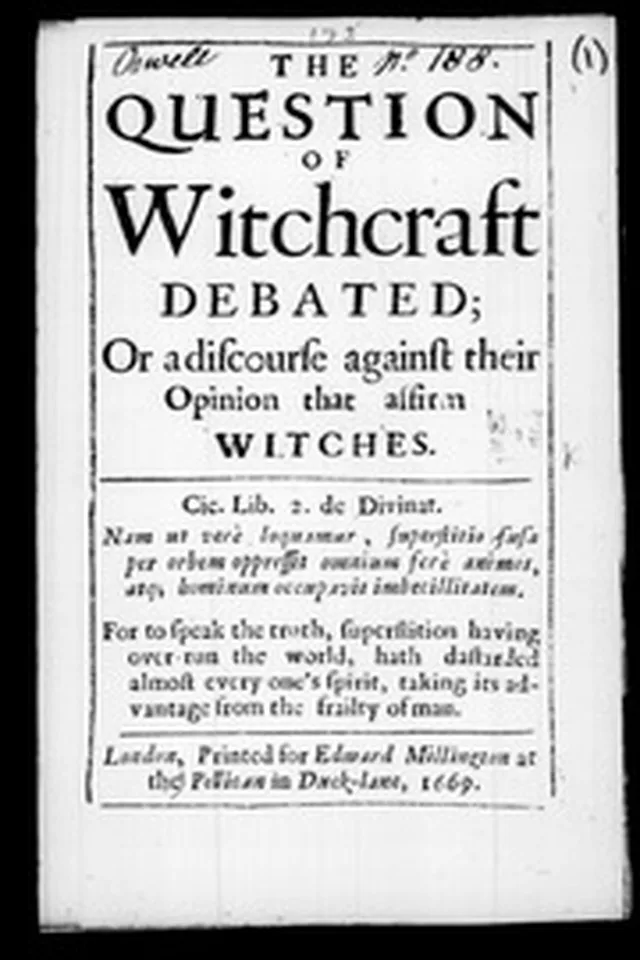
The question of witchcraft debated; ... 1669
 82
82

The question of witchcraft debated; ... 1669


Sophia Crane (Associate Editor) — Wagstaffe's 'The Question of Witchcraft Debated' remains a vital touchstone for understanding the historical discourse on sorcery. Far from a sensationalist tract, it offers a remarkably nuanced examination, probing the societal, psychological, and theological dimensions that shaped beliefs about witchcraft. Wagstaffe's logical dissection of evidence and his contemplation of potential misinterpretations provide invaluable insights into the era's intellectual landscape. This work is essential for scholars of the occult, historians of early modern thought, and practitioners seeking a deeper historical context for the enduring questions surrounding magic and belief. Its strength lies in its measured approach and its challenge to simplistic notions.
📝 Description
82
John Wagstaffe's 1669 text examines the philosophical basis of witchcraft accusations.
Published in 1669, John Wagstaffe's 'The Question of Witchcraft Debated' scrutinizes the beliefs surrounding sorcery and its alleged occurrences. Wagstaffe moves beyond simple lists of accusations, instead examining the philosophical ideas, social worries, and the role of self-deception that drove the witch trials. The book addresses how belief systems, the shaping of perception, and the boundary between the physical and non-physical worlds influenced these events.
This work is for readers interested in the intellectual debates of the period. It considers the power of conviction, the manipulation of how people see things, and the subtle line separating the real from the imagined. Wagstaffe's writing offers a look into a significant point in discussions about forbidden knowledge, focusing on intellectual seriousness blended with the historical anxieties surrounding witchcraft.
Wagstaffe's work appears during a period of intense intellectual and spiritual questioning in England. While not a manual of magical practices, it engages with the broader cultural fascination with the unseen and the forces believed to influence human affairs. It sits alongside contemporary explorations of natural philosophy and critiques of superstition, reflecting a growing interest in rationalizing or dissecting phenomena previously accepted through faith or fear. The book's focus on the psychology and societal roots of witchcraft accusations aligns with emerging Enlightenment inquiries into human reason and belief.
💡 Why Read This Book?
Unravel the historical and philosophical debates surrounding witchcraft. Gain insight into the psychology of belief and societal anxieties in the 17th century. For seekers of arcane knowledge and scholars of esoteric history, this book offers a critical, reasoned perspective on a subject often shrouded in myth and fear, providing a vital foundation for understanding the evolution of occult thought.
⭐ Reader Reviews
Honest opinions from readers who have explored this book.
❓ Frequently Asked Questions
What is the primary focus of 'The Question of Witchcraft Debated'?
The book meticulously debates the existence and nature of witchcraft, examining the evidence, societal beliefs, and philosophical arguments surrounding the phenomenon rather than providing spells or incantations.
Who was John Wagstaffe and when did he write this?
John Wagstaffe was an English writer and polemicist who published 'The Question of Witchcraft Debated' in 1669, during a period of intense interest and fear surrounding witchcraft.
Is this book a practical guide to witchcraft?
No, this is a scholarly and philosophical inquiry into the historical and conceptual aspects of witchcraft, designed for intellectual debate and understanding, not for practical application of magic.
What is the historical significance of this work?
It represents a critical and reasoned examination of witchcraft during a time when such beliefs were prevalent, contributing to the intellectual discourse that eventually led to a decline in witch trials.
Where can I access this digitized text?
This digitized edition is available through the Esoteric Library, derived from the Internet Archive's collection.
🔮 Key Themes & Symbolism
The Nature of Evidence and Belief
This theme scrutinizes the foundations upon which accusations of witchcraft were built. Wagstaffe critically examines the reliability of testimony, the role of superstition, and the psychological factors that could lead individuals to believe in or confess to sorcery. It explores how societal anxieties and pre-existing beliefs could shape perceptions, blurring the lines between reality and delusion, and questioning the empirical basis for condemning individuals as witches.
The Philosophical Underpinnings of Sorcery
Beyond mere accusation, Wagstaffe probes the philosophical dimensions of witchcraft. He questions the very possibility of supernatural pacts and the mechanisms by which alleged magical feats could be accomplished. This theme explores the intellectual debates of the era regarding natural versus supernatural phenomena, the limits of human knowledge, and the theological implications of attributing power to forces beyond divine or natural law, inviting contemplation on the essence of agency and causality.
Societal Anxieties and the Scapegoat
This theme illuminates how the concept of witchcraft served as a mirror to the societal fears and tensions of 17th-century England. Wagstaffe implicitly discusses how accusations of witchcraft could function as a means of social control, a way to channel collective anxieties about plague, famine, or political unrest onto marginalized individuals. It highlights the role of the 'witch' as a scapegoat, a vessel for societal ills, and the psychological need to find tangible explanations for misfortune.
💬 Memorable Quotes
Direct passages from the work, attributed to the author.
“What proof is there that witchcraft is not a Phantasm?”
— This provocative question challenges the tangible evidence presented in witchcraft trials, suggesting that alleged supernatural occurrences might be products of the mind or misinterpretation, rather than objective reality.
“The vulgar sort are easily swayed by fear and fancy.”
— Wagstaffe points to the susceptibility of the general populace to fear and imagination, highlighting how these emotions can override reason and lead to the acceptance of unsubstantiated claims.
“To condemn without clear conviction is a grievous error.”
— This emphasizes the ethical imperative for rigorous proof before judgment, cautioning against the severe consequences of hasty or unfounded accusations in matters of life and death.
“Is it not more plausible that Nature hath her secrets?”
— Here, Wagstaffe subtly suggests that seemingly supernatural events might instead stem from unknown or misunderstood natural laws, offering a rational alternative to supernatural explanations.
💡 Key Ideas
Editorial paraphrase of the work's core concepts — not direct quotes.
The Devil's power is often presumed rather than proven.
This quote questions the direct attribution of all malevolent events to demonic influence, suggesting that such claims are often based on assumption rather than concrete, verifiable evidence of Satanic intervention.
🌙 Esoteric Significance
Tradition
While not a grimoire, this text is significant within the broader tradition of skeptical inquiries into occult phenomena. It represents a crucial step in the intellectual deconstruction of folk magic and demonology, aligning with early rationalist and philosophical movements that sought to differentiate between verifiable phenomena and superstitious beliefs. Its esoteric value lies in clear the historical thought processes that shaped the understanding and eventual dismissal of certain magical practices.
Symbolism
The 'witch' in Wagstaffe's debate functions as a potent symbol of the unknown, the feared, and the misunderstood. The 'debate' itself symbolizes the tension between faith and reason, superstition and empirical evidence. The act of 'debating' the question signifies the intellectual struggle to define the boundaries of reality, the natural, and the supernatural, reflecting a broader societal and philosophical quest for clarity and order in a world perceived as increasingly complex and mysterious.
Modern Relevance
In an age still grappling with misinformation and the allure of conspiracy theories, Wagstaffe's reasoned approach to evidence and belief remains remarkably relevant. His meticulous dissection of claims encourages critical thinking and a healthy skepticism towards unsubstantiated assertions. For modern practitioners and scholars of the esoteric, understanding this historical debate provides crucial context for the evolution of magical thought and the enduring human fascination with phenomena that lie beyond the readily explainable.
👥 Who Should Read This Book
This key work is essential for historians of early modern England, particularly those focused on social history, religious thought, and the history of science. Occult scholars and practitioners will find it useful for understanding the intellectual underpinnings of historical witchcraft beliefs and the shift towards rationalism. Philosophers interested in epistemology, the nature of evidence, and the psychology of belief will discover a rich case study. For general readers fascinated by the darker aspects of human history and the enduring enigma of magic, Wagstaffe offers a compelling, intellectually stimulating journey into a central debate.
📜 Historical Context
Published in 1669, 'The Question of Witchcraft Debated' emerged during a period of significant transition in England. The English Civil War had concluded, and the Restoration was firmly established, yet societal anxieties persisted. While the peak of witch trials had begun to wane in England by this time, the belief in witchcraft remained deeply ingrained in popular consciousness and was still debated in intellectual circles. Wagstaffe's work reflects a growing trend towards rationalism and skepticism that characterized the Enlightenment era, challenging entrenched superstitions with logical inquiry. It stands as a evidence of the intellectual ferment of the late 17th century, where empirical observation and philosophical reasoning started to gain precedence over unquestioning faith and folklore in understanding the world.
📔 Journal Prompts
Reflect on a time when your belief was challenged by reasoned argument. How did this experience shape your understanding?
Consider a modern phenomenon that is widely believed but lacks concrete evidence. How does Wagstaffe's approach to witchcraft apply?
Explore the role of fear and imagination in shaping collective beliefs within your own society or culture.
How does the concept of a 'scapegoat' manifest in contemporary social or political discourse?
If you were a scholar in 1669, what arguments would you employ to either defend or refute the existence of witchcraft based on available knowledge?
🗂️ Glossary
Phantasm
An apparition, a specter, or a hallucination; something perceived by the senses that has no objective reality but is created by the mind.
Vulgar
Referring to the common people or the masses; often used with a connotation of being uneducated or easily swayed.
Sorcery
The practice of magic, especially that which is believed to involve the invocation of evil spirits or the use of supernatural powers for malevolent purposes.
Epistemology
The theory of knowledge, especially with regard to its methods, validity, and scope. Epistemology is the investigation of what distinguishes justified belief from opinion.
Polemicist
A person who engages in controversial debate or argumentation, often with a strong or aggressive stance.
This book appears in 2 collections
🔮 Readers Also Liked
Browse all →




More by Wagstaffe, John.
All books →

From the “Witchcraft” Collection
View all →




More Free Witchcraft & Paganism Books
View all →