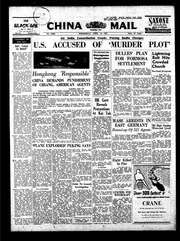
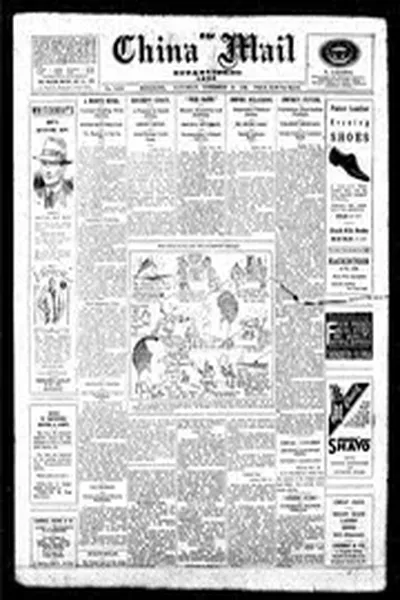
China Mail 1955-04-13
 82
82

China Mail 1955-04-13



Sophia Crane, Associate Editor: This remarkable archival piece from the China Mail, 1955, is a fascinating window into the charged atmosphere of the Cold War, viewed through a lens of suspicion and accusation. The raw, unfiltered pronouncements from Peking Radio regarding the Air India Constellation crash offer a compelling study in propaganda as a form of occult manipulation. It reveals how narratives are constructed to sow discord and assign blame, a practice deeply rooted in ancient esoteric traditions of influencing the masses. Essential reading for those interested in the intersection of history, psychology, and the subtle arts of power. Its strength lies in its unvarnished portrayal of a moment where truth was actively contested.
📝 Description
82
A 1955 newspaper fragment reveals esoteric dimensions to a geopolitical air disaster accusation.
This fragment from the China Mail on April 13, 1955, presents a specific historical event through an unusual lens. It focuses on the accusations surrounding an air disaster, particularly the claims made by Peking Radio. These pronouncements implicated the US and Hong Kong, suggesting a narrative beyond simple political maneuvering.
The text highlights how these official statements were crafted to shape public perception and collective consciousness. It points to veiled language, strategic omissions, and an atmosphere charged with unseen influences. The fragment suggests that the manipulation of truth itself acted as a form of occult art, an illusion built on fear and accusation.
This piece engages with the idea that significant historical events can be interpreted through esoteric frameworks, suggesting hidden forces or occult motivations at play. It aligns with traditions that view propaganda and mass media not just as political tools, but as methods for influencing consciousness on deeper, almost magical levels. The focus on 'veiled language' and 'hidden agendas' places it within a lineage of thought that seeks to uncover concealed meanings and unseen influences behind overt actions.
💡 Why Read This Book?
Uncover the hidden narratives behind a pivotal historical event. Explore how propaganda functions as a tool of esoteric influence, shaping perceptions and sowing discord. This document offers a rare, unfiltered glimpse into the machinations of power during the Cold War, revealing the psychological underpinnings of geopolitical conflict. Ideal for seekers of hidden knowledge, historians, and practitioners of esoteric thought.
⭐ Reader Reviews
Honest opinions from readers who have explored this book.
❓ Frequently Asked Questions
What is the primary event discussed in this document?
The document primarily discusses the crash of an Air India Constellation aircraft and the subsequent accusations made by Peking Radio, implicating the United States and Hong Kong in a 'murder plot.'
What makes this document 'esoteric'?
Its esoteric nature lies in its examination of how narratives are constructed to manipulate perception and sow discord, akin to ancient practices of influencing collective consciousness through charged language and veiled accusations.
Who is the intended audience for this document?
This document is intended for historians, geopolitical analysts, students of propaganda, and individuals interested in the psychological and esoteric dimensions of historical events and power dynamics.
What is the significance of the date 1955-04-13?
This date marks the specific publication of this edition of the China Mail, capturing a precise moment in time when these dramatic accusations were being made, offering a snapshot of contemporary Cold War tensions.
Are there any direct mentions of witchcraft or paganism in the text?
While not explicitly mentioning witchcraft or paganism in the modern sense, the document's themes of accusation, narrative control, and the manipulation of truth resonate with broader esoteric concepts of influence and shadow work.
🔮 Key Themes & Symbolism
The Occult Art of Propaganda
This document illuminates how propaganda operates as a sophisticated form of esoteric influence, akin to ancient magical practices designed to sway public opinion and manipulate emotions. Peking Radio's accusations regarding the Air India crash are not merely political statements but carefully crafted narratives intended to bind the collective consciousness to a specific interpretation of events, fostering fear, resentment, and ultimately, control. The deliberate use of charged language ('murder plot,' 'dastardly acts') serves as incantations, invoking primal reactions and bypassing rational thought. Understanding this process is key to deciphering the hidden forces that shape historical narratives and societal beliefs, revealing the magician behind the curtain of media.
Geopolitical Shadows and Hidden Agendas
Beyond the immediate tragedy, this publication looks at the shadowy field of Cold War geopolitics, where veiled agendas and clandestine operations were the norm. The accusations leveled by Peking against the US and Hong Kong suggest a deeper struggle for narrative dominance and ideological control. The 'plot discovered' narrative implies a hidden hand at work, a secret design that transcends the visible political arena. This theme speaks to the esoteric principle that events are rarely as they appear, and that true understanding requires looking beyond the surface to perceive the underlying currents of ambition, strategy, and power plays orchestrated by unseen forces. It's a lesson in discerning the 'real' actors in the grand cosmic drama.
The Symbolism of Accusation and Blame
The act of accusation itself carries profound symbolic weight, often employed in esoteric traditions to externalize inner conflicts or project unwanted aspects onto an 'other.' In this context, Peking's accusations against the US and Chiang Kai-shek serve as a ritualistic expulsion of perceived malevolence, a projection designed to unify their own populace against a common enemy. The 'search continues' for culpability mirrors the alchemical pursuit of purification and the revelation of hidden truths. This theme encourages contemplation of how blame functions as a psychological and societal mechanism, a powerful force that can both unite and divide, and how its strategic deployment can be a potent tool of influence and control.
💬 Memorable Quotes
Direct passages from the work, attributed to the author.
“'MURDER PLOT' PEKING RADIO CHARGES.”
— This stark declaration transforms a tragic accident into a deliberate act of malice, framing the event through a lens of occult conspiracy and invoking primal fear.
“U.S. ACCUSED OF 'MURDER PLOT'.”
— A direct indictment, positioning the US as the architect of destruction, a common trope in propaganda to demonize adversaries and solidify internal cohesion.
“CHINA DEMANDS PUNISHMENT OF CHIANG, AMERICAN AGENTS.”
— This signifies a call for ritualistic retribution, seeking to exorcise perceived evil and restore a perceived cosmic balance through symbolic justice.
“'PLANE EXPLODED' PEKING SAYS. PLOT DISCOVERED.”
— The assertion of a 'discovered plot' imbues the event with a hidden, intentional design, suggesting that the truth lies beneath the surface, waiting to be revealed.
“SERIOUS RESPONSIBILITY. 'DASTARDLY ACTS'.”
— These phrases carry heavy moral and emotional weight, intended to evoke outrage and underscore the profound, almost karmic, implications of the alleged actions.
🌙 Esoteric Significance
Tradition
This document speaks to themes found in the esoteric tradition of 'magick' and 'occult warfare,' where language and narrative are wielded as powerful tools to influence minds and manifest desired outcomes. The deliberate construction of accusations and the framing of events as 'plots' can be seen as a form of psychic projection and energetic manipulation, aiming to create a specific emotional and ideological resonance within the collective consciousness. It draws parallels to the use of incantations and symbolic rituals in ancient shamanic and magical practices, where words held inherent power to shape reality.
Symbolism
The crash itself can be viewed symbolically as a fall from grace, a disruption of natural order, or a manifestation of hidden discord. Peking's accusations symbolize the projection of shadow aspects onto an external enemy, a common psychological defense mechanism amplified by geopolitical tensions. The 'plot discovered' narrative represents the uncovering of hidden truths or conspiracies, a theme prevalent in Gnostic traditions and mystery schools. The demand for 'punishment' signifies a desire for karmic balance or ritualistic cleansing, an attempt to restore order through symbolic retribution.
Modern Relevance
In an age saturated with information and misinformation, the principles of narrative construction and psychological manipulation revealed in this document remain profoundly relevant. Understanding how propaganda functions – how language is used to evoke emotion, create division, and control perception – is crucial for discerning truth in the digital sphere. The document serves as a potent reminder that behind headlines and political pronouncements often lie carefully orchestrated attempts to influence collective consciousness, a practice that has evolved from ancient esoteric arts into modern media warfare. It encourages critical thinking and a deeper awareness of the unseen forces shaping our understanding of the world.
👥 Who Should Read This Book
This document is a compelling read for a diverse audience. Scholars of Cold War history and international relations will find invaluable primary source material. Students of media studies and propaganda will gain insights into historical methods of narrative control. Seekers of esoteric knowledge will appreciate the exploration of how language and perception can be manipulated as tools of influence, echoing ancient magical practices. Practitioners of critical thinking will be challenged to analyze the subtext and underlying agendas. Even the casual reader interested in the psychological dimensions of conflict and power dynamics will find this a thought-provoking glimpse into a central historical moment.
📜 Historical Context
The year is 1955, a peak period of the Cold War, characterized by intense ideological struggle, proxy conflicts, and a pervasive atmosphere of mutual suspicion between the Eastern and Western blocs. The People's Republic of China, newly established and consolidating its power, was deeply entrenched in its anti-imperialist rhetoric, often employing strong propaganda to counter Western influence and solidify national unity. The Air India Constellation crash, a real-world tragedy, became a potent symbol within this geopolitical landscape, a canvas onto which accusations and counter-accusations could be projected. This era saw media as a primary battleground, where competing narratives were not just reported but actively constructed to shape public opinion and influence international perception, echoing ancient methods of shaping collective consciousness through powerful storytelling and symbolic framing.
📔 Journal Prompts
How does the language used in this document attempt to shape the reader's emotional response and perception of truth?
In what ways can the accusations made by Peking Radio be seen as a form of 'occult warfare' or narrative magick?
Consider a current global event. How might similar narrative construction techniques be at play, shaping public opinion?
What does the concept of a 'discovered plot' reveal about humanity's desire for order and explanation in the face of chaos?
Reflect on the power of symbols in geopolitical discourse. How do symbols like 'murder' or 'agents' function to unify or divide?
🗂️ Glossary
Peking Radio
The official state-run radio broadcasting service of the People's Republic of China during the mid-20th century, used as a primary channel for disseminating government propaganda and political messaging to domestic and international audiences.
Chiang Kai-shek
A prominent political and military leader of the Republic of China, whose nationalist government was defeated by the communists in the Chinese Civil War and retreated to Taiwan.
American Agents
In this context, likely refers to individuals perceived by the Chinese government as operating covertly on behalf of the United States, often associated with espionage or subversive activities.
Formosa
The historical name for Taiwan, which was the seat of the Republic of China government led by Chiang Kai-shek after their retreat from mainland China.
Kai Tak
The former international airport of Hong Kong, which played a role in air travel and logistics during the period discussed.
This book appears in 2 collections
🔮 Readers Also Liked
Browse all →
![Practicae novae imperialis Saxonicae rerum criminalium pars I.[-III.] ... Editio quarta correctior, ... 1658: Iss 198](/img/thumb/practicae-novae-imperialis-saxonicae-rerum-criminalium-pars-i-iii-editio-quarta-correctior-1658-iss-198-carpzov-benedict-1595-1666.webp)






From the “Witchcraft” Collection
View all →




More Free Witchcraft & Paganism Books
View all →