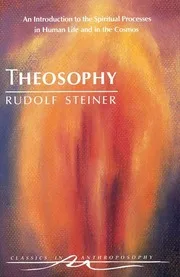
Theosophy: An Introduction to the Supersensible Knowledge of the World and the Destination of Man

 84
84

Theosophy: An Introduction to the Supersensible Knowledge of the World and the Destination of Man



Rudolf Steiner's 'Theosophy' is a monumental achievement, offering a coherent and deeply insightful introduction to the supersensible dimensions of existence. Steiner masterfully bridges the gap between the physical and the spiritual, presenting complex metaphysical concepts with remarkable clarity and intellectual rigor. His exploration of karma, reincarnation, and the evolution of consciousness provides a profound framework for understanding life's deeper meanings. This work is an indispensable resource for anyone seeking to move beyond materialist explanations and engage with the rich tapestry of spiritual science. Its strength lies in its systematic approach and its power to awaken dormant spiritual awareness within the reader. Essential for students of Theosophy and Anthroposophy.
📝 Description
84
Rudolf Steiner published 'Theosophy' in 1904, aiming to introduce supersensible knowledge.
Rudolf Steiner's 1904 book, 'Theosophy: An Introduction to the Supersensible Knowledge of the World and the Destination of Man,' presents a system of thought intended to illuminate the spiritual dimensions of existence. Steiner outlines a framework for understanding the cosmos and humanity's place within it, moving beyond empirical observation to what he termed supersensible perception. He discusses the nature of consciousness, the evolution of the human spirit, and the relationship between the physical and non-physical worlds.
The work details concepts such as subtle bodies, the hierarchical structure of the spiritual world, and the processes of reincarnation and karma. Steiner's aim was to provide a coherent understanding of these matters, making them accessible to those interested in a deeper apprehension of reality. The book is structured to guide the reader through a series of spiritual insights, connecting the individual human journey to larger cosmic patterns.
Published in 1904, 'Theosophy' emerged during a period of intense interest in spiritualism and esoteric philosophy. Steiner's work engages with concepts prevalent in the Theosophical Society, which he was involved with at the time, particularly the ideas of Helena Blavatsky. However, Steiner sought to develop his own distinct approach through what he called 'spiritual science,' emphasizing direct inner experience and clairvoyant faculties cultivated through specific practices. This book functions as an early articulation of his unique cosmological and anthropological theories, distinguishing them from other contemporary esoteric movements.
💡 Why Read This Book?
Embark on a profound journey of self-discovery and cosmic understanding. This book is essential for spiritual seekers, students of occultism, and anyone questioning the ultimate purpose of human existence. Steiner provides a clear, systematic path to understanding the unseen realms and your own spiritual evolution, demystifying complex esoteric concepts. It's an invitation to awaken your inner capacities and perceive reality on a higher plane.
⭐ Reader Reviews
Honest opinions from readers who have explored this book.
❓ Frequently Asked Questions
What is 'supersensible knowledge' according to Steiner?
Supersensible knowledge refers to insights and awareness gained through faculties beyond the ordinary five senses, accessing spiritual realities, cosmic laws, and the inner nature of beings and phenomena.
Does this book require prior knowledge of Theosophy?
While beneficial, prior knowledge is not strictly required. Steiner's introduction is designed to be accessible to earnest seekers, systematically guiding them through foundational concepts.
What is the role of karma and reincarnation in Steiner's Theosophy?
Karma and reincarnation are presented as fundamental cosmic laws governing the evolutionary journey of the soul, explaining the interplay of cause and effect across lifetimes and the development of human consciousness.
Can this book help in personal spiritual development?
Absolutely. Steiner's teachings are inherently practical, aiming to awaken the reader's own spiritual capacities and provide a framework for conscious spiritual growth and self-understanding.
What distinguishes Steiner's Theosophy from other esoteric traditions?
Steiner's approach emphasizes a scientific methodology applied to the spiritual, seeking to provide verifiable experiences and a comprehensible cosmology, leading to the development of Anthroposophy.
🔮 Key Themes & Symbolism
The Evolution of Consciousness
Steiner meticulously outlines the multi-faceted evolution of human consciousness, tracing its journey from primal states through various spiritual epochs. He illustrates how our awareness expands through successive incarnations, guided by cosmic laws and the development of inner faculties. This theme is central to understanding our place in the universe and the inherent potential for spiritual advancement, moving beyond a purely materialist view of existence to one rich with purpose and interconnectedness.
The Hierarchy of Spiritual Beings
This work introduces the concept of a vast cosmic hierarchy, a structured order of spiritual beings who guide and participate in the evolution of the cosmos and humanity. Steiner describes these entities and their roles, revealing the intricate web of forces that sustain reality. Understanding these hierarchies provides a profound perspective on the unseen influences that shape our world and our own spiritual development, fostering a sense of cosmic community and divine order.
Karma and Reincarnation as Cosmic Justice
Steiner presents karma and reincarnation not as punitive mechanisms but as essential principles of cosmic justice and spiritual growth. He explains how our actions and intentions create karmic consequences that shape our future experiences, guiding us toward learning and spiritual maturation across lifetimes. This perspective offers a powerful framework for understanding life's challenges and opportunities, promoting personal responsibility and a deeper appreciation for the soul's enduring journey.
💬 Memorable Quotes
Direct passages from the work, attributed to the author.
“The spiritual world is not a world of dreams, but a world of spiritual realities.”
— Steiner emphasizes that the supersensible realms are as real and tangible as the physical world, accessible through developed spiritual perception.
“Through the development of spirit, man becomes the master of his destiny.”
— This highlights the empowering aspect of Steiner's teachings, suggesting that by cultivating our inner spiritual capacities, we gain agency over our lives and future.
“The universe is permeated by a living spiritual activity.”
— This underscores the dynamic and conscious nature of the cosmos, positing that it is not a dead mechanism but a vibrant, ensouled entity.
“Knowledge of the spiritual world is the key to understanding the physical.”
— Steiner asserts that true comprehension of the material world is only possible when viewed through the lens of its underlying spiritual realities and forces.
💡 Key Ideas
Editorial paraphrase of the work's core concepts — not direct quotes.
Man is a spiritual being clothed in a physical body.
This quote captures the core idea that our true essence is spiritual, with the physical form being a temporary vessel for the soul's journey and development.
🌙 Esoteric Significance
Tradition
Steiner's work is deeply rooted in the Western esoteric tradition, drawing from Gnosticism, Hermeticism, Neoplatonism, and Kabbalah, while simultaneously forging a distinct path. He sought to synthesize these ancient streams of wisdom with a modern, scientific approach, aiming to make spiritual realities accessible and understandable to the contemporary mind. His 'spiritual science' or Anthroposophy represents a unique evolution of Theosophical thought, emphasizing the direct, experiential access to higher realms.
Symbolism
Steiner employs strong symbolism, often reinterpreting ancient motifs to convey complex spiritual concepts. Key symbols include the 'rose cross' representing the union of spirit and matter, the 'tree of life' as a cosmic evolutionary diagram, and various celestial bodies and geometric forms as representations of spiritual forces and processes. These symbols act as gateways, inviting the reader to contemplate deeper meanings and connect with the archetypal forces of the cosmos.
Modern Relevance
In an age often characterized by spiritual seeking and a disconnect from nature, Steiner's insights remain profoundly relevant. His emphasis on the interconnectedness of all things, the inherent spiritual potential within each individual, and the importance of conscious evolution offers a powerful antidote to materialism and existential angst. His work provides a robust framework for understanding the challenges of our time and inspires a path of personal and collective spiritual development.
👥 Who Should Read This Book
This foundational text is a vital read for spiritual seekers and students of esoteric philosophy. Beginners will find Steiner's systematic approach useful, offering a clear entry point into complex Theosophical concepts. Scholars of comparative religion and mysticism will appreciate the intellectual depth and synthesis of ancient wisdom. Practitioners of meditation and spiritual disciplines will find practical guidance for developing their inner faculties and understanding the subtle bodies. Anyone grappling with questions of life's purpose, the nature of reality, and the destiny of humanity will discover profound answers and a renewed sense of cosmic belonging.
📜 Historical Context
Published in the early 20th century, a period of immense scientific and philosophical upheaval, 'Theosophy: An Introduction to the Supersensible Knowledge of the World and the Destination of Man' emerged within the burgeoning esoteric revival. Rudolf Steiner, initially a prominent figure in the Theosophical Society, began to articulate his unique spiritual-scientific perspective, which would later blossom into Anthroposophy. This era saw a widespread questioning of purely materialistic worldviews, leading many to seek deeper spiritual truths and ancient wisdom traditions. Steiner's work offered a structured, modern interpretation of these ancient insights, aiming to provide a comprehensible and verifiable path to spiritual knowledge, resonating with those disillusioned by the limitations of conventional science and religion.
📔 Journal Prompts
Reflect on a moment when you perceived something beyond the ordinary senses. What did you feel or understand?
How does the concept of karma influence your understanding of your current life circumstances?
Consider your personal evolution. What spiritual capacities do you feel are developing within you?
What role do you imagine spiritual beings play in the unfolding of human events?
How can you apply the principle of 'man is a spiritual being' to your daily interactions and decisions?
🗂️ Glossary
Theosophy
A term meaning 'divine wisdom,' referring to a system of esoteric philosophy that seeks to understand the fundamental nature of the universe, humanity's place within it, and the underlying spiritual realities.
Anthroposophy
Rudolf Steiner's 'wisdom of the human being,' a spiritual philosophy and method of research that builds upon Theosophy, focusing on the development of human consciousness and the spiritual evolution of humanity.
Supersensible
Pertaining to realms or knowledge that lie beyond the perception of the ordinary physical senses, accessible through developed spiritual faculties.
Ahriman
In Steiner's cosmology, a spiritual being or force representing materialism, intellectualism without spirit, and the hardening, entropic aspects of existence.
Lumen
A spiritual light or insight; often used to denote a higher form of consciousness or spiritual perception.
This book appears in 2 collections
🔮 Readers Also Liked
Browse all →




More by Rudolf Steiner
All books →



From the “Theosophy” Collection
View all →





More Free Theosophy & Anthroposophy Books
View all →