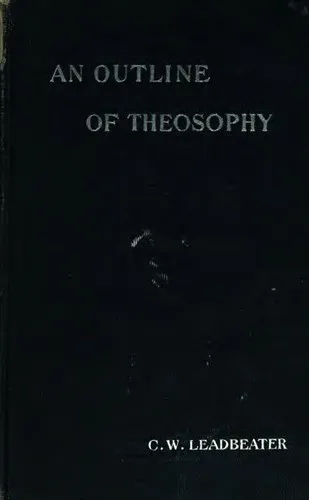
An outline of theosophy
 80
80

An outline of theosophy
Charles Leadbeater’s *An Outline of Theosophy* functions as a clear, if somewhat dry, primer on a complex spiritual system. Leadbeater, a prolific writer for the Theosophical Society, adopts a direct, instructional tone that aims for clarity above all. His exposition of the seven planes of existence and the process of reincarnation provides a structured understanding of these concepts, a significant strength for newcomers. However, the text occasionally feels overly systematized, presenting the Theosophical model as established fact rather than a framework for exploration. A particular passage detailing the different types of etheric and physical bodies, while informative, can become dense for the uninitiated. The work’s limitation lies in its lack of engagement with critiques or alternative interpretations, presenting a singular view. Despite this, it remains a useful, albeit unadorned, guide to the core doctrines.
📝 Description
80
Charles Webster Leadbeater's 1933 book provides a structured introduction to Theosophy.
An Outline of Theosophy, written by Charles Webster Leadbeater, aims to clarify the core ideas of the esoteric philosophy established by Helena Blavatsky and the Theosophical Society. Leadbeater, a significant figure in the movement, organizes complex concepts into a systematic format for understanding.
The book serves as an entry point for those interested in the Theosophical worldview. It is suitable for students of esoteric traditions who want to grasp a major movement from the late 19th and early 20th centuries. Readers interested in comparative religion, occultism, and alternative spiritual philosophies will find explanations of karma, reincarnation, and the subtle bodies useful.
This work is part of the Theosophical tradition, which began in the late 19th century with Helena Blavatsky's writings. Theosophy sought to synthesize elements from ancient wisdom traditions with contemporary scientific and philosophical ideas. Leadbeater's outline draws from this foundation, contributing to the spread of Theosophical thought during a time of significant spiritual and intellectual change.
💡 Why Read This Book?
• Understand the specific Theosophical model of reincarnation and karma, which differs in detail from broader spiritualist interpretations, to grasp its unique view on cyclical existence. • Learn about the concept of the 'seven planes of existence' as outlined by Leadbeater, providing a structured map of consciousness and reality beyond the physical. • Gain insight into the Theosophical understanding of the human constitution, including the distinct roles of the physical, astral, and mental bodies, as presented in the foundational era of the movement.
⭐ Reader Reviews
Honest opinions from readers who have explored this book.
❓ Frequently Asked Questions
What is the primary goal of *An Outline of Theosophy*?
The primary goal is to provide a clear, systematic introduction to the fundamental principles and concepts of Theosophy, as developed by Helena Blavatsky and elaborated by figures like Leadbeater.
Who was Charles Webster Leadbeater and what was his role?
Charles Webster Leadbeater was a prominent, influential, and sometimes controversial member of the Theosophical Society, known for his extensive writings on occult subjects and his clairvoyant abilities.
Does the book discuss Helena Blavatsky's *The Secret Doctrine*?
While not a direct analysis of *The Secret Doctrine* (1888), Leadbeater's outline builds upon the foundational concepts introduced in Blavatsky's major work, aiming to clarify its core ideas.
What is the Theosophical view on evolution presented in the book?
The book outlines a dual evolutionary process: a material evolution guided by spiritual 'monads' and a spiritual evolution of consciousness through successive incarnations.
Is *An Outline of Theosophy* suitable for absolute beginners to esotericism?
Yes, the work is structured as an outline, making it relatively accessible for beginners who wish to understand the specific framework of Theosophy, though prior exposure to spiritual concepts can be helpful.
When was *An Outline of Theosophy* first published?
The first publication date listed for this specific outline is 2016, indicating it is a modern compilation or edition of Leadbeater's teachings.
🔮 Key Themes & Symbolism
The Seven Planes of Existence
The work details the Theosophical cosmology, which posits multiple planes of reality beyond the physical. These include the etheric, astral, mental, and higher spiritual planes. Each plane possesses its own distinct laws and forms of consciousness. Leadbeater explains how the human being interacts with and traverses these planes throughout its evolutionary journey, particularly during sleep and after death. Understanding these planes is crucial for grasping the Theosophical model of the universe and the subtle bodies.
Karma and Reincarnation
Central to Theosophy is the principle of karma, the law of cause and effect governing actions and their consequences across lifetimes. Reincarnation is presented not merely as rebirth, but as a progressive unfolding of the soul's consciousness through a series of physical lives. The book elaborates on how karma shapes an individual's circumstances and the purpose of repeated embodiment: spiritual evolution and the purification of the lower vehicles, allowing the higher self to manifest more fully.
The Human Constitution
Leadbeater's outline provides a detailed description of the human being as a composite entity, far more complex than the physical body alone. It introduces concepts such as the etheric body (vital body), the astral body (emotions), and the mental body (thought). The work explains how these subtle bodies are vehicles for different aspects of consciousness and how their development, or lack thereof, influences an individual's experience and spiritual progress.
Spiritual Hierarchy and Evolution
Theosophy posits a guiding intelligence behind the evolutionary process. This work touches upon the concept of a spiritual hierarchy, often referred to as the Masters or Elder Brothers, who oversee humanity's development. Evolution is presented as a purposeful journey, not a random occurrence, driven by spiritual forces and the inherent potential within each monad (individual spark of divinity) to achieve a higher state of consciousness.
💬 Memorable Quotes
“The physical body is the lowest and densest of the vehicles of consciousness.”
— This statement emphasizes the Theosophical view that the material form is but one layer of a multi-faceted being, serving as the most tangible but least spiritually developed aspect of the self.
“Karma is the unerring law of cause and effect, shaping destiny across lives.”
— This highlights the deterministic yet ultimately just nature of karma within Theosophy, where every action has a consequence that influences future experiences, guiding the soul's journey.
“The astral body is the seat of emotions and desires.”
— This succinctly defines the function of the astral body in Theosophical thought, identifying it as the vehicle through which feelings and appetites are experienced and expressed.
“Reincarnation provides the opportunity for the soul to learn and evolve.”
— This interpretation focuses on the redemptive and educational purpose of repeated lives in Theosophy, framing embodiment as a necessary stage for spiritual growth and self-realization.
“Thought is a force that can shape the mental and astral planes.”
— This conveys the Theosophical understanding of the power of the mind, suggesting that mental activity has tangible effects on non-physical realities and influences one's own experience.
🌙 Esoteric Significance
Tradition
This work is firmly rooted in the Theosophical tradition, a syncretic esoteric system heavily influenced by Hinduism, Buddhism, Hermeticism, and Neoplatonism. It functions as a clarification and systematization of the core teachings first presented by Helena Blavatsky. Leadbeater's contribution lies in making these complex ideas more digestible for a broader audience, adhering to the Theosophical goal of presenting an ancient wisdom adapted for the modern West.
Symbolism
Key symbols explored include the Seven Planes of Existence, representing different states of consciousness and reality, and the Monad, symbolizing the divine spark within each individual on its evolutionary path. The concept of the subtle bodies—etheric, astral, and mental—also functions symbolically, representing layers of human experience and vehicles for spiritual development, mapping the inner cosmos.
Modern Relevance
Leadbeater's systematic explanations of karma, reincarnation, and the subtle bodies continue to inform contemporary esoteric practitioners and New Age thought. Modern students of comparative spirituality, occultism, and consciousness studies often turn to Theosophical texts like this outline to understand the historical development and specific doctrines of one of the 20th century's most impactful esoteric movements.
👥 Who Should Read This Book
• Aspiring students of Theosophy seeking a foundational text to grasp its core principles regarding cosmology, karma, and spiritual evolution. • Researchers interested in the history of Western esotericism and the impact of the Theosophical Society on spiritual thought in the late 19th and early 20th centuries. • Individuals exploring comparative religion and philosophy who wish to understand a major modern esoteric system distinct from traditional religious doctrines.
📜 Historical Context
Charles Leadbeater's *An Outline of Theosophy* emerges from the intellectual milieu shaped by the Theosophical Society, founded in 1875 by Helena Blavatsky, Henry Steel Olcott, and William Quan Judge. This late 19th-century movement sought to synthesize Eastern and Western esoteric traditions, presenting a 'wisdom religion' that challenged prevailing materialistic scientific and religious orthodoxies. Theosophy gained significant traction, particularly after the publication of Blavatsky's *The Secret Doctrine* in 1888. Leadbeater himself became a highly influential, though controversial, figure within the movement, known for his claims of clairvoyance and his prolific writings that elaborated on Blavatsky's complex doctrines. During this period, spiritualism was also prevalent, offering a different, often less philosophical, approach to the afterlife and psychic phenomena. Theosophy, with its intricate cosmology and emphasis on evolution, provided a more structured and intellectually demanding alternative. Leadbeater's work aimed to make these ideas more accessible, contributing to the widespread dissemination of Theosophical thought.
📔 Journal Prompts
The concept of the Seven Planes of Existence as a map for consciousness.
Reflecting on the interplay between personal actions and the law of Karma.
The structure of the subtle bodies (etheric, astral, mental) and their relation to daily experience.
Consider the evolutionary journey of the Monad through successive lives.
Analyzing the Theosophical understanding of the physical body as a vehicle.
🗂️ Glossary
Monad
In Theosophy, the divine spark or individual soul, considered the eternal, evolving principle within each being, destined to achieve perfection through a long process of incarnation.
Astral Body
The vehicle of emotions, desires, and sensations in Theosophical teachings. It is considered a subtle body, denser than the mental body but finer than the physical, and survives physical death.
Mental Body
The vehicle of thought and intellect in Theosophy. It is further divided into higher and lower aspects, corresponding to abstract reasoning and concrete thought, respectively.
Etheric Body
Also known as the vital body, this is considered the energetic counterpart to the physical body, responsible for life force. It is closely related to the physical form and is the first to disintegrate upon death.
Theosophical Society
An international organization founded in 1875 by Helena Blavatsky and others, dedicated to the study of comparative religion, philosophy, and science, and the investigation of unexplained laws of nature and the powers latent in humanity.
Planes of Existence
In Theosophy, these are different levels or realms of reality and consciousness, ranging from the physical to highly spiritual dimensions, each with its own laws and inhabitants.
Karma
The universal law of cause and effect, where actions performed in one life influence the circumstances and experiences of subsequent lives, guiding spiritual evolution.