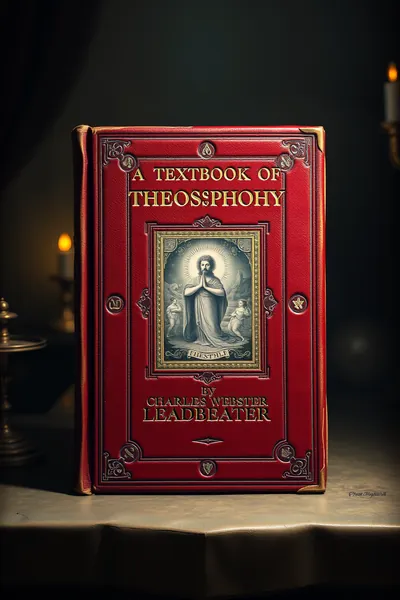
A Textbook of Theosophy

 73
73

A Textbook of Theosophy
Leadbeater's 'A Textbook of Theosophy' presents the architectural blueprint of his understanding of the Theosophical worldview with remarkable clarity. It eschews flowery language for a more direct, didactic approach, which is its primary strength. For instance, the detailed breakdown of the seven 'principles' of the human constitution, moving from the physical to the spiritual, offers a structured framework for contemplating consciousness. However, the sheer density of the material, presented without much concession to the uninitiated, can be overwhelming. A passage discussing the evolution of the 'monad' through mineral, plant, and animal kingdoms, while informative, requires significant prior conceptual grounding. This is a reference work, not an invitation to casual perusal; its utility is directly proportional to the reader's commitment to absorbing its intricate doctrines. It provides the scaffolding, but the reader must provide the experiential brickwork.
📝 Description
73
Charles Webster Leadbeater's A Textbook of Theosophy, published in 1997, explains Helena Blavatsky's system.
This book presents the core concepts of Theosophy in a structured way. Leadbeater addresses topics such as the nature of consciousness, cosmic evolution, karma, reincarnation, and the subtle bodies and planes of existence. It aims to make these esoteric ideas understandable for students of the Theosophical movement.
The volume is best suited for those already studying Theosophy or individuals interested in its foundational principles. Readers who prefer clear, systematic explanations of metaphysical ideas will find it useful. It requires focused attention rather than casual reading, offering detailed insights into spiritual evolution and the structure of the human being from a Theosophical viewpoint.
Charles Webster Leadbeater was a significant figure in the Theosophical Society, particularly during the early 20th century. His writings helped to elaborate and popularize the teachings of Helena Blavatsky, whose 'The Secret Doctrine' was published in 1888. Leadbeater's interpretations influenced how many people understood Theosophy, even when they sparked debate within the society. This book appeared during a time when various spiritual and occult movements offered alternative worldviews compared to established Western religions and the growing influence of science.
💡 Why Read This Book?
• Gain a structured understanding of Theosophical cosmology, particularly the stages of evolution and the nature of the 'monad' as described by Leadbeater, offering a unique metaphysical framework. • Learn the specific Theosophical view of the human constitution, detailing the seven 'principles' from the physical body to the spiritual self, providing a distinct model of consciousness. • Grasp the mechanics of karma and reincarnation as presented in the text, focusing on the concept of the 'Great Plan' and its implications for individual and universal development.
⭐ Reader Reviews
Honest opinions from readers who have explored this book.
❓ Frequently Asked Questions
What is the primary purpose of Charles Webster Leadbeater's A Textbook of Theosophy?
The book aims to systematically explain the core doctrines and principles of Theosophy, as formulated by Helena Blavatsky. It serves as an educational resource for students seeking a comprehensive understanding of its cosmology, ethics, and spiritual philosophy.
When was A Textbook of Theosophy first published?
Charles Webster Leadbeater's A Textbook of Theosophy was first published in 1997, though Leadbeater himself was active in the Theosophical movement much earlier, with many of his works dating from the late 19th and early 20th centuries.
What are some of the key topics covered in A Textbook of Theosophy?
Key topics include the evolution of the cosmos, the seven principles of man, the nature of karma and reincarnation, the subtle bodies (astral and mental), and the various planes of existence within Theosophical cosmology.
Is A Textbook of Theosophy suitable for beginners in esoteric studies?
While it aims for clarity, the book assumes a certain level of engagement with metaphysical concepts. Beginners might find it dense, but it offers a systematic introduction to Theosophical thought if approached with dedication.
How does A Textbook of Theosophy relate to Helena Blavatsky's work?
This textbook elaborates on and systematizes the foundational teachings presented by Helena Blavatsky in works like 'The Secret Doctrine'. Leadbeater sought to make these complex ideas more accessible and organized for students of Theosophy.
Does the book discuss the concept of the 'Great Plan'?
Yes, the book extensively discusses the 'Great Plan,' outlining the Theosophical view of a divinely guided evolutionary process for all life, from the smallest atom to the highest spiritual beings.
🔮 Key Themes & Symbolism
Cosmic Evolution and Planes
The work systematically details the Theosophical understanding of the universe's unfolding, from the initial involution of spirit into matter to the subsequent evolution across various planes of existence. It posits a cyclical process of manifestation and withdrawal, governed by intricate laws. Leadbeater describes distinct realms beyond the physical, such as the astral and mental planes, detailing their unique characteristics and the entities that inhabit them. This framework provides a comprehensive map of reality as understood within the Theosophical tradition, emphasizing a grand, orderly progression.
The Human Constitution and Reincarnation
A central focus is the detailed analysis of the human being, conceptualized not merely as a physical body but as a complex of seven 'principles' or vehicles, ranging from the physical to the spiritual. The book explains how these principles interact and how the higher ones survive the death of the physical form. It elaborates on the process of reincarnation, presenting it as a necessary mechanism for the soul's 'monad' to learn and evolve through successive lifetimes, guided by the law of karma.
Karma and the Great Plan
The concept of karma is presented as a fundamental law of spiritual cause and effect, governing the experiences and circumstances of individuals across lifetimes. This is intrinsically linked to the notion of the 'Great Plan,' a cosmic blueprint for the orderly evolution of consciousness throughout the universe. Leadbeater outlines the roles of various spiritual hierarchies and the 'monads' within this grand scheme, suggesting a purpose and direction to all existence that transcends individual human understanding.
Subtle Bodies and Clairvoyance
The book offers detailed explanations of the non-physical bodies, particularly the 'astral body' and 'mental body,' describing their structure, function, and relationship to the physical form. Leadbeater, who claimed clairvoyant abilities, uses these concepts to interpret esoteric phenomena and spiritual teachings. The text addresses the development of such faculties, framing them as natural extensions of human evolution, albeit requiring specific conditions and understanding to be properly utilized and interpreted.
💬 Memorable Quotes
“The monad is the divine spark, the true self, which passes through the kingdoms of nature.”
— This encapsulates the Theosophical concept of an eternal, spiritual essence that journeys through various forms of life—mineral, plant, animal, and human—to gain experience and evolve across cosmic cycles.
“Karma is the unerring law of cause and effect, shaping destiny through past actions.”
— This highlights the fundamental Theosophical principle that every action generates consequences, determining future experiences and guiding the soul's evolutionary path across multiple lifetimes.
“The astral body is the vehicle of emotion and desire, capable of functioning independently of the physical.”
— This defines the non-physical 'astral body' as the seat of feelings and urges, suggesting its ability to operate and perceive even when separated from the physical form, a key concept in understanding dreams and afterlife states.
“The mental body is the seat of thought and intellect, enabling reasoning and abstract comprehension.”
— This describes the 'mental body' as the component of the human constitution responsible for cognitive functions, including logical thinking, conceptualization, and the understanding of higher spiritual ideas.
“Evolution is a process of unfolding divine consciousness through diverse forms and experiences.”
— This paraphrase suggests that spiritual evolution, as viewed in Theosophy, is not merely biological but a purposeful expansion of inherent spiritual awareness, driven by accumulated experience across vast timescales.
🌙 Esoteric Significance
Tradition
This work is firmly rooted in the Theosophical tradition, which itself draws heavily from Neoplatonism, Gnosticism, Hinduism, and Buddhism, synthesized by Helena Blavatsky. Leadbeater’s contribution lies in systematizing and elaborating upon this synthesis, particularly concerning cosmology and the nature of the human constitution. While building upon Blavatsky's foundational texts like 'The Secret Doctrine' (1888), Leadbeater's presentation emphasizes a structured, almost scientific, approach to esoteric principles, making it a key text for understanding the Theosophical worldview.
Symbolism
The text frequently employs the symbol of the 'seven principles' of man, representing a layered spiritual-material structure. The concept of the 'monad' serves as a potent symbol of the divine spark within each being, destined for evolutionary pilgrimage. Furthermore, the 'Great Plan' functions symbolically as the overarching cosmic order, imbuing existence with purpose and direction, while the various 'planes' (physical, astral, mental) act as symbolic maps of consciousness's journey.
Modern Relevance
Leadbeater's detailed exploration of subtle bodies, karma, and reincarnation continues to influence contemporary esoteric thought, particularly within modern Theosophical organizations and related movements. Concepts like the 'astral body' and 'mental body' have found echoes in various forms of New Age spirituality, energy healing practices, and consciousness studies, demonstrating the enduring impact of his systematic presentation of Theosophical ideas.
👥 Who Should Read This Book
• Students of Theosophy seeking a systematic exposition of its core doctrines, including cosmic evolution, karma, and reincarnation, will find this book an essential reference. • Individuals interested in comparative religion and philosophy who wish to understand a significant 20th-century esoteric system that synthesizes Eastern and Western concepts. • Seekers exploring the nature of consciousness and the subtle human constitution, particularly those curious about concepts like the 'astral body' and 'mental body,' will gain a structured perspective.
📜 Historical Context
Charles Webster Leadbeater’s 'A Textbook of Theosophy,' first published in 1997 but drawing from decades of his earlier writings, emerged from the fertile ground of late 19th and early 20th-century esoteric thought. The Theosophical Society, co-founded by Helena Blavatsky in 1875, offered a synthesis of Eastern and Western mystical traditions, challenging the prevailing Victorian rationalism and materialism. Leadbeater was a key figure in disseminating and elaborating upon Blavatsky’s complex doctrines, particularly her cosmology and teachings on reincarnation and karma. His work competed with other burgeoning spiritual movements of the era, such as Spiritualism and various forms of occultism, while also influencing later New Age philosophies. Leadbeater’s interpretations, particularly those concerning a hierarchical spiritual structure and the nature of subtle bodies, were influential but also generated controversy, leading to his expulsion and later re-admission into the Theosophical Society. This textbook represents a consolidation of those teachings for students.
📔 Journal Prompts
The nature of the 'monad' and its journey through different kingdoms.
Reflecting on specific instances of cause and effect related to personal 'karma'.
Analyzing the structure and function of the 'astral body' in daily life.
Considering the concept of the 'Great Plan' in relation to personal aspirations.
Mapping personal experiences onto the described 'planes' of existence.
🗂️ Glossary
Monad
The fundamental, divine spark or spiritual unit that is the true Self, believed to undergo a long process of evolution through various kingdoms of nature and successive incarnations.
Karma
The universal law of cause and effect, where actions (causes) inevitably lead to corresponding results (effects), shaping an individual's destiny across lifetimes.
Astral Body
A subtle, non-physical body composed of finer matter, considered the vehicle of emotions, desires, and sensations, capable of functioning independently of the physical body.
Mental Body
The subtle body associated with thought, intellect, and reasoning. It is responsible for cognitive processes, abstract thinking, and the comprehension of spiritual concepts.
Planes of Existence
Different levels or realms of reality, each composed of finer or denser matter/energy than the physical. These include the physical, astral, mental, and higher spiritual planes.
Great Plan
The overarching, divinely orchestrated process of evolution for all life in the universe, guiding the development of consciousness through cosmic cycles.
Principles of Man
The seven distinct aspects or vehicles of the human being, according to Theosophy, ranging from the physical body to the spiritual self (Atma-Buddhi-Manas).