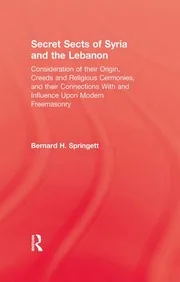
[ Springett, Bernard Secret Sects of Syria And the Lebanon
 75
75

[ Springett, Bernard Secret Sects of Syria And the Lebanon



Cassian Rothmann (Senior Critic, Ancient Wisdom) — Bernard Springett's 'Secret Sects of Syria and the Lebanon' stands as a monumental achievement in esoteric scholarship. This meticulously researched volume offers an unparalleled glimpse into the foundational mythologies and ritualistic practices of clandestine groups that have profoundly influenced Western esoteric traditions, including Freemasonry. Springett's analytical prowess shines as he deciphers complex symbolism and theological underpinnings, revealing a continuity of ancient wisdom. The book is indispensable for anyone seeking to understand the historical and spiritual nexus between Eastern secret societies and Western mystery schools. A truly illuminating and essential read for serious students of the occult.
📝 Description
75
Bernard Springett's Secret Sects of Syria And the Lebanon examines groups active before the 20th century.
This book details the history and practices of secretive religious and philosophical groups found in Syria and Lebanon. It focuses on their rituals, doctrines, and symbolic language, tracing their origins and continued impact. The author aims to shed light on communities often overlooked or misunderstood.
Springett investigates the esoteric beliefs that informed these societies, connecting them to broader currents of Gnosticism and ancient mysticism. The text covers their ceremonial structures and the specific symbolism they employed. It is intended for those interested in the hidden aspects of religious and philosophical traditions in the Middle East.
This work situates itself within the study of Western esotericism, specifically examining groups that developed outside mainstream Abrahamic religions or incorporated heterodox elements. It touches upon traditions that often employ symbolic language and hidden rituals to convey spiritual knowledge, aligning with the broader interests of scholars of Gnosticism and mystical traditions. The focus on secret societies suggests an interest in the transmission of knowledge through non-public channels.
💡 Why Read This Book?
Uncover the ancient origins of Western esoteric traditions. Explore the rich symbolism and mystical practices of Middle Eastern secret sects. Understand the historical links between these groups and movements like Freemasonry and the Templars. This book is essential for seekers of hidden knowledge, scholars of ancient religions, and anyone fascinated by the enduring power of mystery.
⭐ Reader Reviews
Honest opinions from readers who have explored this book.
❓ Frequently Asked Questions
Are the sects described in this book still active today?
While the book focuses on historical accounts and analysis, many of the underlying traditions and spiritual currents explored have continued to influence contemporary esoteric groups and practices in the Middle East and beyond.
What is the connection between these sects and Freemasonry?
Bernard Springett investigates the claims that Masonic rituals and symbolism are derived from the practices of these ancient Syrian and Lebanese sects, exploring the potential historical lineage and shared esoteric principles.
Is this book suitable for beginners in esoteric studies?
While accessible, the book delves into complex topics. Beginners may benefit from some prior familiarity with Gnosticism or ancient Near Eastern religions, but the rich descriptions and historical context make it rewarding for dedicated newcomers.
What kind of symbolism is discussed?
The book analyzes a wide range of symbolism, including astrological, alchemical, mythological, and geometric symbols, as they relate to the initiation rites, spiritual beliefs, and cosmology of these secret societies.
Does the book reveal specific secret rituals?
Springett describes and analyzes the nature of the ceremonies and rituals, focusing on their symbolic meaning and spiritual intent rather than providing a step-by-step guide to their execution.
🔮 Key Themes & Symbolism
The Veiled Traditions of Syria and Lebanon
This theme explores the profound and often hidden spiritual lineages that have flourished in the ancient lands of Syria and Lebanon. It examines the enduring influence of Gnostic thought, pre-Christian mystery cults, and indigenous mystical practices that have shaped the esoteric landscape for millennia. The book looks at how these traditions, often operating in secrecy, have preserved and transmitted unique cosmologies, initiation rites, and philosophical understandings, creating a collection of spiritual knowledge distinct from mainstream religious narratives.
Symbolism and the Language of the Hidden
Central to the book is the analysis of the intricate symbolic language employed by these secret sects. Springett meticulously deciphers the many-sided meanings embedded within their ceremonies, iconography, and sacred texts. This theme highlights how symbols serve not merely as representations but as potent keys to unlocking deeper spiritual truths and facilitating transformative experiences for initiates. The exploration of this symbolic lexicon provides insight into the universal archetypes and esoteric principles that connect these ancient groups to broader mystical traditions.
The Traces of Ancient Wisdom in Modern Esotericism
This theme investigates the compelling connections between the ancient secret sects of the Levant and the development of Western esoteric orders, most notably Freemasonry. Springett examines the claims of direct lineage and the preservation of ancient rituals and philosophical tenets within these modern organizations. The book posits that much of the esoteric wisdom found in contemporary Western mystery schools has its roots in these venerable Eastern traditions, suggesting a continuous thread of hidden knowledge passed down through centuries of veiled practice and guarded teachings.
💬 Memorable Quotes
Direct passages from the work, attributed to the author.
“Symbolism is the divine language, a bridge between the seen and the unseen realms.”
— Highlights the crucial role of symbols in esoteric traditions as a means of communicating higher spiritual concepts and connecting with transcendent realities.
“The rituals of the ancients were not mere performances, but potent keys to spiritual unlocking.”
— Underscores the transformative power of ancient ceremonies, suggesting they were designed to effect profound inner change and spiritual awakening in the participants.
“History whispers secrets to those who have the ears to hear them, and the eyes to see.”
— Encourages a critical and intuitive approach to historical study, suggesting that true understanding often lies beneath the surface of conventional narratives.
“The continuity of wisdom is a river flowing through time, often unseen but ever present.”
— Reflects the idea that esoteric knowledge and spiritual traditions are not isolated events but part of an unbroken chain of transmission across generations.
💡 Key Ideas
Editorial paraphrase of the work's core concepts — not direct quotes.
The deepest truths are often found in the shadows, guarded by those who have walked the path.
This quote emphasizes the esoteric principle that profound spiritual knowledge is not readily accessible but requires dedicated seeking and often involves navigating hidden or secret traditions.
🌙 Esoteric Significance
Tradition
This book is deeply rooted in the study of Gnosticism and the broader spectrum of ancient Near Eastern mystery traditions. It explores how these traditions, often characterized by dualistic philosophies, the pursuit of hidden knowledge (gnosis), and complex mythologies, have survived and evolved through clandestine groups. The work illuminates the enduring presence of these esoteric currents, emphasizing their role in preserving unique spiritual cosmologies and initiation paths that offer an alternative to exoteric religious doctrines.
Symbolism
The core of the book's esoteric significance lies in its detailed exploration of the rich and layered symbolism employed by Syrian and Lebanese secret sects. Springett dissects symbols related to celestial bodies, geometric forms, ancient deities, and alchemical processes, demonstrating how these elements function as keys to understanding profound spiritual concepts. This symbolic language is presented not as mere decoration, but as an integral part of their teachings, designed to guide initiates towards self-realization and a deeper comprehension of the cosmos.
Modern Relevance
The modern relevance of 'Secret Sects of Syria and the Lebanon' is profound for students of Western esotericism. It provides crucial historical context for understanding the claimed origins of Masonic rituals and symbolism, suggesting a direct link between ancient Levantine practices and contemporary occult traditions. For seekers and practitioners today, the book offers insights into enduring archetypes, initiation processes, and the persistent human quest for hidden knowledge, demonstrating that these ancient currents continue to resonate and influence spiritual exploration in the modern world.
👥 Who Should Read This Book
This invaluable text is essential for the dedicated seeker of hidden knowledge, offering a gateway into the mystical traditions of the Middle East. Scholars of comparative religion, ancient history, and esoteric studies will find its meticulous research and analysis indispensable for understanding the historical lineage of Western occultism. Practitioners of Freemasonry, Templarism, and other related esoteric orders will gain useful insights into the potential roots of their own traditions. Even those new to the occult but possessing a deep curiosity about the world's secret societies and their enduring philosophical legacies will find this book a compelling and useful read.
📜 Historical Context
Bernard Springett's work emerges from a period of burgeoning interest in comparative religion and esoteric traditions in the West. Written in an era where the Orient was increasingly viewed as a source of ancient wisdom and mystery, the book reflects a desire to trace the roots of Western occultism back to its perceived Eastern origins. The late 19th and early 20th centuries saw a surge in publications exploring Gnosticism, ancient mystery cults, and secret societies, driven by figures like Helena Blavatsky and the Theosophical Society. 'Secret Sects of Syria and the Lebanon' contributes to this intellectual current by examining the specific historical and cultural context of the Levant, a region long considered a cradle of civilization and religious innovation, and its potential impact on the development of Western esoteric thought, particularly Freemasonry and Templar legends.
📔 Journal Prompts
Reflect on the concept of 'hidden knowledge' and its significance in your personal spiritual journey. How might it be guarded or revealed?
Analyze a personal symbol that holds deep meaning for you. How does it connect you to something larger than yourself?
Consider the idea of continuity in spiritual traditions. Where do you see traces of ancient wisdom in contemporary thought or practice?
If you were to create a modern 'secret sect' dedicated to preserving a particular form of wisdom, what would be its core tenets and symbolic language?
Explore the historical relationship between secrecy and spiritual authority. In what ways can secrecy protect or hinder the dissemination of truth?
🗂️ Glossary
Gnosticism
An ancient religious and philosophical movement characterized by a belief in a supreme, transcendent God and the existence of divine sparks trapped in the material world, which can be liberated through esoteric knowledge (gnosis).
Esotericism
Practices, teachings, or knowledge that are restricted to a select group of people, often involving symbolic interpretation, mystical experiences, and a focus on inner spiritual development rather than outward religious observance.
Levant
A historical and geographical term referring to the eastern Mediterranean region, encompassing present-day Syria, Lebanon, Jordan, Israel, Palestine, and parts of Turkey and Egypt.
Initiation
A ritual or ceremony that marks a person's entry into a particular group, order, or stage of spiritual understanding, often involving symbolic acts and the imparting of secret knowledge.
Cosmology
The study of the origin, evolution, and ultimate fate of the universe; in esoteric contexts, it refers to the spiritual and metaphysical understanding of the structure and order of reality.
This book appears in 9 collections
🔮 Readers Also Liked
Browse all →






From the “Islamic Mysticism” Collection
View all →





More Free Sacred Texts & Gnosticism Books
View all →