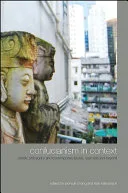
Confucianism in Context
 71
71

Confucianism in Context
Wonsuk Chang and Leah Kalmanson's "Confucianism in Context" offers a valuable corrective to Western oversimplifications of this vast philosophical tradition. The authors skillfully demonstrate how Confucianism, far from being a monolithic entity, was shaped and reshaped by its interactions with Korean and Japanese cultures, a point particularly well-articulated in their discussion of Neo-Confucian developments. While the work excels in providing historical and cultural breadth, it occasionally struggles to fully convey the *experiential* dimension that might draw a reader seeking deeper esoteric connections, focusing more on intellectual history. The exploration of Confucianism as a "dialogic way of thought" is its strongest conceptual contribution, highlighting its inherent flexibility. This book serves as an essential primer for understanding the multifaceted nature of Confucian thought beyond its Chinese origins.
📝 Description
71
### Unpacking Confucianism This volume offers a comprehensive exploration of Confucianism, moving beyond simplistic definitions to reveal its dynamic evolution and enduring significance. It meticulously traces the tradition's roots in China, examining its philosophical underpinnings and historical development.
### East Asian Interconnections The work then broadens its scope to investigate the profound influence of Korean and Japanese cultures on the shaping of Confucian thought. It highlights how these distinct cultural contexts fostered unique interpretations and applications of Confucian principles, demonstrating its adaptability.
### A Dialogic Philosophy Confucianism is presented not as a static dogma but as a dialogic mode of thought, inherently sensitive to specific locations and prevailing conditions. This perspective underscores its capacity for continuous adaptation and engagement with diverse environments.
### Contemporary Global Relevance Ultimately, the book positions Confucianism as a vital philosophical resource for navigating our increasingly multicultural and globalizing world. Its emphasis on relational ethics and social harmony offers valuable perspectives for contemporary challenges.
💡 Why Read This Book?
• Gain a nuanced understanding of Confucianism's development beyond China, specifically its intricate relationship with Korean and Japanese cultural adaptations, as detailed in the sections on East Asian Interconnections. • Learn to view Confucianism as a flexible, dialogic philosophy rather than a rigid doctrine, appreciating its sensitivity to "locations and conditions" as presented in the analysis of its contemporary relevance. • Discover Confucianism's potential as a philosophical resource for globalized societies by examining its emphasis on relational ethics and social harmony, offering practical insights for modern challenges.
⭐ Reader Reviews
Honest opinions from readers who have explored this book.
❓ Frequently Asked Questions
When was Confucianism in Context first published?
The book "Confucianism in Context" by Wonsuk Chang and Leah Kalmanson was first published on November 10, 2010, offering a contemporary scholarly perspective on the tradition.
What is the primary focus of Confucianism in Context?
The book's primary focus is to provide a wide-ranging view of Confucianism, its historical development in China, and its significant impact and adaptation within Korean and Japanese cultures for Western readers.
Does the book discuss the contemporary relevance of Confucianism?
Yes, "Confucianism in Context" actively discusses the contemporary relevance of Confucianism, presenting it as a valuable philosophical resource for navigating our multicultural and globalizing world.
Who are the authors of Confucianism in Context?
The authors are Wonsuk Chang and Leah Kalmanson. Their collaboration brings a dual perspective to the examination of Confucian thought and its cross-cultural diffusion.
What distinguishes this book's approach to Confucianism?
This book distinguishes itself by exploring Confucianism's dialogic nature and its deep engagement with Korean and Japanese cultural contexts, moving beyond a purely Sinocentric view.
Is Confucianism in Context suitable for beginners in philosophy?
Yes, the book is designed to be accessible to Western readers, providing a broad overview and explaining the tradition's development and relevance in a clear, contextualized manner.
🔮 Key Themes & Symbolism
Cross-Cultural Adaptation
The work meticulously traces how Confucianism, originating in China, was not merely transplanted but actively adapted and transformed by the distinct cultural landscapes of Korea and Japan. It highlights specific philosophical shifts and societal integrations that occurred in these regions, demonstrating Confucianism's remarkable capacity for syncretism and its evolution into localized traditions, thereby challenging a monolithic understanding of the philosophy.
Dialogic and Contextual Philosophy
Central to the book's argument is the portrayal of Confucianism as a 'dialogic way of thought,' inherently responsive to its specific 'locations and conditions.' This perspective emphasizes its dynamic, rather than static, nature. It suggests that Confucian principles are not absolute but are articulated and applied through continuous engagement with the socio-historical and cultural milieu, making it a living tradition.
Modern Global Significance
Chang and Kalmanson position Confucianism as a potent philosophical resource for the contemporary world, particularly in an era of increasing globalization and multiculturalism. The book argues that its emphasis on ethical cultivation, social harmony, and relational responsibility offers valuable frameworks for addressing modern societal challenges and fostering intercultural understanding.
Reinterpreting Eastern Thought
This volume serves as a crucial bridge for Western readers seeking to understand Eastern philosophical traditions. By contextualizing Confucianism within its broader East Asian development and highlighting its dialogic essence, the authors encourage a more sophisticated and less exoticized appreciation of its intellectual and ethical contributions.
💬 Memorable Quotes
“Confucianism is shown to be a valuable philosophical resource for a multicultural, globalizing world.”
— This statement encapsulates the book's core argument: that the principles and adaptive nature of Confucianism offer potent tools for navigating the complexities of modern, interconnected societies.
“A dialogic way of thought, highly sensitive to locations and conditions.”
— This phrase defines Confucianism not as a fixed set of rules, but as a flexible, responsive intellectual tradition that evolves based on its specific historical and cultural environment.
“The work goes on to show the deep impact of Korean and Japanese cultures on Confucian thinking.”
— This highlights a key contribution of the book: its examination of how Confucianism was transformed and enriched through its interactions and integration with distinct East Asian cultural frameworks.
“What is Confucianism?”
— The book directly confronts this fundamental question, aiming to provide a comprehensive and nuanced answer that moves beyond superficial understandings and explores its multifaceted nature.
“Discussing the development of Confucianism in China...”
— This indicates the foundational historical analysis within the book, establishing the roots of the tradition before exploring its subsequent diffusion and adaptation.
🌙 Esoteric Significance
Tradition
While primarily a work of academic philosophy and history, "Confucianism in Context" touches upon esoteric sensibilities by framing Confucianism as a living, adaptive tradition rather than a dogmatic system. It resonates with esoteric traditions that emphasize inner cultivation and harmonious integration with the cosmos, particularly in its depiction of Confucianism's sensitivity to 'locations and conditions.' It departs from rigidly defined Western esoteric lineages, offering a different lens on practical wisdom.
Symbolism
The book implicitly engages with the symbolism inherent in Confucian practice, such as the emphasis on rituals ('li') as a means of cultivating social harmony and personal virtue. The concept of 'ren' (benevolence, humanity) can be seen as a symbolic representation of the ideal interconnectedness between individuals and society, a core tenet in many esoteric paths focused on unity.
Modern Relevance
Contemporary thinkers and practitioners interested in applied ethics, cross-cultural communication, and community building find relevance in this work. Its framing of Confucianism as a dialogic philosophy applicable to globalized contexts aligns with modern needs for adaptable ethical frameworks, influencing discussions in fields ranging from political philosophy to organizational psychology.
👥 Who Should Read This Book
['• Students of comparative philosophy: Those seeking to understand the nuances of Confucianism beyond its Chinese origins and explore its intricate development within Korean and Japanese cultural spheres.', '• Scholars of East Asian Studies: Researchers interested in the cross-pollination of ideas and the ways philosophical traditions adapt to new cultural contexts, particularly concerning the period after classical Chinese Confucianism.', '• Individuals interested in global ethics: Readers looking for philosophical resources that offer perspectives on social harmony, relational responsibility, and ethical cultivation applicable to contemporary multicultural societies.']
📜 Historical Context
Published in 2010, "Confucianism in Context" emerged during a period of renewed global interest in Eastern philosophies and their potential contributions to contemporary ethical and political discourse. The intellectual climate saw scholars increasingly moving beyond Sinocentric interpretations to explore the broader East Asian reception of Confucianism. This work arrived as a significant counterpoint to earlier, more monolithic presentations, notably engaging with scholarship that had been tracing Neo-Confucian developments in Korea and Japan since the mid-20th century. While not directly engaging in polemics, its detailed examination of Korean and Japanese influences implicitly challenged scholars who focused primarily on classical Chinese Confucianism, such as those associated with the Chicago School's comparative philosophy project. The book's emphasis on contextuality and dialogue also reflected a broader trend in the humanities towards post-structuralist and relational modes of analysis.
📔 Journal Prompts
The dialogic nature of Confucianism: How does its sensitivity to 'locations and conditions' challenge a fixed understanding of moral principles?
Confucianism's impact on Korean and Japanese cultures: Identify specific adaptations discussed in the text and their implications.
The role of ritual ('li') in Confucian thought: Reflect on its function in cultivating virtue and social harmony as presented.
Intercultural dialogue: Consider how Confucian principles of benevolence ('ren') might inform contemporary global ethical discussions.
Personal ethical cultivation: How can the concept of Confucian self-improvement be applied in a modern, secular context?
🗂️ Glossary
Dialogic Way of Thought
A mode of philosophical inquiry and expression characterized by active engagement, responsiveness to context, and the continuous exchange of ideas, rather than adherence to fixed doctrines.
Ren (仁)
A core Confucian concept often translated as benevolence, humaneness, or goodness. It signifies the ideal virtue of empathy and profound care for others, forming the basis of ethical relationships.
Li (禮)
Refers to ritual propriety, etiquette, and social norms. In Confucianism, 'li' is crucial for maintaining social order, cultivating personal virtue, and expressing respect within hierarchical relationships.
Neo-Confucianism
A philosophical movement that emerged in China during the Song dynasty (960–1279) and later spread to Korea and Japan, synthesizing Confucian ethics with metaphysical and cosmological theories.
Sinocentric
Characterized by a belief in the centrality and superiority of Chinese culture or civilization. A Sinocentric view of Confucianism would prioritize its development solely within China.
Contextual Relevance
The quality of being applicable or significant within a specific historical, cultural, or social setting, emphasizing that ideas and practices are shaped by their circumstances.
East Asian Cultures
Refers collectively to the distinct yet interconnected cultural traditions of countries in East Asia, including China, Korea, and Japan, highlighting their shared historical influences and unique developments.