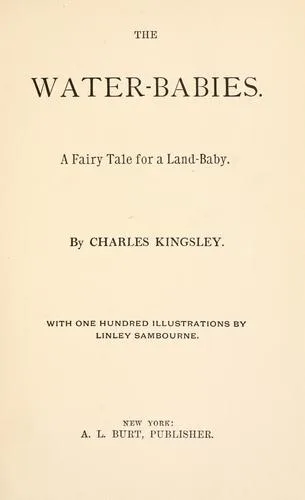
The water-babies: a fairy tale for a land-baby
 80
80

The water-babies: a fairy tale for a land-baby
Charles Kingsley's "The Water-Babies" is an ambitious, if occasionally uneven, allegorical fantasy. Its strength lies in its audacious social critique, using the whimsical journey of Tom, the chimney sweep, to expose the brutal realities of Victorian industrialism and class division. The transformation of Tom into a water-baby serves as a potent metaphor for spiritual and physical cleansing. However, the narrative's didacticism can sometimes overwhelm the storytelling, with overt moralizing and scientific explanations interrupting the flow. The passage detailing Tom's journey through the "Great Sea-Dragon's Teeth" (representing polluted waters) is particularly striking in its vivid, if grim, depiction of ecological damage. Despite its dated language and some heavy-handed preaching, the book remains a significant work for its imaginative critique of societal ills and its exploration of nature's restorative power. It is a fairy tale with a conscience.
📝 Description
80
Charles Kingsley published "The Water-Babies" in 1863, a fairy tale criticizing Victorian industrial society.
Charles Kingsley's "The Water-Babies: A Fairy Tale for a Land-Baby," first published in 1863, uses a fantastical narrative to critique the social and environmental ills of Victorian England. The story follows Tom, a young chimney sweep, who is transformed into a water-baby and embarks on a spiritual journey. This transformation serves as an allegory for the purification of the soul and a critique of the harsh conditions faced by the working class, particularly children, in the age of industrial expansion. Kingsley, a Christian Socialist, wove together elements of natural history, theology, and social commentary to address the pollution and class disparities of his time.
The narrative contrasts the grim, industrial world of the "land-baby" with the cleansing, natural world of the "water-baby." Through Tom's experiences, the book examines themes of suffering, spiritual growth, and redemption. It also touches upon early scientific ideas about evolution and adaptation, framing them within a spiritual context that suggests an underlying divine order. The work appeals to readers interested in Victorian literature and social critique, especially those who appreciate allegorical storytelling that uses fantasy to explore ethical and philosophical questions.
Published in 1863, "The Water-Babies" engages with mystical traditions through its depiction of spiritual purification and transformation. The narrative suggests that suffering can lead to a cleansing of the soul, a concept found in various mystical and religious systems. Kingsley also integrates early scientific thought on evolution and adaptation, interpreting these through a spiritual lens that posits a divine framework for natural processes. This blend of spiritual allegory, natural philosophy, and social critique situates the work within a broader turn-of-the-century interest in finding meaning and order amidst rapid societal and scientific change.
💡 Why Read This Book?
• Gain insight into the Victorian Christian Socialist movement by examining Kingsley's critique of industrial pollution and class disparity, as evidenced in the stark contrast between the grimy city and the pristine ocean in "The Water-Babies." • Explore early conceptualizations of environmentalism and spiritual redemption through suffering, particularly through Tom's transformation from a soot-covered chimney sweep to a purified water-baby. • Understand the allegorical use of natural history and theology by analyzing how Kingsley employs concepts like the 'Sea-Parson' and the 'other-world' to convey moral and spiritual lessons to a Victorian audience.
⭐ Reader Reviews
Honest opinions from readers who have explored this book.
❓ Frequently Asked Questions
What is the primary allegory in Charles Kingsley's "The Water-Babies"?
The primary allegory concerns the spiritual and physical purification of Tom, a chimney sweep, who is transformed into a water-baby. This journey critiques Victorian industrial society, its pollution, and its class injustices, suggesting a path to redemption through suffering and connection with nature.
When was "The Water-Babies" first published and what was its reception?
"The Water-Babies" was first published in 1863. While popular as a children's story, its social commentary and sometimes grim depictions also sparked discussion and debate among adult readers and critics of Victorian social conditions.
How does "The Water-Babies" connect to Victorian social issues?
The book directly addresses the dire conditions of child labor, particularly chimney sweeps, and the environmental degradation caused by industrialization. Kingsley, a Christian Socialist, used the fantasy narrative to advocate for social reform and a more humane society.
What role does nature play in the narrative of "The Water-Babies"?
Nature serves as a realm of purity, healing, and spiritual growth. The aquatic world, in contrast to the polluted industrial land, offers a space for Tom's redemption and transformation, highlighting Kingsley's view of nature as restorative.
Is "The Water-Babies" considered an esoteric text?
While not strictly esoteric in the vein of occult traditions, "The Water-Babies" incorporates spiritual allegories, moral transformation, and a critique of materialism that aligns with broader metaphysical and reformist currents of the 19th century.
Who are the main characters and what do they represent?
The protagonist is Tom, a chimney sweep who undergoes a spiritual transformation. Other key figures include Mrs. Doasyouwouldbedoneby, representing Christian charity, and Mr. Gryll, a figure of nature's wisdom, all serving allegorical purposes within Kingsley's moral framework.
🔮 Key Themes & Symbolism
Industrialization and Social Critique
Kingsley vividly contrasts the grim reality of chimney sweeps like Tom with the idealized, purified world of the water-babies. The narrative serves as a direct indictment of the exploitation of child labor and the environmental devastation wrought by Victorian industry, highlighting the moral failings of a society focused on profit over people and planet. The depiction of soot-choked cities and polluted waterways underscores the destructive impact of unchecked progress.
Spiritual Purification and Transformation
The core of the story lies in Tom's journey from a mistreated, 'land-baby' to a 'water-baby.' This transformation is a process of spiritual cleansing, achieved through hardship, repentance, and immersion in the natural world. The narrative suggests that suffering, coupled with a sincere desire for goodness, can lead to moral and spiritual regeneration, a concept echoing various mystical traditions focused on purification.
Nature as a Moral and Healing Force
Nature, particularly the aquatic realm, is portrayed as a benevolent and restorative force, a stark counterpoint to the corrupting influence of the industrial landscape. The sea creatures and the natural laws governing their world offer lessons in kindness, duty, and divine order. Kingsley champions nature not just as a physical environment but as a spiritual teacher, capable of healing the wounds inflicted by civilization.
Theology and Natural Law
Kingsley attempts to reconcile scientific observation with Christian theology. The work explores the idea of a divine order manifested in natural laws, suggesting that understanding the natural world is a way to understand God's creation. Characters like the 'Sea-Parson' embody this fusion, teaching spiritual truths through the lens of marine biology and natural history.
💬 Memorable Quotes
Direct passages from the work, attributed to the author.
“When the washerwoman's baby was born, it was a very small, wrinkled, red thing, and looked exactly like a little, overboiled, red cabbage.”
— This whimsical yet stark description sets the tone, juxtaposing the mundane reality of birth with a fantastical, almost grotesque, comparison. It hints at the story's blend of natural observation and fairy-tale exaggeration, preparing the reader for a world where the ordinary is seen through an extraordinary lens.
“Poor little Tom! I am afraid he was not a good boy. But he was a very miserable boy, and miserable folk are often naughty.”
— This reflects the narrative's sympathetic approach to Tom's initial plight. It suggests a connection between suffering and misbehavior, implying that societal neglect and harsh conditions contribute to a child's 'naughtiness,' rather than inherent wickedness.
“He went into the water, and the water was clean and cool, and he felt himself clean and cool.”
— This simple statement marks a key moment of purification for Tom. It signifies his transition from the filth and misery of his life as a chimney sweep to a state of spiritual and physical renewal within the natural, aquatic element.
“There are no tears in heaven.”
— This comforting assertion, often repeated, speaks to the narrative's theological underpinnings. It offers solace by suggesting a future state free from earthly suffering, aligning the story's moral arc with Christian eschatology and the promise of ultimate peace.
💡 Key Ideas
Editorial paraphrase of the work's core concepts — not direct quotes.
The other world is not far from this one.
This line captures the story's metaphysical dimension, suggesting that the spiritual or 'other' realm is not distant but accessible, particularly through experiences of nature and moral transformation. It bridges the mundane and the mystical.
🌙 Esoteric Significance
Tradition
While not aligning strictly with a single esoteric lineage, "The Water-Babies" draws from Christian Gnosticism and Neoplatonic thought, emphasizing spiritual purification through suffering and a perceived divine order within nature. The idea of transformation from a corrupted state to a purer one echoes Gnostic themes of escaping material bondage. Kingsley's blend of natural science and spiritual allegory also presages later Theosophical interests in reconciling empirical knowledge with mystical truths.
Symbolism
The primary symbols include water, representing purification, spiritual rebirth, and the divine feminine principle; the chimney sweep (Tom), symbolizing the fallen human soul trapped by material conditions and societal neglect; and the industrial city, standing for corruption, spiritual death, and the perversion of natural order. The journey through the sea allegorically represents the soul's path towards enlightenment and redemption.
Modern Relevance
Contemporary eco-spiritual movements and ecotheologians often cite "The Water-Babies" for its early articulation of environmental ethics and the interconnectedness of spiritual well-being with ecological health. Thinkers concerned with social justice and the critique of consumerism find resonance in Kingsley's allegorical condemnation of industrial exploitation and materialism. Its themes of redemption through hardship continue to inform discussions on personal growth and overcoming adversity.
👥 Who Should Read This Book
• Students of Victorian literature interested in social reform movements and allegorical storytelling, seeking to understand how authors like Kingsley used fantasy to critique contemporary society. • Readers exploring the intersection of religion, nature, and early environmentalism, who will find Kingsley's attempt to reconcile Christian theology with natural science compelling. • Individuals drawn to narratives of personal transformation and redemption, particularly those who appreciate stories where overcoming adversity leads to spiritual and moral renewal.
📜 Historical Context
Published in 1863, "The Water-Babies" emerged amidst the fervent social and industrial changes of Victorian England. Charles Kingsley, a prominent Christian Socialist, penned the tale as a direct response to the appalling conditions faced by working-class children, particularly chimney sweeps. The era was marked by rapid urbanization and technological advancement, leading to widespread pollution and social stratification. Kingsley's work functioned as a moral allegory, critiquing the dehumanizing effects of industrial capitalism. His contemporaries, like Charles Dickens, also explored urban poverty in works such as "Oliver Twist" (1838), though Kingsley's approach was more overtly infused with theological and naturalistic philosophy. The book's reception was mixed; while lauded for its imaginative storytelling, its didacticism and sometimes grim portrayal of child labor drew attention and debate, positioning it as a significant piece of Victorian social commentary.
📔 Journal Prompts
Tom's transformation from a 'land-baby' to a 'water-baby' signifies purification. Reflect on a personal experience where a challenging environment led to inner cleansing.
The industrial city represents corruption in "The Water-Babies." Consider how modern urban environments might symbolize spiritual or ecological compromise.
Analyze the role of characters like Mrs. Doasyouwouldbedoneby in guiding Tom. How do figures of compassion influence transformative journeys?
The 'other world' is presented as accessible. How might your perception of reality shift if you actively sought spiritual presence in the mundane?
Contemplate the symbolism of water in the narrative. What does the sea represent in your own personal mythology or spiritual understanding?
🗂️ Glossary
Land-Baby
A term used in the book to refer to human children, particularly those existing in the mundane, industrial world, contrasting with the idealized 'water-babies.'
Water-Babies
Spiritualized, purified beings residing in the sea, representing innocence, cleanliness, and a state of grace achieved after escaping the corruption of the land.
Chimney Sweep
Referring to young boys like Tom, forced into dangerous labor cleaning soot from industrial chimneys, symbolizing exploited labor and the harsh realities of the Victorian working class.
Sea-Parson
An allegorical character, a type of wise, guiding figure in the aquatic world who teaches the water-babies about morality and the natural order, embodying Kingsley's fusion of theology and natural science.
Mrs. Doasyouwouldbedoneby
A benevolent fairy-like figure who embodies Christian charity and the Golden Rule ('Do as you would be done by'), representing the principle of kindness and ethical treatment.
Mr. Gryll
A wise, ancient character often associated with nature's ancient wisdom, providing guidance and perspective to the water-babies.
Great Sea-Dragon's Teeth
A symbolic representation of polluted waters and the dangers lurking within them, illustrating the environmental consequences of industrial waste.
🔮 Readers Also Liked
Browse all →







More by Charles Kingsley
All books →
More Free Occult Philosophy Books
View all →