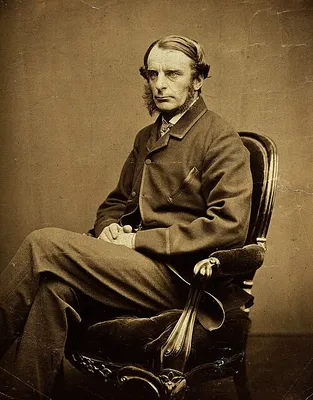
Charles Kingsley
Charles Kingsley was an Anglican priest, professor, and author known for Christian socialism and novels like 'The Water-Babies'.
Charles Kingsley (1819–1875) was an Anglican priest, university professor, historian, novelist, and poet deeply involved in social reform. He was a prominent figure in Christian socialism, though his attempts to form labour cooperatives were unsuccessful. Kingsley also held strong Anti-Catholic views and was known for his historical novels and children's literature.
His academic career included professorships at Cambridge and tutorship to the Prince of Wales. He was also a canon at Chester Cathedral and Westminster Abbey, where he founded a society for natural science. Kingsley's personal life involved a prominent literary family; his daughter and nephew also became writers. He passed away from pneumonia in 1875.
Kingsley showed an early interest in evolutionary theory, welcoming Charles Darwin's work. His social concerns are evident in his famous book 'The Water-Babies,' which addressed child labour. He was also a proponent of Anglo-Saxonism and held prejudiced views towards the Irish. His writings included novels, poetry, sermons, and works on natural history.
Literary and Social Contributions
Charles Kingsley was a prolific writer whose works spanned various genres, including novels, poetry, and sermons. He is particularly remembered for his novels such as 'Yeast,' 'Alton Locke,' 'Hypatia,' 'Westward Ho!,' 'The Water-Babies,' and 'Hereward the Wake.' His literary output often reflected his deep engagement with social issues and his belief in Christian socialism. While his direct efforts to establish labour cooperatives did not succeed, they contributed to broader discussions and later reforms. Kingsley's novel 'The Water-Babies' is a notable example of his social commentary, using a fairy tale format to highlight the plight of child chimney sweeps. He also wrote 'The Heroes,' a collection of Greek myths for children, and 'Glaucus, or the Wonders of the Shore,' where he coined the term 'pteridomania' to describe a fascination with ferns.
Academic and Clerical Career
Beyond his writing, Kingsley held significant academic and clerical positions. He served as a priest in the Church of England, becoming the Rector of Eversley in 1844. His academic career saw him appointed as the Regius Professor of Modern History at the University of Cambridge in 1860, and he also tutored the Prince of Wales. Later in his career, he became a canon at Chester Cathedral and subsequently at Westminster Abbey. During his time at Chester, he was instrumental in founding the Chester Society for Natural Science, Literature and Art, which played a role in establishing the Grosvenor Museum. He also served as the president of the Birmingham and Midland Institute.
Intellectual and Personal Views
Kingsley was an early adopter and supporter of evolutionary ideas, famously corresponding with Charles Darwin and welcoming the publication of 'On the Origin of Species.' He expressed a belief that the divine could be understood through the concept of original forms capable of self-development. His worldview was also marked by a strong sense of Anglo-Saxonism, promoting the idea of a distinct Teutonic or Norse heritage for the English people, blending mythology with his Protestant faith. However, his views were not without controversy; he held deeply critical and derogatory opinions about the Irish population. He was also known for his public disagreements with figures like John Henry Newman.
Key Ideas
- Christian socialism
- Anglo-Saxonism
- Pteridomania (a craze for ferns)
Books by Charles Kingsley
2 free public domain books · Read online or download