The Three Little Wolves and the Big Bad Pig
 73
73

The Three Little Wolves and the Big Bad Pig
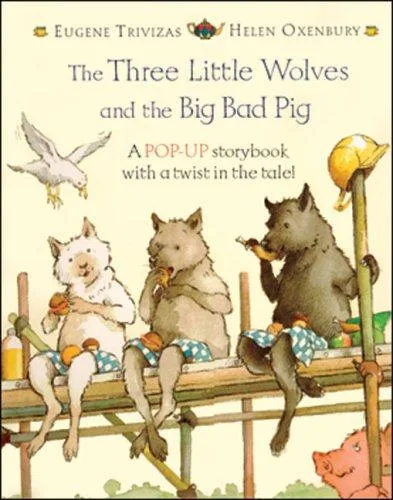
Trivizas's reimagining of the wolf and pig fable is a welcome disruption. The narrative’s strength lies in its audacious subversion of the familiar, presenting the pig not as a victim but as a truly menacing force. The clever construction of the wolves' attempts to escape and rebuild, particularly their final refuge in a surprisingly modern setting, highlights the author's wit. However, the rapid pacing, while engaging, occasionally leaves little room for deeper emotional resonance with the wolves' plight. A passage where the wolves adapt their strategy by seeking unconventional shelter, rather than relying solely on traditional building materials, exemplifies this inventive spirit. The book ultimately succeeds as a sharp, playful commentary on narrative expectations.
📝 Description
73
Eugenios Trivizas's 1993 book subverts the classic wolf and pig tale with a satirical twist.
Published in 1993, Eugenios Trivizas's "The Three Little Wolves and the Big Bad Pig" retells a familiar fairy tale with a modern, often satirical approach. It presents three wolf siblings building their houses, only to face a determined pig aiming for their destruction. This narrative moves beyond a simple morality lesson, as Trivizas skillfully flips conventional expectations and challenges the usual predator and prey roles.
The book appeals to readers who enjoy literary deconstruction and fairy tale retellings that offer depth. It is suited for young adults and adults interested in exploring resilience, cleverness, and the disruption of established hierarchies. Those drawn to postmodern literature or children's stories that promote critical thought will find value here. The clever wordplay and unexpected plot developments also engage readers who appreciate intellectual puzzles within their stories.
While categorized under Supernatural & Occult Fiction, the book's "esoteric" nature lies in its postmodern deconstruction of archetypes. Trivizas engages with the tradition of questioning established narratives and flipping traditional power dynamics. This approach mirrors a broader esoteric tendency to reveal hidden structures or challenge surface realities, particularly within storytelling. The playful inversion of predator and prey roles invites readers to reconsider familiar symbolic relationships, a characteristic found in various allegorical and philosophical traditions that seek to uncover deeper meanings.
💡 Why Read This Book?
• Understand the subversion of archetypes by examining how the traditionally vulnerable pig becomes the primary antagonist in "The Three Little Wolves and the Big Bad Pig," offering a fresh perspective on predator-prey dynamics. • Experience the theme of resilience through the wolves' repeated efforts to rebuild and escape the Big Bad Pig, demonstrating their adaptability after their houses are destroyed. • Appreciate narrative innovation by recognizing how Eugenios Trivizas, in his 1993 work, playfully deconstructs a classic fairy tale structure for a contemporary audience.
⭐ Reader Reviews
Honest opinions from readers who have explored this book.
❓ Frequently Asked Questions
Who is Eugenios Trivizas and why is he significant?
Eugenios Trivizas is a prominent Greek author, celebrated for his innovative and often humorous approach to children's literature. His work, including "The Three Little Wolves and the Big Bad Pig" (1993), is known for its wit and subversion of traditional tales.
What makes "The Three Little Wolves and the Big Bad Pig" different from the original story?
The primary difference is the inversion of roles: the wolves are the protagonists seeking safety, while the pig is the aggressive antagonist. This flips the conventional narrative and archetypes of the classic fairy tale.
What are the main themes explored in the book?
The book explores themes of resilience, wit, and the subversion of expectations. It challenges readers to reconsider established narratives and the nature of threat.
Is this book suitable for young children?
While based on a children's story, the satirical elements and subversion of archetypes might be more appreciated by older children and adults. Its complexity offers layers of interpretation beyond a simple narrative.
What is the original publication year of "The Three Little Wolves and the Big Bad Pig"?
The book was first published in 1993, positioning it within a period of significant postmodern influence on literary works.
Does the book offer any lessons about building or architecture?
While the act of building houses is central, the book uses it metaphorically to explore security and vulnerability. The focus is less on architectural advice and more on the wolves' persistent efforts to find safety.
🔮 Key Themes & Symbolism
Archetypal Inversion
This work masterfully inverts traditional archetypes, particularly those found in the 'three little pigs' narrative. The wolves, typically the villains, are portrayed as vulnerable protagonists seeking shelter, while the pig, usually a victim, assumes the role of a menacing antagonist. This subversion encourages readers to question ingrained perceptions of good and evil and to consider how narratives shape our understanding of power dynamics. The unexpected shift challenges the reader's preconceived notions, prompting a deeper analysis of character roles and narrative authority.
Resilience and Adaptation
The narrative underscores the theme of resilience through the wolves' persistent struggle against the Big Bad Pig. Despite repeated setbacks and the destruction of their homes, the siblings demonstrate an unwavering determination to survive and rebuild. This cyclical process of destruction and reconstruction highlights their adaptability and resourcefulness in the face of overwhelming threat. Their ability to learn and adjust their strategies, moving beyond simple building to more complex forms of evasion, serves as a potent metaphor for overcoming adversity.
The Nature of Threat
Trivizas explores the unpredictable nature of threats, demonstrating that danger can emerge from unexpected sources. The Big Bad Pig represents a force that defies conventional expectations, forcing the wolves to confront a danger they are ill-equipped to handle initially. This concept prompts reflection on how we identify and prepare for risks, suggesting that perceived vulnerabilities do not always align with actual dangers. The story encourages a critical examination of assumptions and a heightened awareness of the complexities of the world.
Satirical Commentary
Beyond its narrative, the book offers a subtle satirical commentary on societal structures and expectations. By twisting a beloved fairy tale, Trivizas critiques the predictability of narratives and perhaps even the complacency that can arise from them. The wolves' reliance on traditional building methods, which ultimately fail, can be seen as a metaphor for outdated approaches to problem-solving. The pig's relentless pursuit, while humorous, also serves as a stark reminder of persistent challenges that defy easy solutions.
💬 Memorable Quotes
Direct passages from the work, attributed to the author.
“The wolves, terrified, ran as fast as they could to the house of their brother.”
— This emphasizes the vulnerability of the wolves and their reliance on each other. It drives the plot forward as they seek refuge and solidarity against a common, unexpected enemy.
“They decided to build a house that was very strong indeed.”
— This reflects the original story's premise but gains new meaning given the antagonists. It highlights the wolves' attempt to follow logical, albeit ultimately insufficient, security measures.
“But the Big Bad Pig was much too strong for them.”
— This reinforces the reversal of power dynamics. The pig's strength is emphasized, making the wolves' predicament more dire and their resilience more crucial.
“The wolves learned that even the most familiar stories could be turned upside down.”
— This is an interpretation of the book's meta-narrative intent, suggesting the story itself is a lesson in deconstruction and critical thinking about established tales.
💡 Key Ideas
Editorial paraphrase of the work's core concepts — not direct quotes.
The Big Bad Pig huffed and he puffed and he blew their houses down.
This line directly subverts the original tale's famous sequence, immediately signaling to the reader that familiar roles have been reversed. It establishes the pig as the primary destructive force.
🌙 Esoteric Significance
Tradition
While not explicitly aligned with a single esoteric lineage, the book's subversion of archetypes and its exploration of unexpected threats can be viewed through a Gnostic lens. The traditional narrative represents a form of received wisdom or established 'truth' (akin to the material world), while the pig's disruptive force can symbolize a disruptive gnosis or a revelation that overturns the perceived order. The wolves' struggle to adapt and find new forms of safety mirrors the Gnostic seeker's journey to navigate illusion and find true refuge.
Symbolism
The 'Big Bad Pig' itself symbolizes the disruptive force that challenges established order and perceived security. It represents the unexpected antagonist, defying traditional roles. The act of 'building houses' symbolizes the creation of perceived safety and societal structures, which are shown to be vulnerable. The wolves' repeated flight and rebuilding represent the cyclical nature of struggle and adaptation, a core concept in many esoteric traditions emphasizing perseverance through trials.
Modern Relevance
Contemporary thinkers and practitioners interested in narrative psychology and deconstruction find value in Trivizas's work. It appeals to modern approaches to therapy that encourage reframing personal narratives and challenging limiting beliefs (the 'big bad pig' within). The book's playful yet pointed subversion of familiar tropes is relevant to critical theory discussions and educational practices that aim to foster analytical thinking in young minds, encouraging them to question established narratives.
👥 Who Should Read This Book
• Young adults and adults interested in literary deconstruction and fairy tale retellings that offer a critical perspective. • Educators and parents seeking resources that encourage critical thinking and challenge traditional narrative assumptions in children's literature. • Readers who appreciate humor and satire woven into storytelling, particularly those who enjoy seeing classic tales reimagined in unexpected ways.
📜 Historical Context
Eugenios Trivizas's "The Three Little Wolves and the Big Bad Pig," published in 1993, emerged in an era where children's literature increasingly engaged with postmodern sensibilities. This period saw a rise in authors challenging traditional narrative structures and archetypes, a trend exemplified by works that playfully deconstructed classic fairy tales. Trivizas's approach aligns with this movement, offering a satirical twist on the familiar "three little pigs" story. While not directly engaging with a specific competing school of thought like magical realism, its subversion of archetypes can be seen as a counterpoint to more straightforward, didactic children's literature prevalent in earlier decades. The book gained recognition within Greece, where Trivizas is a significant literary figure, contributing to a broader international discourse on innovative storytelling for young audiences.
📔 Journal Prompts
The Big Bad Pig's unexpected aggression as a narrative disruption.
The wolves' repeated efforts to rebuild their homes.
Reflecting on the subversion of the pig archetype.
Comparing the wolves' initial strategies with their later adaptations.
Identifying moments where expectations are deliberately overturned.
🗂️ Glossary
Archetype
In literature and psychology, an archetype is a typical character, action, or situation that seems to represent universal patterns of human nature. The book plays with established archetypes like the 'villainous wolf' and 'vulnerable pig'.
Subversion
The act of undermining the power and authority of an established system or institution. In this context, Trivizas subverts the traditional fairy tale narrative and its associated character roles.
Postmodernism
A broad movement in late 20th-century philosophy, arts, and architecture that, loosely speaking, arose as a reaction against the assumptions and practices of modernism. It often involves skepticism, irony, and the questioning of grand narratives.
Narrative Structure
The framework or blueprint of a story, including the sequence of events, plot development, and character arcs. The book deliberately alters this structure from its source material.
Satire
The use of humor, irony, exaggeration, or ridicule to expose and criticize people's stupidity or vices, particularly in the context of contemporary politics and other topical issues. The book uses satire to comment on fairy tale conventions.
Fairy Tale
A story, typically for children, featuring folkloric characters like fairies, giants, and talking animals, often involving magic and a clear moral lesson. This book reimagines a classic fairy tale.
Protagonist
The leading character or one of the major characters in a drama, movie, novel, or other literary work. In this story, the wolves take on the protagonist role.
🔮 Readers Also Liked
Browse all →







More by Eugenios Trivizas
All books →
More Free Occult Philosophy Books
View all →