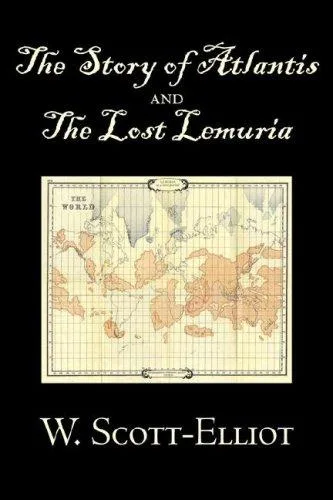
The Story of Atlantis and the Lost Lemuria
 71
71

The Story of Atlantis and the Lost Lemuria
W. Scott-Elliot’s account of Atlantis and Lemuria is less a historical document and more a meticulously constructed esoteric mythos, presented with the conviction of revealed truth. The strength of the work lies in its imaginative scope and its attempt to synthesize diverse occult ideas into a coherent, albeit speculative, history of humanity. Scott-Elliot’s detailed descriptions of Atlantean society, particularly their alleged advanced psychic abilities and architectural marvels, are vivid. However, the text's primary limitation is its absolute lack of empirical grounding; it operates entirely within the realm of metaphysical assertion, making critical engagement difficult for those outside its philosophical framework. The passages detailing the supposed downfall of Atlantis through cataclysmic geological events, while dramatic, serve more as allegorical warnings about spiritual decline than historical accounts. This book serves as a fascinating artifact of late 19th-century esoteric thought, offering a particular vision of humanity's lost past.
📝 Description
71
### What It Is
The Story of Atlantis and the Lost Lemuria presents a narrative that bridges geological speculation with ancient myth, drawing heavily on occult traditions to reconstruct the histories of two legendary continents. W. Scott-Elliot, working within the esoteric milieu of the late 19th and early 20th centuries, details supposed cycles of planetary evolution and human development. The work posits Atlantean and Lemurian civilizations as advanced societies predating recorded history, whose downfall served as a crucial, albeit catastrophic, turning point for the planet.
### Who It's For
This text is primarily for readers with an established interest in esoteric philosophies, comparative mythology, and ancient speculative history. It will appeal to those who explore theosophy, occultism, and alternative cosmologies. Individuals curious about the origins of widespread myths concerning lost continents and advanced ancient peoples will find the material engaging. It is not intended for those seeking purely scientific or historical accounts, but rather for those open to metaphysical interpretations of human and planetary pasts.
### Historical Context
Published initially in the context of a burgeoning interest in spiritualism and occultism, The Story of Atlantis and the Lost Lemuria emerged during a period when figures like Helena Blavatsky were popularizing concepts of root races and ancient, forgotten civilizations. Scott-Elliot's work aligns with the Theosophical movement's efforts to synthesize Eastern and Western esoteric traditions, presenting a grand narrative of cosmic and human evolution. This intellectual climate saw a proliferation of speculative works on prehistory, often influenced by emerging geological theories and a romanticized view of the past.
### Key Concepts
The book elaborates on the concept of Root Races, suggesting humanity has evolved through distinct, advanced stages. It details the physical and spiritual characteristics attributed to Atlanteans and Lemurians, describing their advanced technologies and societal structures. The narrative also explores the cyclical nature of cosmic and planetary existence, a core tenet in many esoteric cosmologies, and the idea that cataclysmic events are integral to evolutionary progression.
💡 Why Read This Book?
• Gain a unique perspective on the lore of Atlantis and Lemuria, understanding their portrayal within the Theosophical movement's framework, a significant branch of esoteric thought that emerged in the late 19th century. • Explore Scott-Elliot's detailed descriptions of advanced ancient civilizations, offering imaginative insights into their societal structures, technologies, and spiritual practices as envisioned in the early 20th century. • Understand the esoteric concept of Root Races and cyclical evolution, as presented in his work, which has influenced subsequent spiritual and metaphysical literature.
⭐ Reader Reviews
Honest opinions from readers who have explored this book.
❓ Frequently Asked Questions
When was W. Scott-Elliot's The Story of Atlantis and the Lost Lemuria first published?
The initial publication of W. Scott-Elliot's The Story of Atlantis and the Lost Lemuria was in 1925, though its concepts were explored and disseminated earlier through esoteric circles and related publications.
What is the connection between this book and Theosophy?
W. Scott-Elliot was closely associated with the Theosophical Society, and his work on Atlantis and Lemuria aligns with Theosophical teachings on ancient root races and the cyclical evolution of humanity and planets.
Does the book provide scientific evidence for Atlantis and Lemuria?
No, the book does not present scientific evidence. It is an esoteric and speculative work, drawing on occult traditions, psychic impressions, and philosophical reasoning rather than empirical research.
What are the 'Root Races' mentioned in the book?
The 'Root Races' are a Theosophical concept describing successive stages of human evolution. Scott-Elliot details the supposed characteristics and histories of earlier Root Races, including the Lemurians and Atlanteans.
What happened to Atlantis and Lemuria according to Scott-Elliot?
According to Scott-Elliot's narrative, both Atlantis and Lemuria were vast continents that eventually succumbed to cataclysmic geological events, marking the end of their respective epochs in human history.
Is this book considered a primary source for Atlantean studies?
While influential within esoteric circles, it is considered a primary source for understanding late 19th and early 20th-century esoteric interpretations of Atlantis, rather than for historical or archaeological study.
🔮 Key Themes & Symbolism
Ancient Civilizations Reimagined
The work reconstructs the mythical continents of Atlantis and Lemuria not merely as geographical locations but as advanced civilizations integral to humanity's evolutionary path. Scott-Elliot details their societal structures, spiritual advancements, and the unique characteristics of their inhabitants, presenting them as precursors to modern humanity. These descriptions are rooted in esoteric lore, offering a metaphysical perspective on lost histories that predates current archaeological understanding.
Root Races and Evolution
A central theme is the concept of 'Root Races,' a framework within esoteric thought for understanding human evolution through distinct, long-lasting epochs. Scott-Elliot elaborates on the supposed physical and psychic attributes of earlier root races, particularly the Lemurians and Atlanteans, positing them as vastly different from contemporary humans. This evolutionary model frames human history as a series of grand cycles, with each race playing a crucial role.
Cosmic Cycles and Cataclysm
The narrative emphasizes the cyclical nature of planetary and human existence, a common theme in esoteric cosmologies. Scott-Elliot describes how these ancient civilizations met their end through massive geological upheavals and cataclysms. These events are not presented as mere accidents but as integral parts of a larger cosmic order, serving as transformative junctures that clear the way for new evolutionary phases.
Esoteric Cosmology
This book functions as an exposition of an esoteric cosmology, mapping out a grand, hidden history of the Earth and its inhabitants. It draws upon and synthesizes various spiritual and occult traditions to present a unified, albeit speculative, vision. The work aims to reveal a deeper, spiritual dimension to history, suggesting that conventional accounts overlook fundamental truths about humanity's origins and destiny.
💬 Memorable Quotes
“The history of Atlantis and Lemuria is a history of humanity's past evolution.”
— This statement encapsulates the book's core premise: that these legendary continents were not mere fictions but actual stages in humanity's development, crucial for understanding our origins.
“Humanity has passed through many stages of evolution before reaching its present form.”
— This reflects the concept of Root Races and cyclical evolution, suggesting that our current human form is the result of a long, complex process involving previous, distinct stages of development.
“The downfall of Atlantis was a consequence of its spiritual and physical imbalances.”
— This interpretation highlights the moral or spiritual dimension often attributed to the fall of advanced civilizations in esoteric literature, where decline is linked to internal decay as much as external forces.
“Lemuria predates Atlantis, representing an earlier phase of human civilization.”
— This establishes a chronological framework within the book's narrative, positioning Lemuria as a more ancient and perhaps less complex predecessor to the Atlantean epoch.
“These ancient continents held secrets of science and spirituality far beyond our modern comprehension.”
— This emphasizes the advanced nature of the Atlantean and Lemurian civilizations, suggesting a lost wisdom that modern society has yet to rediscover or surpass.
🌙 Esoteric Significance
Tradition
This work is firmly rooted in the Theosophical tradition, a syncretic spiritual movement founded in the late 19th century. It extends Helena Blavatsky's concepts of Root Races and planetary evolution, offering a more detailed narrative of these epochs. Scott-Elliot's contribution lies in structuring these ideas into a coherent, albeit speculative, history of humanity's distant past, aligning with Theosophy's goal of uncovering universal spiritual laws and ancient wisdom.
Symbolism
The continents of Atlantis and Lemuria themselves function as potent symbols. Atlantis represents a highly advanced, yet ultimately flawed, civilization whose downfall serves as a cautionary tale about spiritual materialism and technological hubris. Lemuria symbolizes an earlier, more primal stage of human evolution, often associated with a greater connection to the Earth and a less developed, but perhaps purer, consciousness. The cataclysmic destruction of these lands symbolizes cyclical destruction and rebirth in cosmic history.
Modern Relevance
Contemporary esoteric practitioners, particularly those within Theosophical, Anthroposophical, and New Age circles, continue to engage with Scott-Elliot's work. His narratives have influenced subsequent literature on lost civilizations, ancient astronauts, and alternative historical timelines. Thinkers and writers exploring concepts of pre-diluvian societies, cycles of human development, and the spiritual history of Earth often reference or draw inspiration from his detailed accounts of Atlantean and Lemurian life.
👥 Who Should Read This Book
• Students of Theosophy and esoteric philosophy seeking foundational texts on ancient root races and planetary evolution. • Comparative mythology enthusiasts interested in the origins and development of global myths concerning lost continents and advanced ancient peoples. • Readers exploring speculative historical narratives and alternative cosmologies who are open to metaphysical interpretations of humanity's past.
📜 Historical Context
W. Scott-Elliot's "The Story of Atlantis and the Lost Lemuria" emerged in 1925, a period deeply influenced by the Theosophical Society's doctrines, popularized by Helena Blavatsky. The late 19th and early 20th centuries saw a surge of interest in spiritualism, occultism, and alternative histories, fueled by a desire to find meaning beyond conventional scientific and religious frameworks. Scott-Elliot’s work fits squarely within this milieu, presenting a detailed esoteric cosmology that synthesized elements of Eastern philosophies with Western speculative traditions. He was a contemporary of thinkers like Rudolf Steiner, who also explored ancient civilizations and spiritual evolution. While competing schools of thought focused on archaeological discoveries or evolutionary biology, Scott-Elliot's approach was rooted in metaphysical interpretation and channeled 'occult' knowledge. The reception of such works was often divided: embraced by esoteric practitioners and enthusiasts, while largely dismissed by mainstream academia as pseudoscience.
📔 Journal Prompts
The concept of Root Races and their supposed characteristics.
Reflect on the symbolic meaning of Atlantis's cataclysmic end.
Analyze the Lemurian civilization as described by Scott-Elliot.
Consider the relationship between spiritual development and technological advancement in the Atlantean narrative.
Explore the idea of cyclical evolution presented in the book's historical framework.
🗂️ Glossary
Atlantis
In Scott-Elliot's work, a legendary continent and advanced civilization that existed in a past epoch of human evolution, characterized by significant technological and psychic development before its destruction.
Lemuria
A mythical continent described as preceding Atlantis, representing an earlier stage of human evolution with distinct physical and spiritual characteristics, often depicted as more ethereal or primal.
Root Races
A Theosophical concept referring to successive stages of humanity's evolution, each with distinct physical, mental, and spiritual attributes, spanning vast geological epochs.
Manu
In this context, a spiritual or divine being responsible for guiding the development and evolution of a specific Root Race.
Cyclical Evolution
The idea that existence, including planetary and human development, occurs in grand cycles of creation, preservation, and dissolution, with each cycle building upon the last.
Astral Body
An esoteric concept referring to a subtle or non-physical body that is believed to accompany the physical body, often associated with consciousness, emotions, and psychic phenomena.
Etheric Body
A subtle energy body, often described as a template or energetic counterpart to the physical body, crucial in esoteric physiology and healing.