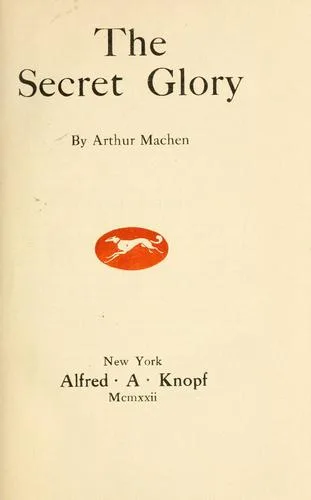
The secret glory
 80
80

The secret glory
Arthur Machen’s "The Secret Glory" is a work that demands patience, rewarding the reader with moments of profound, almost unbearable spiritual intensity. Its strength lies in Machen’s unparalleled ability to evoke the presence of the sacred within the utterly mundane, transforming everyday settings into potential sites of revelation. The description of the protagonist's ascent towards a perceived divine presence, particularly in the passages concerning the "secret glory" itself, is handled with a delicate and awestruck reverence. However, the narrative's deliberate pacing and often abstract spiritual focus can occasionally feel static, leaving the reader adrift in a sea of subjective experience without sufficient grounding. A particular strength is the depiction of the protagonist’s gradual disillusionment with conventional piety, which then opens him to a more direct, personal encounter. The book’s ultimate verdict rests on its singular, almost devotional, portrayal of spiritual questing.
📝 Description
80
Arthur Machen's 1922 novel, "The Secret Glory," presents a young man's awakening to hidden spiritual realities.
Published in 1922, Arthur Machen's "The Secret Glory" is not a conventional story. It follows a young man whose experiences shatter his ordinary view of the world, drawing him toward a form of mystical awareness. The novel exists on the edge of everyday life and the supernatural, hinting that deeper truths are concealed just beyond the mundane. Machen's prose creates an atmosphere that emphasizes psychological depth over a fast-paced plot. The narrative concerns itself with the possibility of divine revelation within the human mind. It looks at religious experience and the nature of sanctity.
This book appeals to those who enjoy literary fiction that engages with the numinous and the ineffable. Readers who appreciate atmospheric writing and psychological exploration will find it rewarding. It is suitable for those interested in early 20th-century occult literature. The themes of hidden sanctity and ecstatic vision align with a period of searching for spiritual meaning.
Emerging after World War I, a time of widespread disillusionment and spiritual seeking, "The Secret Glory" reflects a broader interest in esoteric traditions. This period saw many turning to spiritualism and alternative religious experiences as established institutions offered less comfort. Machen, known for his visionary fiction, wrote during this era, engaging with themes of hidden sanctity and ecstatic vision. The novel aligns with a contemporary fascination with personal religious experience and the potential for direct encounter with the divine.
💡 Why Read This Book?
• Experience Machen's distinctive prose that conjures unseen worlds, offering a unique literary approach to spiritual awakening, as exemplified in his descriptions of the Welsh countryside serving as a backdrop for divine revelation. • Understand the concept of "hidden sanctity" and how true spiritual power may exist beyond institutional recognition, a theme explored through the protagonist's quest for the secret glory. • Engage with a vision of ecstatic experience as a direct apprehension of the divine, distinct from mere emotionalism, a core element in the book's exploration of mystical encounter.
⭐ Reader Reviews
Honest opinions from readers who have explored this book.
❓ Frequently Asked Questions
What is the primary theme of Arthur Machen's 'The Secret Glory'?
The primary theme is the discovery of hidden sanctity and direct spiritual experience, suggesting that the divine is accessible through a personal, often ecstatic, encounter that transcends conventional religious structures.
When was 'The Secret Glory' originally published?
Arthur Machen's 'The Secret Glory' was first published in 1922, reflecting the spiritual searching prevalent in the post-World War I era.
What kind of spiritual experience does the book describe?
The book describes a profound, often overwhelming, spiritual experience that the protagonist comes to understand as the 'secret glory,' a direct apprehension of the divine.
How does 'The Secret Glory' relate to other esoteric literature?
It aligns with early 20th-century visionary fiction and explores themes of immanent divinity and hidden spiritual realms, similar to works by contemporaries interested in mysticism and the supernatural.
Is 'The Secret Glory' considered a horror novel?
While Machen is known for supernatural tales, 'The Secret Glory' leans more towards spiritual and mystical exploration than outright horror, though it does contain elements of the uncanny.
What is the significance of the Welsh setting in the novel?
The Welsh landscape serves as a potent, almost numinous, backdrop that reflects the protagonist's inner spiritual journey, grounding the transcendent in a specific, ancient locale.
🔮 Key Themes & Symbolism
Hidden Sanctity and the Numinous
The core concept revolves around the idea that true holiness, the 'secret glory,' exists unrecognized within the ordinary world and certain individuals. Machen suggests that this divine effulgence is not confined to established religious structures but can be perceived directly through intense personal experience, often in unassuming settings. The work challenges readers to look for the sacred beyond institutional dogma, finding it immanent in nature and in the receptive human soul. This theme aligns with broader esoteric interests in direct mystical apprehension.
Ecstatic Apprehension of the Divine
Central to the narrative is the protagonist's journey towards an ecstatic state, interpreted not as mere emotional fervor but as a direct, albeit fleeting, apprehension of ultimate reality. This experience is portrayed as profoundly transformative, altering the individual's perception of self and the cosmos. Machen's depiction suggests that such mystical states are not rare anomalies but potential facets of consciousness, accessible to those who cultivate spiritual receptivity and a willingness to abandon conventional understanding.
The Power of Place and Ancient Echoes
Machen imbues specific locations, particularly the Welsh landscape, with a palpable spiritual resonance. These places act as conduits, echoing ancient sanctity and facilitating the protagonist's visionary experiences. The narrative implies that certain geographical sites retain a spiritual charge, capable of awakening dormant mystical faculties in sensitive individuals. This connects to a long-standing esoteric tradition that views landscape as imbued with spiritual significance and historical memory.
Disillusionment and Spiritual Rebirth
The book traces a path from disillusionment with superficial or institutionalized religion to a more profound, personal spiritual rebirth. The protagonist's initial dissatisfaction with conventional piety serves as a catalyst, pushing him to seek a deeper truth. This journey underscores the esoteric principle that shedding false perceptions and attachments is often a necessary precursor to authentic spiritual insight and union with the divine.
💬 Memorable Quotes
“The world is a spirit, and the body is a manifestation of that spirit.”
— This interpretation suggests a core tenet of Machen's vision: that the material world is not separate from but an expression of a deeper, spiritual reality. It implies that understanding the true nature of existence requires looking beyond the physical form to its underlying essence.
“He had seen the veil withdrawn, and the secret glory revealed.”
— This refers to the protagonist's ultimate spiritual attainment. It signifies a moment of profound revelation where the hidden, divine reality ('secret glory') becomes directly perceptible, transcending the limitations of ordinary consciousness and perception.
“There are more things in heaven and earth than are dreamt of in our philosophy.”
— Paraphrased concept: The narrative implies that human understanding and philosophical systems are insufficient to grasp the full scope of reality, hinting at hidden dimensions and spiritual truths that lie beyond current conceptual frameworks.
“The true saint is not he who is canonized by the Church, but he who has seen the light.”
— This challenges conventional notions of sanctity, proposing that genuine spiritual attainment is marked by direct personal experience of the divine ('seeing the light') rather than official recognition by religious institutions.
“He found the divine not in prayer, but in the sheer intensity of living.”
— This highlights a shift from ritualistic or formal religious practice to a more immanent understanding of the divine. It suggests that spiritual connection can be found in the profound engagement with life itself, in its rawest and most intense moments.
🌙 Esoteric Significance
Tradition
While not strictly adhering to a single lineage, "The Secret Glory" draws heavily from Christian mysticism, particularly the concept of divine immanence and ecstatic union, alongside a broader Romantic and Symbolist sensibility that perceives spiritual truths in nature and art. It echoes Gnostic ideas of hidden knowledge and direct apprehension of the divine, bypassing intermediary structures. The work fits within the Western Esoteric Tradition's interest in visionary experience and the exploration of subjective reality as a pathway to the sacred.
Symbolism
The 'Secret Glory' itself functions as a primary symbol, representing the direct, ineffable experience of the divine or ultimate reality, often perceived as an overwhelming light or presence. The Welsh landscape serves as another potent symbol, acting as a sacred geography that resonates with ancient spiritual power and facilitates the protagonist's breakthrough. The concept of the 'hidden church' symbolizes the community of those who have experienced this direct connection, existing unseen within the mundane world.
Modern Relevance
Contemporary interest in "The Secret Glory" reflects a modern yearning for direct spiritual experience beyond institutional religion. Thinkers and practitioners in fields like transpersonal psychology, depth psychology, and contemporary mysticism find resonance in Machen's portrayal of the numinous and the transformative power of visionary states. His work continues to inspire those exploring the intersection of consciousness, spirituality, and literature, particularly within circles interested in Catholic mysticism and nature-based spirituality.
👥 Who Should Read This Book
• Seekers of profound spiritual literature who appreciate atmospheric prose and a focus on subjective experience over plot. • Students of early 20th-century esoteric thought and visionary fiction, particularly those interested in Arthur Machen's unique contributions. • Readers drawn to explorations of mysticism, the divine immanence, and the concept of hidden sanctity beyond conventional religious frameworks.
📜 Historical Context
Published in 1922, "The Secret Glory" emerged from an era deeply marked by the trauma of World War I and a consequent search for meaning beyond materialist explanations. This period saw a flourishing of interest in spiritualism, Theosophy, and various esoteric movements as people grappled with profound loss and societal upheaval. Machen, already known for his uncanny tales, positioned himself within this milieu, offering a vision of immanent divinity and direct mystical experience. He was writing in proximity to authors like Algernon Blackwood, who also explored the sublime in nature, and figures within the Hermetic Order of the Golden Dawn and similar societies who were actively investigating occult traditions. The novel’s focus on a personal, ecstatic encounter with the sacred can be seen as a response to both the perceived failures of traditional religion and the spiritual hunger of the age, standing apart from the more academic or ritualistic occultism of some contemporaries.
📔 Journal Prompts
The protagonist's encounter with the 'secret glory'—reflect on moments where the extraordinary felt present in the ordinary.
Consider the symbolism of the Welsh landscape as a conduit for spiritual revelation.
Analyze the tension between institutional religion and direct ecstatic experience presented in the narrative.
Reflect on the concept of 'hidden sanctity' and its potential manifestations in contemporary life.
Explore the idea of disillusionment as a catalyst for deeper spiritual seeking, as seen in the protagonist's journey.
🗂️ Glossary
Secret Glory
The central concept, representing a direct, overwhelming, and ineffable experience of the divine or ultimate spiritual reality, often perceived as a luminous presence.
Numinous
A quality of divine or spiritual presence that evokes awe, wonder, and a sense of the sacred, often associated with uncanny or mysterious experiences.
Ecstasy
In this context, not mere emotional excitement, but a state of profound spiritual awareness where the individual directly apprehends divine reality.
Hidden Church
The idea of a spiritual community or fellowship composed of individuals who have experienced direct divine contact, existing unrecognized within the broader, conventional world.
Immanence
The philosophical or theological concept that the divine is present within the material world and the universe, rather than being entirely transcendent or separate.
Visionary Experience
A subjective experience characterized by profound insights, symbolic imagery, or direct apprehension of spiritual or otherworldly realities.
Sanctity
The state of being holy or sacred; the quality of being revered or consecrated, often implying a close connection to the divine.